Feb 21, 2025·RIOT-Specific Information6 Cognitive Abilities of the RIOT
Discover the 6 key cognitive abilities tested by the RIOT IQ Test: Verbal Reasoning, Fluid Reasoning, Spatial Ability, Working Memory, Processing Speed, and Reaction Time.
Dr. Russell T. WarneChief Scientist
6 Cognitive Abilities of the RIOT
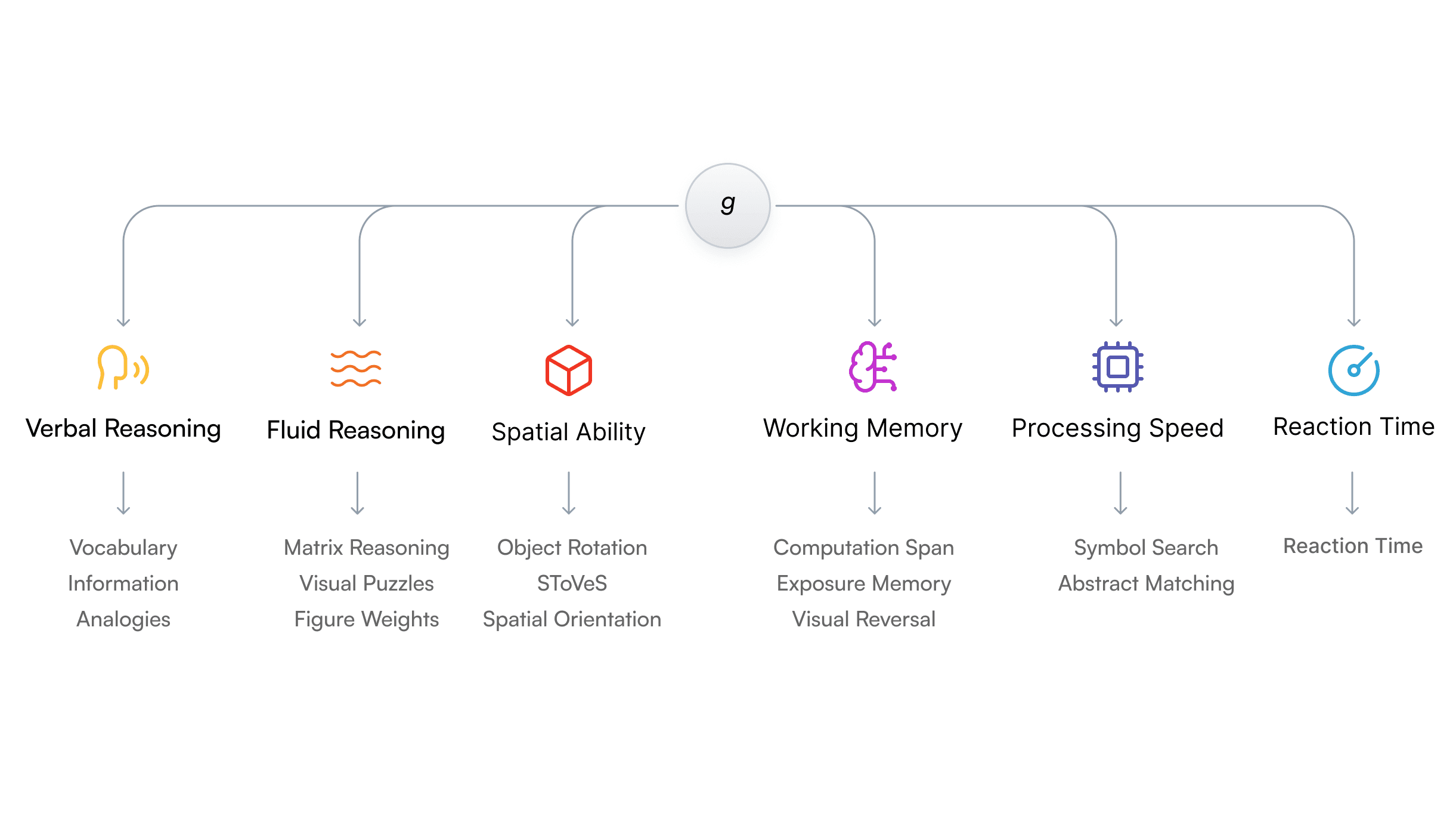
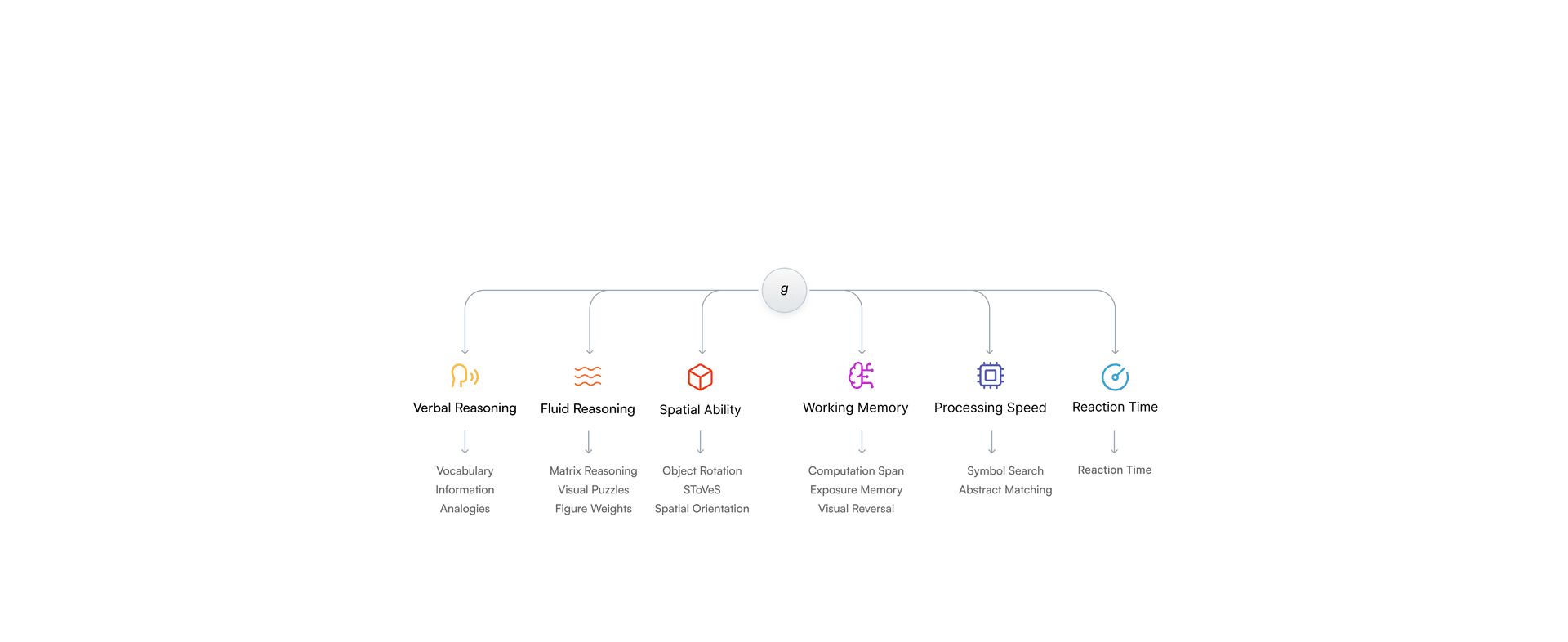
Our team here at Riot IQ selected what we believed were the 6 most important broad intelligence abilities: Verbal Reasoning, Visuospatial Ability, Working Memory, Processing Speed, and Reaction Time. Readers familiar with other intelligence tests may notice that the broad cognitive abilities on the RIOT are the same as those on the fifth edition of the Wechsler Adult Intelligence Scale (WAIS-5). Our Chief Scientist (Dr. Russell T. Warne) selected these abilities in January 2024, before the WAIS-5’s developers announced the same abilities in April 2024. This independent convergence in scientific opinion vindicates our team's decision to measure these five abilities. These are shown in Figure 1, and described in detail below. Figure 1. The hierarchical model of intelligence, an alternate theoretical perspective on the structure of intelligence.
Verbal Reasoning
Language is one of the most important cognitive functions in humans, and the capacity to use language to communicate an infinite number of ideas is a unique human capacity (Workman & Reader, 2021), and language is abstract in both its form and the content. Language seems to be a vital medium for complex thought in humans, and verbalization during learning process greatly aids in retaining knowledge (Jensen, 1971/1973). These characteristics make verbal reasoning a strong candidate for measuring in an intelligence test. Verbal reasoning tasks have been part of intelligence tests for over 100 years (Gibbons & Warne, 2019), and verbal tasks are excellent measures of overall intelligence (Deary & Brett, 2015). Moreover, scores on verbal tasks often correlate strongly with performance in academic pursuits because school is often a highly verbal activity. All of these reasons made verbal ability an important construct for the RIOT to measure.
Fluid Reasoning
This is a combination of Fluid reasoning and Spatial ability. Fluid reasoning is psychologists’ term for “. . . the capacity to figure out novel problems” (Jensen, 1998, p. 123). Fluid reasoning tasks often must be solved by deducing rules and patterns in stimuli that are presented with little context. The ability to solve these tasks is a strong marker of intelligence (Jensen, 1998), and fluid reasoning tasks are one of the most frequent types of item formats on intelligence tests. Like verbal ability, fluid reasoning is a predictor of many academic and life outcomes (e.g., Callis et al., 2023; Wrulich et al., 2014). Because of its conceptual and practical value, our team chose to measure fluid reasoning with the RIOT.
Spatial Ability
Spatial ability is the capacity to think about objects in two- and three-dimensional space. It is useful in daily tasks, such as navigation and efficiently packing objects into a confined space. Spatial ability is used in many careers, especially in physical science, engineering, many of the trades, and visual design. However, many intelligence tests—especially those used in academic settings—do not include measures of spatial ability, which is why one expert called spatial ability “. . . a sleeping giant for talent identification and development” (Lubinski, 2010). Spatial ability tests add provide information that is not available from measures of general intelligence or other cognitive abilities, and this information improves predictions of life outcomes that require understanding and manipulating two- and three-dimensional space (McHenry et al., 1990; Shea et al., 2001; Webb et al., 2007). Including spatial ability on the RIOT seemed like an important opportunity to measure this theoretically and practically important cognitive ability.
Working Memory
Working memory is “. . . a brain system that provides temporary storage and manipulation of information . . .” (Baddeley, 1992, p. 556). Working memory has a limited storage capacity; healthy adults typically can hold 5-9 pieces of information in working memory before it gets overloaded (Miller, 1956). People with more ability to retain information in working memory tend to be better at solving complex mental tasks, which is why working memory seems to be an important pre-requisite for strong performance on many intelligence tests (Carpenter et al., 1990; Kyllonen & Christal, 1990). Our team here at Riot IQ chose to include working memory on the test because it seems to be so fundamentally important for complex problem solving—a sine qua non of intelligence.
Processing Speed
Processing speed is the ability of the mind to respond to information quickly. Tasks that measure processing speed tend to be very easy (Deary, 2020; Jensen, 1998) so that there is no need to slow down to ensure that they perform them correctly. A quick processing speed is advantageous because it helps a person comprehend and transform information before new information enters is introduced. One major reason that processing speed is an important variable to measure is that there is a major slowdown in processing speed as people age (Deary et al., 2024; Hunt, 2011; Ritchie et al., 2016).
Reaction Time
Reaction time is a cognitive ability that refers to the speed at which an individual can detect, process, and respond to stimuli in their environment. Reaction time is more focused on basic stimulus-response speed, while processing speed encompasses a broader set of mental operations. A person might have quick reaction times but slower processing speed if they can rapidly respond to simple stimuli but take longer to complete tasks requiring more complex mental operations.
That's all for the 6 cognitive abilities on the RIOT. Read about all 15 of the RIOT subtests here. Take our professional IQ test
Want to know your IQ? Try the first ever professional online IQ test.
AuthorDr. Russell T. WarneChief Scientist