Feb 23, 2025·Advanced Topics & ResearchDo Non-g Gains from the Flynn Effect Matter?
Rising IQ scores (Flynn effect) are due to specific skill gains, not general intelligence (g). Does it matter? Yes and no. Learn why.
Dr. Russell T. WarneChief Scientist

Nobody questions the existence of the Flynn effect, which is the tendency for average IQ scores in a population to increase over time. The effect has been found in every country where data exist (Flynn, 1987), and the phenomenon has now been studied for over 30 years.In the 21st century, psychologists learned that the increases in IQ were driven by increases in the specific, non-
g abilities that contribute to people’s IQ scores (Woodley et al., 2014). Because
g is a global cognitive ability, this means that increases in the narrower cognitive abilities (e.g., spatial ability, verbal ability, abstract reasoning) are the driving force of increasing IQ scores. In other words, the Flynn effect is raising IQ without raising general intelligence. Therefore, IQ scores from different time periods measure different combinations of mental abilities, with the non-
g abilities generally gaining importance in later cohorts than younger cohorts (Wicherts et al., 2004).

This post is brought to you today by Spearman’s
g, which is the general factor that emerges from almost any set of scores on a series of cognitive tasks.
This is why comparing older generations’ IQ scores with later generations’ IQ scores produces the nonsensical results. If IQ measures solely general intelligence, then it may seem that younger groups are much smarter than their grandparents. But that conclusion flies in the face of reality and experience because it implies a level of disability so extreme that large numbers of people more than a century ago would have had difficulty mastering language, using a toilet, and other basic functions. The reality is that these IQ scores are not measuring the same abilities in the same proportions in different cohorts, and they are not directly comparable.
So what?
The scholarly literature on this topic can get very technical, and it is natural to ask why any of this matters at all.
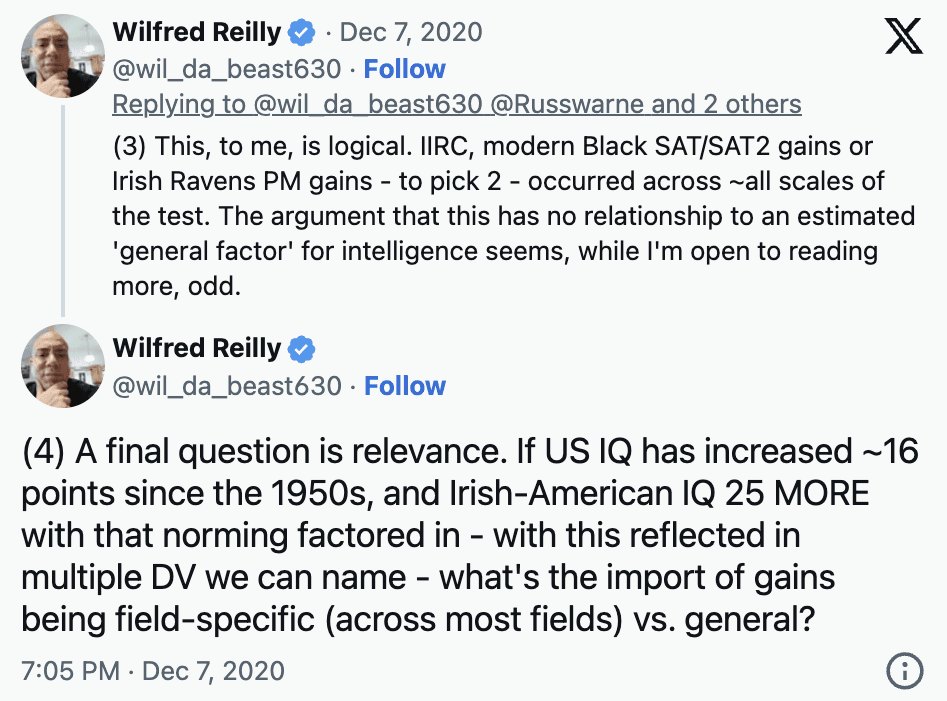
If IQ is interpreted as measure of problem solving skills (and not global intelligence), then younger generations ARE better at solving abstract problems than their grandparents were. Why does it matter if this improved problem solving capacity originates in general intelligence or in other cognitive abilities?
This is the sort of question that Wilfred Reilly asked me in a friendly exchange on Twitter last month:
The recently deceased James Flynn would respond that it doesn’t matter. Indeed, in a recent article where he explored the decrease in g and the increase in IQ from improvement in non-g factors, he stated:
"This tendency toward reduced IQ [genetically] has been swamped ever since it began by huge environmentally induced gains. But what I wish to note is that the word “intelligence” has been reserved to describe the genetic decline, and that it has been withheld form the environmental increase. If there had been dysgenic mating for speed (slower people having a few more children than fast people), and yet due to the jogging craze, the average person could run a faster mile, no one would say that “speed” had been falling. If there had been dysgenic mating for height, and yet thanks to greatly improved nutrition, people were on average taller than they used to be, no one would say that “height” had been falling.”
In this view, whether increased problem solving is due to an increase in g or non-g abilities is irrelevant. People are still getting better at solving problems, no matter what abilities they may (or may not) use. If there are multiple paths to solving problems correctly, then privileging one path (e.g., relying on a general intellectual ability like g) does not make much sense. It is a very pragmatic view that I am sympathetic towards.
Why the type of increases matter
There are reasons why it does matter whether increases in problem solving skills are due to g or non-g abilities. From a purely academic standpoint, this matters because it tells us something about the nature of cognitive abilities. The Flynn effect must be purely environmental (because human genes pools do not change fast enough to be the cause of the Flynn effect), so the abilities that change the most over time are likely the abilities that are most easily influenced by the environment. Conversely, because Flynn effect gains are not on g, this shows that variation in general intelligence is likely not strongly related to environmental variation (at least, within wealthy countries).
The second reason this matters is because it shows that IQ differences do not necessarily all have the same cause. This is the mistake that James Flynn made originally: he believed that if generational gains in IQ could be shown to be “hollow” (i.e., not reflecting a real increase in intelligence), then average differences in IQ across racial groups would also be purely environmental in origin (Flynn, 1987). However, American between-cohort Flynn effect gains and American within-cohort population differences are not the same phenomenon. The former is due to a change in non-g abilities (Woodley et al., 2014), but the latter is mostly due to an average difference in g (Jensen, 1998). This difference also applies to many other countries for which data exist.
Therefore, it is not correct to assume that IQ differences all have the same cause. Group A and Group B might have an average IQ difference that is due to their differences in non-g abilities. But Group C and Group D might have an average IQ difference that is due to a difference in g. Superficially, the average IQ differences may appear similar, but their causes could be very different.
The third reason that it matters whether Flynn effect gains are on g or not is that it tells us something about the potential to narrow or close average IQ gaps between groups. If Flynn effect gains were on g (or on both g and non-g abilities), it would increase the likelihood that average IQ gaps between groups could close completely. Unfortunately, this is not the case. The non-g nature of the Flynn effect implies that — within the current range of environments in wealthy countries — further environmental interventions are probably not going to close the g-caused portion of IQ differences (because of that portion’s resistance to known environmental influences that are typically found in wealthy nations).
Finally, the distinction between g and non-g abilities is important because g is the engine of IQ scores’ validity. In other words, the g contribution to IQ is the principal reason that IQ scores correlate with other variables (Zaboski et al., 2018), and more specific, non-g scores add less predictive power beyond the predictive validity of measures of global ability (e.g., Ackerman et al., 2013; Kell et al., 2013). This matters because any improvements that the Flynn effect brings to IQ will have probably have a more limited impact on school achievement and career success than an increase of g would have.
To g or not to g?
Therefore, whether the non-g nature of Flynn effect gains in IQ matters depends on the preferred perspective. If the concern is whether people can solve abstract problems, then it does not matter. If the goal is to understand the nature of cognitive abilities, the Flynn effect, and causes of average group IQ differences, then it does matter.
This nuanced perspective continues psychology’s grand tradition of being the “fence sitting science.” The non-g nature of the Flynn effect matters, and it does not. In my view, subscribing fully to one view or another is an oversimplification.
References
Link to this article on my (Russell Warne's) website:
https://russellwarne.com/2021/01/03/do-non-g-gains-from-the-flynn-effect-matter-yes-and-no/Ackerman, P. L., Kanfer, R., & Calderwood, C. (2013). High school Advanced Placement and student performance in college: STEM majors, non-STEM majors, and gender differences.
Teachers College Record, 115(10), 1-43.
Flynn, J. R. (1987). Massive IQ gains in 14 nations: What IQ tests really measure.
Psychological Bulletin, 101(3), 171-191.
https://doi.org/10.1037/h0090408Flynn, J. R. (2018). Reflections about intelligence over 40 years.
Intelligence, 70, 73-83.
https://doi.org/10.1016/j.intell.2018.06.007Jensen, A. R. (1998).
The g factor: The science of mental ability. Praeger.
Kell, H. J., Lubinski, D., Benbow, C. P., & Steiger, J. H. (2013). Creativity and technical innovation: Spatial ability’s unique role.
Psychological Science, 24(9), 1831-1836.
https://doi.org/10.1177/0956797613478615Wicherts, J. M., Dolan, C. V., Hessen, D. J., Oosterveld, P., van Baal, G. C. M., Boomsma, D. I., & Span, M. M. (2004). Are intelligence tests measurement invariant over time? Investigating the nature of the Flynn effect.
Intelligence, 32(5), 509-537.
https://doi.org/10.1016/j.intell.2004.07.002Woodley, M. A., te Nijenhuis, J., Must, O., & Must, A. (2014). Controlling for increased guessing enhances the independence of the Flynn effect from g: The return of the Brand effect.
Intelligence, 43, 27-34.
https://doi.org/10.1016/j.intell.2013.12.004Zaboski, B. A., II, Kranzler, J. H., & Gage, N. A. (2018). Meta-analysis of the relationship between academic achievement and broad abilities of the Cattell-horn-Carroll theory.
Journal of School Psychology, 71, 42-56.
https://doi.org/10.1016/j.jsp.2018.10.001Take our professional IQ test
Want to know your IQ? Try the first ever professional online IQ test.
AuthorDr. Russell T. WarneChief Scientist