IQ and Crime: Does Lower Intelligence Predict Offending?
IQ and crime are linked: offenders score about 7 to 10 IQ points lower on average, and about half the link survives when brothers are compared.
Dr. Russell T. WarneChief Scientist
Share
People who commit crimes score lower on IQ tests on average, by roughly 7 to 10 points in the largest studies. The link is moderate, it holds after accounting for family income and social class, and in a Swedish study of 700,514 men about half of it remained when brothers were compared with each other.
This page explains what the large cohort studies show, whether the gap reflects which offenders get caught, why lower IQ might raise the risk of offending, and what the research says about high IQ, including whether many criminals are unusually intelligent. A correlation across hundreds of thousands of people describes averages. It cannot tell you whether any individual will break the law.
What the research shows
For much of the twentieth century, sociology textbooks taught that IQ had little to do with delinquency. In a 1977 review, Travis Hirschi and Michael Hindelang argued that this position rested on early negative reviews and misread findings. They concluded that the link between IQ and delinquency was at least as strong as the link with social class for official records, and stronger for self-reported delinquency, and that IQ had an effect independent of class.
Later register studies with whole populations have confirmed the pattern:
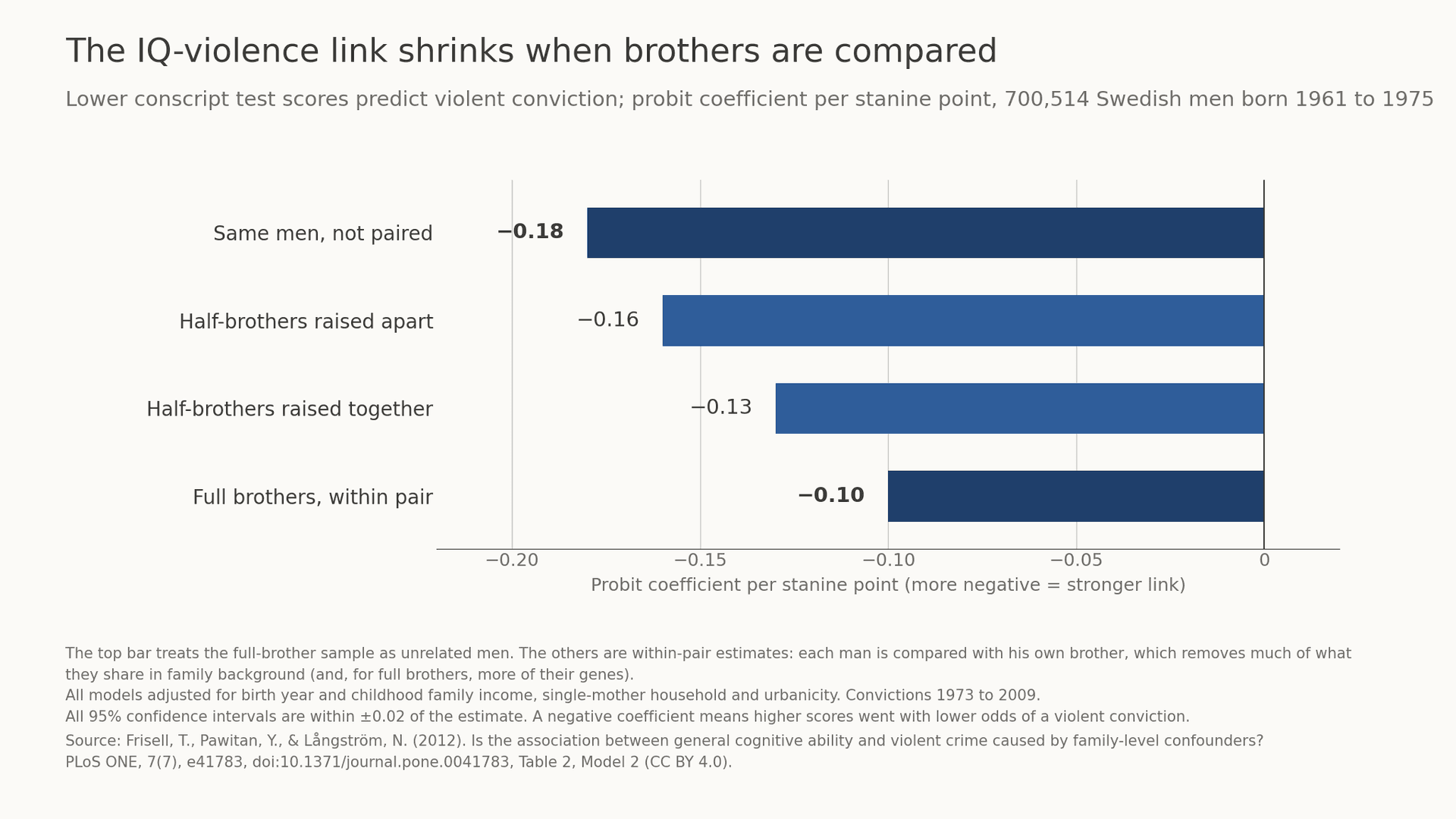
• Sweden: Thomas Frisell and colleagues linked the conscription test scores of 700,514 men born between 1961 and 1975 with violent crime convictions up to 2009. Lower cognitive ability at age 18 predicted a higher chance of a violent conviction across the whole range of scores. In the full-brother sample, men with a violent conviction averaged 3.9 on the 1 to 9 "stanine" scale used by the military, against 5.2 for men without one.
• Finland: Joseph Schwartz and colleagues followed 21,513 men from a cohort of nearly everyone born in Finland in 1987, using nine measures of offending from official records. The relationship was mostly linear, with lower scores going with more offending, and showed some curving only at the very lowest and very highest ability levels.
To convert the Swedish numbers to IQ points: the stanine scale has a standard deviation of 2, so a gap of 1.3 stanines is about 0.65 standard deviations, or roughly 10 IQ points on a scale with a standard deviation of 15. In the two half-brother samples the gap was 1.0 stanine, about 7.5 points.
The overall rate is worth keeping in view. Among the full brothers in the Swedish study, 6.6% had any violent conviction over several decades, so most men at every level of test score were never convicted.
Is the link real or just about who gets caught?
Two objections come up often. The first is "differential detection": perhaps lower-IQ offenders are simply easier to catch. Terrie Moffitt and Phil Silva tested this in the Dunedin cohort in New Zealand. At age 13, they compared teenagers known to police with teenagers who reported similar amounts of delinquency but had no police record. The two groups did not differ in IQ, and both scored lower than non-delinquent peers. The IQ gap was found in offending itself, beyond who got caught.
The second objection is family background. Poverty and social disadvantage are linked to both lower test scores and higher crime rates, a theme covered in our page on IQ and poverty. Moffitt and colleagues found in two Danish prospective studies that the negative correlation between IQ and delinquency remained after socioeconomic status was statistically removed.
Statistical controls can miss things, which is why the Swedish sibling comparisons matter. Brothers share their parents, neighborhood and much else. Frisell's team found that the association was smaller within pairs of half-brothers and smaller still within pairs of full brothers, at about half the population estimate (the figure on this page). The more two brothers have in common, the more shared influences such a comparison removes: their test scores correlated 0.49 for full brothers, 0.33 for half-brothers raised together and 0.24 for half-brothers raised apart. Their conclusion was that factors shared by brothers explain part of the IQ-violence link and that a substantial part remains, which is consistent with some causal role for ability itself.
Why lower IQ might raise the risk of offending
Several explanations have support, and they are not mutually exclusive. Hirschi and Hindelang argued that the effect runs mainly through school: children who struggle academically get fewer rewards from school, attach less to it and drift toward delinquent peers. Moffitt and colleagues similarly suggested that weaker verbal ability limits a child's chances of earning rewards in the classroom.
Moffitt later proposed that delinquency hides two different groups. Most teenagers who break rules do so only during adolescence and then stop. A small group behaves antisocially at every stage of life, and in her theory their path begins with childhood neuropsychological problems that interact with difficult environments over years. Weaker neuropsychological functioning is therefore part of the early picture for the persistent group, while the much larger adolescence-limited group needs no such explanation.
IQ is only one of many traits studied in relation to offending. Psychopathy, for example, has its own relationship with intelligence, discussed in our page on IQ and psychopathy.
Do criminals have high IQs?
The popular image of the criminal mastermind does not match the data, since offenders as a group score below average. Two findings add nuance:
• The very top of the range: in a United States sample, Daniel Mears and Joshua Cochran found a curvilinear pattern in which both the lowest and highest IQ groups reported less offending than people in the middle. The Finnish register study likewise found some curvature only at the extremes, with the overall pattern mostly linear.
• High IQ as a protective factor: Maria Ttofi and colleagues searched 18 databases and pooled 15 prospective longitudinal studies to ask whether higher intelligence protects people who otherwise face high risk. Among high-risk young people, those with higher intelligence had about 2.3 times the odds of not offending (odds ratio 2.32, 95% confidence interval 1.49 to 3.63). In low-risk groups the effect was smaller and not statistically significant (odds ratio 1.33).
The studies on this page measure juvenile delinquency and convictions for offenses such as violence, theft, drugs and drunk driving. None of them looks at fraud or other white-collar crime separately, so they say little about the IQ of white-collar offenders.
Frequently asked questions
Is there a link between IQ and crime?
Yes. Offenders score about 7 to 10 IQ points lower on average, and the link holds after controlling for social class and, partly, when brothers are compared.
Do criminals have high IQs?
On average, no. Offenders as a group score below average, although some studies find slightly less offending at the very top of the IQ range as well as at the very bottom.
Can an IQ score predict whether someone will commit a crime?
No. The correlation describes averages across large populations, and most people at every score level never commit a violent crime.
Does a high IQ protect against crime?
It appears to help most for people facing other risks. A meta-analysis of 15 longitudinal studies found that higher intelligence roughly doubled the odds of not offending among high-risk youth.
Is the IQ gap just because less intelligent offenders get caught?
The evidence says no. In the Dunedin study, teenagers who reported delinquency but had no police record had IQ scores as low as those known to police.
The takeaway
IQ and crime are related, with offenders scoring roughly 7 to 10 points lower on average. The link survives controls for social class and holds partly within families, which suggests some causal role, likely working through school and early neuropsychological development. It is a population-level pattern and says nothing certain about any individual. If you want a reliable measure of your own reasoning ability, take the RIOT IQ test.
References
1. Hirschi, T., & Hindelang, M. J. (1977). Intelligence and delinquency: A revisionist review. American Sociological Review, 42(4), 571-587. [doi.org/10.2307/2094556](. doi.org
2. Frisell, T., Pawitan, Y., & Långström, N. (2012). Is the association between general cognitive ability and violent crime caused by family-level confounders? PLoS ONE, 7(7), e41783. [doi.org/10.1371/journal.pone.0041783](. doi.org
3. Schwartz, J. A., Savolainen, J., Aaltonen, M., Merikukka, M., Paananen, R., & Gissler, M. (2015). Intelligence and criminal behavior in a total birth cohort: An examination of functional form, dimensions of intelligence, and the nature of offending. Intelligence, 51, 109-118. [doi.org/10.1016/j.intell.2015.06.001](. doi.org
4. Moffitt, T. E., & Silva, P. A. (1988). IQ and delinquency: A direct test of the differential detection hypothesis. Journal of Abnormal Psychology, 97(3), 330-333. [doi.org/10.1037/0021-843X.97.3.330](. doi.org
5. Moffitt, T. E., Gabrielli, W. F., Mednick, S. A., & Schulsinger, F. (1981). Socioeconomic status, IQ, and delinquency. Journal of Abnormal Psychology, 90(2), 152-156. [doi.org/10.1037/0021-843X.90.2.152](. doi.org
6. Moffitt, T. E. (1993). Adolescence-limited and life-course-persistent antisocial behavior: A developmental taxonomy. Psychological Review, 100(4), 674-701. [doi.org/10.1037/0033-295X.100.4.674](. doi.org
7. Mears, D. P., & Cochran, J. C. (2013). What is the effect of IQ on offending? Criminal Justice and Behavior, 40(11), 1280-1300. [doi.org/10.1177/0093854813485736](. doi.org
8. Ttofi, M. M., Farrington, D. P., Piquero, A. R., Lösel, F., DeLisi, M., & Murray, J. (2016). Intelligence as a protective factor against offending: A meta-analytic review of prospective longitudinal studies. Journal of Criminal Justice, 45, 4-18. [doi.org/10.1016/j.jcrimjus.2016.02.003](. doi.org
Figure by RIOT IQ. Data from Frisell, Pawitan & Långström (2012), PLoS ONE 7(7), e41783 (doi.org/10.1371/journal.pone.0041783), Table 2, CC BY 4.0.
Take our professional IQ test
Want to know your IQ? Try the first ever professional online IQ test.