Explore research on how high IQ correlates with success in education, career, income, and health, while other factors such as personality and opportunity also play key roles.
Dr. Russell T. WarneChief Scientist
Share
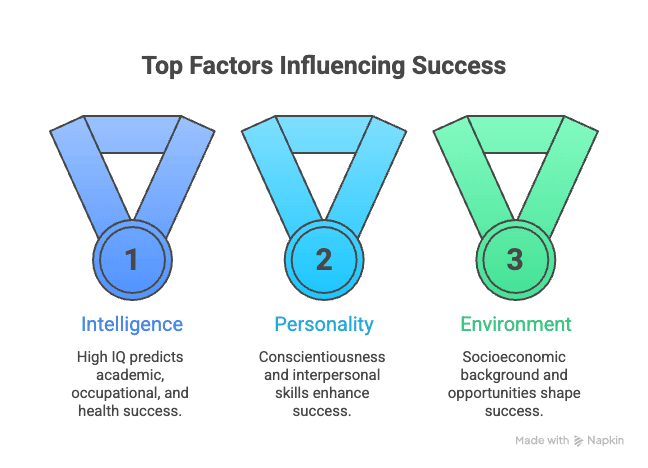
High IQ correlates with success across many domains of life. Intelligence predicts numerous positive outcomes such as academic achievement, occupational attainment, income, health, and longevity, but IQ is not the only factor that matters, nor does a high IQ guarantee success for any individual person.
What Does the Research Show About IQ and Life Outcomes?
Decades of research demonstrate that IQ correlates with a wide array of positive life outcomes.Academic performance shows one of the strongest relationships: higher IQ predicts better grades, higher test scores, and a greater likelihood of completing advanced education. This makes intuitive sense, as academic work directly requires the cognitive abilities that IQ tests measure.
In the workplace, IQ predicts job performance across virtually all occupations, though the correlation is stronger for cognitively complex jobs. Higher intelligence helps people learn job tasks more quickly, solve problems more effectively, and adapt to changing circumstances. This translates into differences in occupational attainment and income; people with higher IQs tend to enter more prestigious careers and earn more money over their lifetimes.
Beyond career and education, IQ correlates with physical health and longevity. That means that people with higher IQs tend to live longer and experience fewer health problems. The reasons are not entirely clear but likely include genetic influences, better health decisions, quicker recognition of symptoms, more effective navigation of healthcare systems, and possibly third variables like socioeconomic status.
The strength of the correlation between IQ and success varies considerably across different domains. In highly cognitively complex fields, such as theoretical physics, mathematics, philosophy, medicine, law, intelligence matters enormously. These fields require abstract reasoning, complex problem-solving, and the ability to master vast bodies of technical knowledge. Even someone with an IQ that is “merely above average” (110 or 115) would struggle to find success in these fields.
For professional occupations generally, a minimum IQ threshold exists. Most careers requiring advanced education effectively screen for intelligence through educational requirements or training regimens. If someone can't complete the needed education program (e.g., college, medical school, graduate school), many professional careers become inaccessible, regardless of other qualities they possess.
In contrast, for jobs with lower cognitive complexity, the correlation between IQ and performance weakens. A brilliant person may still outperform a coworker with a lower IQ, but the differences in job performance are smaller because there are fewer tasks that capitalize on the smarter person’s cognitive ability. In jobs like this, other factors like conscientiousness, interpersonal skills, and work ethic become more important.
What Other Factors Matter for Success?
Personality traits, particularly conscientiousness (being organized, disciplined, and reliable), predict outcomes independent of IQ. In academic settings,combining IQ with measures of conscientiousness produces better predictions of performance than either variable alone. A moderately intelligent but highly conscientious student can outperform a brilliant but lazy classmate.
Socioeconomic background influences success through multiple pathways: access to quality education, social networks and connections, financial resources that allow for unpaid internships or advanced education, and cultural capital that helps navigate professional environments. These advantages do not eliminate the importance of intelligence but do show that IQ doesn't operate in a vacuum.
Specific skills and domain knowledge matter immensely. An architect needs spatial reasoning skills that might not be fully captured by a general IQ score. A musician needs auditory processing and motor coordination. A writer needs verbal facility. While general intelligence helps in acquiring these specific competencies, focused practice and training in the relevant domain are essential.
Motivation and opportunity also matter. Someone with a high IQ who lacks motivation or does not develop their skills accomplishes less than someone with moderate intelligence and intense drive. Similarly, opportunities matter; someone born in a wealthy country with good educational institutions has advantages that someone with equal intelligence but fewer opportunities does not enjoy. Social competency influences success in fields requiring teamwork, leadership, or client relationships. The ability to understand others' perspectives, manage one's own emotions, and navigate social situations effectively contributes to success in ways that IQ tests do not measure.
Is High IQ Necessary for Success?
Whether high IQ is necessary depends on the domain under consideration. If success is measured by professional accolades in a field like theoretical physics or philosophy, then a high IQ is necessary because entering these fields is nearly impossible without being smarter than average. In fields like business, a high IQ may not be essential, but earning promotions and a higher income are more likely as IQ increases.
Another consideration is how “success” is defined. For stable employment and independent living, research suggests a minimum IQ of around 80. Below this threshold, functioning independently becomes increasingly difficult. The U.S. military, for example, is barred from accepting recruits scoring below an IQ of 80 because training becomes impractical.
However, defining success purely in terms of career achievement or income misses much of what makes life meaningful. Successful relationships, raising children, contributing to the community, pursuing hobbies, and finding personal fulfillment do not require exceptional intelligence. Many people with average IQs lead deeply satisfying lives.
How Much Does IQ Matter Compared to Other Factors?
Quantifying exactly how much IQ matters relative to other factors is difficult because the answer varies by outcome and context. In predicting academic performance, IQ might account for 50-70% of the variance, depending on the educational level and specific outcome measured. For job performance, meta-analyses suggest IQ accounts for roughly 20-50% of the variance in performance ratings, depending on job complexity. This makes it one of the best single predictors available, but most variation in outcomes still comes from other sources.
One way to think about IQ's role is as a constraint or enabler rather than a determinant. Below certain thresholds, IQ limits what is possible. Someone with IQ 85 will not become a neurosurgeon regardless of other qualities. As IQ increases, a person has more options and a greater ability to excel in their chosen area of life. Nonetheless, a high IQ merely opens doors; whether someone walks through them depends on motivation, opportunity, personality, and choices.
Research on compensation for lower IQ suggests that other factors can make up for moderate intelligence differences. High conscientiousness can compensate for perhaps 5-7 IQ points in academic or work settings. Strong social support, beneficial personality traits, and cultural values can cushion the impact of lower intelligence. However, there are limits. Nothing fully compensates for very large IQ deficits in cognitively demanding contexts.
What Are the Exceptions to the IQ-Success Relationship?
While higher IQ generally predicts better outcomes, important exceptions exist. Some conditions are more common in high-IQ populations, including anorexia nervosa and high-functioning autism. These are not caused by high IQ, but they do show higher prevalence among intelligent individuals for reasons that aren't fully understood.
Certain personality patterns can undermine the benefits of high intelligence. Extreme perfectionism might lead to paralysis rather than achievement. High openness to experience combined with low conscientiousness might result in many started but few finished projects. Excessive rumination might turn intelligence inward in unproductive ways.
Mismatches between intelligence and the environment can create problems. A highly intelligent child in an unstimulating educational environment might become bored and disengaged, developing poor work habits despite high ability. An intelligent adult in a job far below their capabilities might become demoralized and perform poorly.
Cultural values and life goals matter too. Someone from a culture that prioritizes family and community over individual achievement might choose paths that do not maximize income or professional success despite having high intelligence. This isn't failure, but an example of how life goals may result in a different understanding of “success.”
For those seeking to understand their own cognitive abilities, the Reasoning and Intelligence Online Test (RIOT) provides a scientifically valid assessment. Created by Dr. Russell T. Warne (who has over 15 years of intelligence research experience), the RIOT experienced rigorous development, including expert review, the first proper US-based online norm sample, and adherence to professional testing standards. Understanding cognitive strengths and limitations can help with realistic goal-setting and strategic decision-making, which is why the RIOT provides both a global IQ and subscores. This nuanced information can help examinees make realistic plans and align their work and educational goals with their strengths and potential.
Watch “The Ability That Predicts STEM Success Better Than IQ” with Dr. Thomas Coyle on the Riot IQ YouTube channel to explore how intelligence relates to real-world achievement.
Take our professional IQ test
Want to know your IQ? Try the first ever professional online IQ test.