Feb 24, 2025·General IQ & IntelligenceStudying IQ Matters
Explore how IQ data can revolutionize society by enhancing intelligence via gene editing, fighting dementia, and tracking cognitive health.
Dr. Russell T. WarneChief Scientist
IQ tests— you probably have pre-conceived notions of them that causes some not so great guttural reactions. Humor me for a second. Because IQ tests do measure something extremely valuable that could potentially help society progress in some incredible ways.
What do they measure? Unsurprisingly, they measure intelligence.
Yes, these tests approximate intelligence, and are the best measure of intelligence we have to date. What’s more, the scores gathered from IQ tests are useful for a myriad of reasons you may have never imagined. When collected on large scales, IQ data can unveil science-fiction type of possibilities that would shock you. 1 & 2 being the kickers:
1. Increase human intelligence through genetic modification (no joke)
2. Fight diseases such as dementia (potentially)
3. Track individual and group cognitive health over time
4. Research in cognitive sciences
5. Expedite access to social services such as educational or healthcare
6. Inform policy changes
7. Remedy deficiencies in education
8. Match people up with successful career paths
9. Understand humanity better (e.g., evolutionary psych, cross-cultural and cross-species relational psychology)
For time’s sake, I’ll focus on numbers 1-3.
1. IQ data can allow us to increase human intelligence through genetic modification
Yes— this is ACTUALLY doable, and I don’t mean by funding more educational, but by combining millions of IQ scores with new innovations in gene editing. I have spoken with genomics researchers from the University of Washington and have read through countless studies on the modification of human intelligence via gene editing.
It is 100% possible. Scientists have been able to modify DNA using a revolutionary technology known as CRISPR for some time now, and it’s just getting better (
1-min video for more on CRISPR).
Why would gene-editing work for a complex trait like intelligence? Also, isn’t intelligence nurture-
not nature- based.
The fact of the matter is a significant portion of intelligence is genetic/nature based. About 50%-80% of your intelligence comes from genes. If you are scratching your head or disagreeing,
here's a good jump-off point for understanding the genetics of intelligence. However, no need to read that link, as this screenshot is what’s important
👇 If you can't read the highlighted text in the image because it is too small (happens on some browsers) I wrote the text below the image in quotes
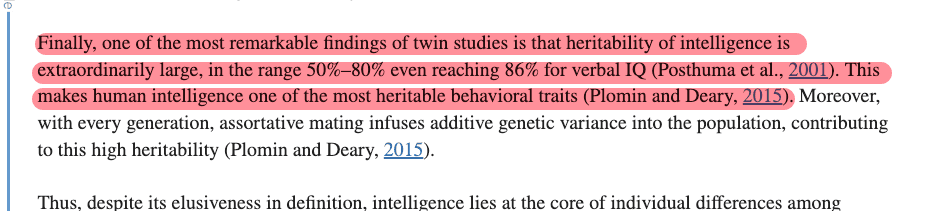
“Finally, one of the most remarkable findings of twin studies is that heritability of Intelligence is extraordinarily large, in the range 50&-80% even reaching 86% for verbal IQ (Posthuma et all.,2001). This makes human intelligence one of the most heritable behavioral traits (Palomino and Deary, 2015)."
What does intelligence being a genetic trait imply? One implication, is that a critical barrier holding us back from significantly improving human intelligence by way of CRISPR gene-editing is correctly identifying which genes to edit.
Why don’t we know which genes to edit to improve our intelligence? Because we don’t have enough intelligence data (IQ scores) to reveal the map that links intelligence to our genes. If researchers had millions of IQ scores, the scores could be mapped with the genetic makeup of the corresponding individual (imagine mapping your IQ score data with your
23&me data). With millions of these connected data points, researchers would be able to identify which genes correlate most with higher intelligence traits. With that data set, CRISPR could then be used to accurately target those genes which improve a person’s intelligence, cognitive ability, whatever you want to call it.
Pause here, though. Think about that—
wow, the human race can actually modify human intelligence genetically?!? Our main road block here is only that we need more IQ data? YES. It’s wild; read more
here.

2. IQ data may help fight diseases such as dementia
We’ve all heard of dementia and its unfortunate symptoms: memory loss, inability to plan or problem-solve, language challenges, disorientation, difficulty with abstract thinking, etc.
How do IQ tests relate to dementia? Often, IQ tests are broken up into cognitive ability sections (similar to dementia symptoms) known as indexes. For example, the
RIOT IQ Test is broken up into 5 indexes:
1. Memory—is the ability to remember and use multiple pieces of information.
2. Visuospatial—is the ability to use locations and directions and to draw conclusions using information that is contained in images.
3. Speed—is the ability to quickly comprehend information and produce a response.
4. Verbal—is the ability to understand and work with language.
5. Reaction Time—measures how quickly a person responds to a stimulus or selects and executes the correct response when presented with multiple stimulus options.
Since some IQ tests (like the
RIOT) give you index scores, which are essentially just cognitive ability scores.. if we had millions of index scores, scientists could determine which genes directly affect each individual cognitive skill. Once identified, gene editing could possibly target & improve specific traits such as memory— arguably a promising breakthrough for the battle to delay dementia onset across humans. Concrete evidence has yet been published, but I propose that this is likely doable.
Currently, scientists do not approach fighting dementia through this lens. They tend to treat the illness by helping neurons survive the onslaught of plaques and tangles through gene editing. I believe there is an issue with this approach because there are numerous avenues that lead to developing dementia. Therefore there is unlikely to be a silver bullet “cure”.
I propose a silver bullet “mitigation” tactic using gene editing to improve intelligence as a whole or specific cognitive abilities. I believe this is a valid and necessary avenue to explore in the pursuit of preventing dementia throughout the human life cycle. FYI, the gene editing would likely be done in embryo stage. If we each come into the world equipped with a higher cognitive ability from early life, dementia onset could theoretically be delayed significantly. My hypothesis brought me to
this study published by the NIH
👇 If you can't read the highlighted text in the image, I again wrote the text below the image in quotes
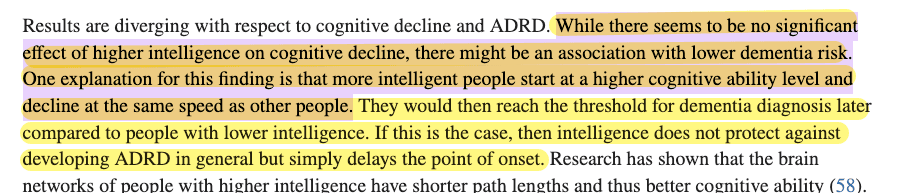
"While there seem to be no significant effect of higher intelligence on cognitive decline, there might be an association with lower dementia risk. One explanation for this finding is that more intelligent people start at a higher cognitive ability level and decline at the same speed as other people. They would read the threshold for dementia diagnosis later compared to people with lower intelligence. If this is the case, then intelligence does not protect against developing ADRD in general but simply delays the point of onset.”
I would like to clarify that I don’t believe gene editing intelligence is a cure-all for dementia, but I do believe it can delay the onset of dementia. If so, that’s pretty damn good considering where the state of dementia treatment is today. The possibility of utilizing IQ score data to improve the growing dementia epidemic looks remarkably promising. I’ll end this section by asking Google what the #1 prevention of dementia is:
 Drum roll…
So, before you bank on gene editing your way to cognitive health, go pump some weights and do some cardio.
Now, what else can we use IQ data for?
3. IQ data for tracking individual and group cognitive health over time
Have you ever thought about your heart health? Or your muscle health? Probably. But, have you thought about your cognitive health?
…
…
…Crickets…
🦗I also hadn’t given my cognitive health much thought, and I don’t think most of us have.
Why is that? After all, the brain is the executor of your being, Sooooo... what gives?
Well, upon further investigation, tracking your cognitive health seems to require some serious resources (brain scans, in - testing, money, yada yada). A lot of these processes are expensive and time consuming. Because of this, cognitive health just doesn’t seem like a viable metric for the average person to track over time.
This is where I see IQ tests and
longitudinal data being extremely useful to everyday people as they age. Imagine taking a 3-5 minute online IQ test as part of your annual health checkup. That’s a short amount of time we can all sacrifice each year to monitor our cognitive health, which becomes especially important for us after the age of 50, when we’re at higher risk of cognitive decline.
You may not think an IQ tests fits hand-in-hand with cognitive health. But believe me, I have been building an IQ test with
Dr. Russell T. Warne for the last 6 months, and I’ve learned an immense amount about these tests. As it turns out, IQ tests would be a great candidate for tracking cognitive health. A good IQ test doesn’t just test you on a few specific subjects like math, reading, or vocabulary. It tests you on a wide range of subjects and measures how well you can reason and problem-solve. Fascinatingly, it doesn’t even really matter what kind of questions are asked on the test— what matters more is that the participant is challenged to utilize varying cognitive skills to answer a diverse battery of questions. The variability of the questions is an important factor in the quality of the IQ score as a measurement of general intelligence. If you want to learn more about general intelligence and IQ tests,
watch this 5-min Youtube video.Ultimately, personalized longitudinal IQ test data can be helpful for tracking cognitive ability over time, but is by no means a definitive solution to monitoring cognitive health. We should consider this for what it is: a quick, affordable online cognitive health monitoring tool that can offer personalized insight to help inform individual and clinical decisions.
Who knows, maybe with an online cognitive testing platform like the
RIOT (shameless plug), the United States wouldn’t be caught in the throes of a presidential rebranding scramble, like so:

Wrapping up: IQ data seems to have quite a few unexpected use cases
All in all, regardless of how you feel about IQ testing/data and assigning numbers to humans, statistics are a necessary multi-disciplinary tool that can effectively help to revolutionize policy, research, funding, and social services such as education and healthcare. It’s no different than utilizing lab work results to inform a diagnosis and treatment plan. It’s an entirely personal and private data point. We don’t have to treat IQ as a demeaning scarlet letter meant to rank/order you among all other humans to determine your intellectual value. It’s entirely possible to gather IQ data without turning the world into a dystopian episode of Black Mirror. I am proposing that we treat intelligence data as any other health metric. Tracking intelligence can be significantly beneficial for yourself and society at large once enough IQ data is collected. So, let’s get on with it— the practice of IQ testing as a means to improving cognitive health, both personally and collectively, awaits us.
Parting notes
How do I take an IQ test?
Self plug, our
RIOT IQ Test is coming mid 2025. Otherwise if you want to take an IQ test now you can hire a psychologist to administer you the
WAIS, which is an in-person assessment. Although expensive, this is the best option you have for a thorough IQ analysis until the
RIOT IQ Test launches mid 2025. It may have been launched since the posting of this article.
Additional Related Reading
Take our professional IQ test
Want to know your IQ? Try the first ever professional online IQ test.
AuthorDr. Russell T. WarneChief Scientist
