🇺🇸The official website of Riot IQ
Log in
  • Home
  • About

Table of Contents

  • What Counts as Crystallized Intelligence
  • Crystallized and Fluid: A Working Partnership
  • Where Crystallized Intelligence Comes From
  • The Ability That Ages Well
  • Can You Grow Crystallized Intelligence?
  • See Both Halves of Your Own Profile
  • Frequently Asked Questions
  • What is crystallized intelligence in simple terms?
  • What is an example of crystallized intelligence?
  • Does crystallized intelligence decline with age?
  • Is crystallized intelligence just memory?
  • How do IQ tests measure crystallized intelligence?
  • References
Aug 3, 2026·General IQ & Intelligence

What Is Crystallized Intelligence?

What is crystallized intelligence? The knowledge and skills you build through learning and experience. How it differs from fluid ability and ages well.

Dr. Russell T. WarneChief Scientist
Share
What Is Crystallized Intelligence?
Crystallized intelligence, abbreviated “Gc,” is the store of knowledge and skills you acquire through education, culture, and experience: vocabulary, facts, language mastery, and practiced procedures. It is the counterpart to “fluid intelligence,” your capacity to reason through brand-new problems, in the two-part model psychologist Raymond Cattell formalized in 1963. Unlike fluid ability, which peaks young, crystallized intelligence typically keeps growing well into middle age and holds up strongly in later life.


What Counts as Crystallized Intelligence

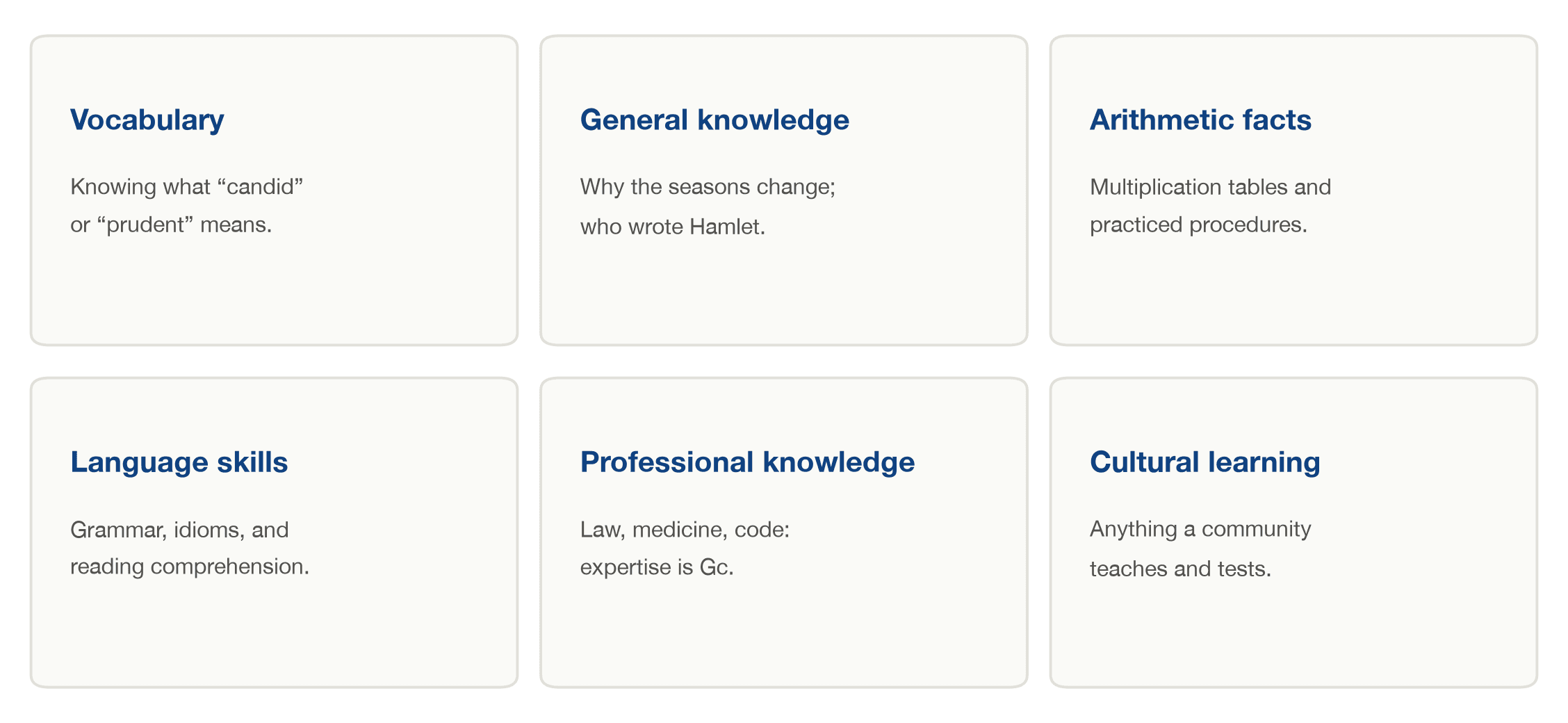
“Crystallized” is a precise metaphor: this is ability that has taken durable form. Whenever reasoning was applied to learning something, the residue it left, the word learned, the fact retained, the method internalized, became crystallized intelligence.

Six cards with examples of crystallized intelligence: vocabulary, general knowledge, arithmetic facts, language skills, professional knowledge, and cultural learning
The modern Cattell-Horn-Carroll model, the blueprint behind today's major IQ batteries, treats comprehension-knowledge as one of the broad abilities every full-scale score samples. On tests it shows up as vocabulary items, general information questions, and verbal comprehension tasks; our overview of IQ test question types shows those formats alongside their fluid counterparts.


Crystallized and Fluid: A Working Partnership

The two abilities are distinct but deeply intertwined, and they correlate: people with strong fluid reasoning tend to build knowledge faster, a dynamic Cattell called “investment.” In his phrase, fluid ability is invested in learning, and crystallized ability is the return. That is why the pair rise together in childhood, then part ways across adulthood.

• Reading this article: Decoding the words is crystallized skill; connecting the ideas to what you already believe is fluid work.

• A doctor diagnosing: Recalling disease patterns is crystallized; reasoning about a patient who fits none of them is fluid.

• Learning a language: Fluid ability speeds up acquisition; the resulting vocabulary and grammar become new crystallized ability.

For a fuller side-by-side comparison, see our article on fluid vs. crystallized intelligence, and for the novel-reasoning half of the pair, our guide to fluid intelligence.


Where Crystallized Intelligence Comes From

Three ingredients build Gc: ability, opportunity, and time. The strongest single lever researchers have quantified is education. A meta-analysis of over 600,000 participants found that each additional year of schooling raises measured intelligence by roughly one to five IQ points, with the largest, most durable gains on exactly the knowledge-loaded measures that define crystallized ability. Reading habits, occupational complexity, and the intellectual richness of daily life keep contributing long after school ends.

Culture decides the content. A brilliant person raised on seafaring knowledge and one raised on case law hold different crystallized libraries built by the same process, which is why knowledge items on IQ tests are written and normed within a culture rather than imported across them.


The Ability That Ages Well

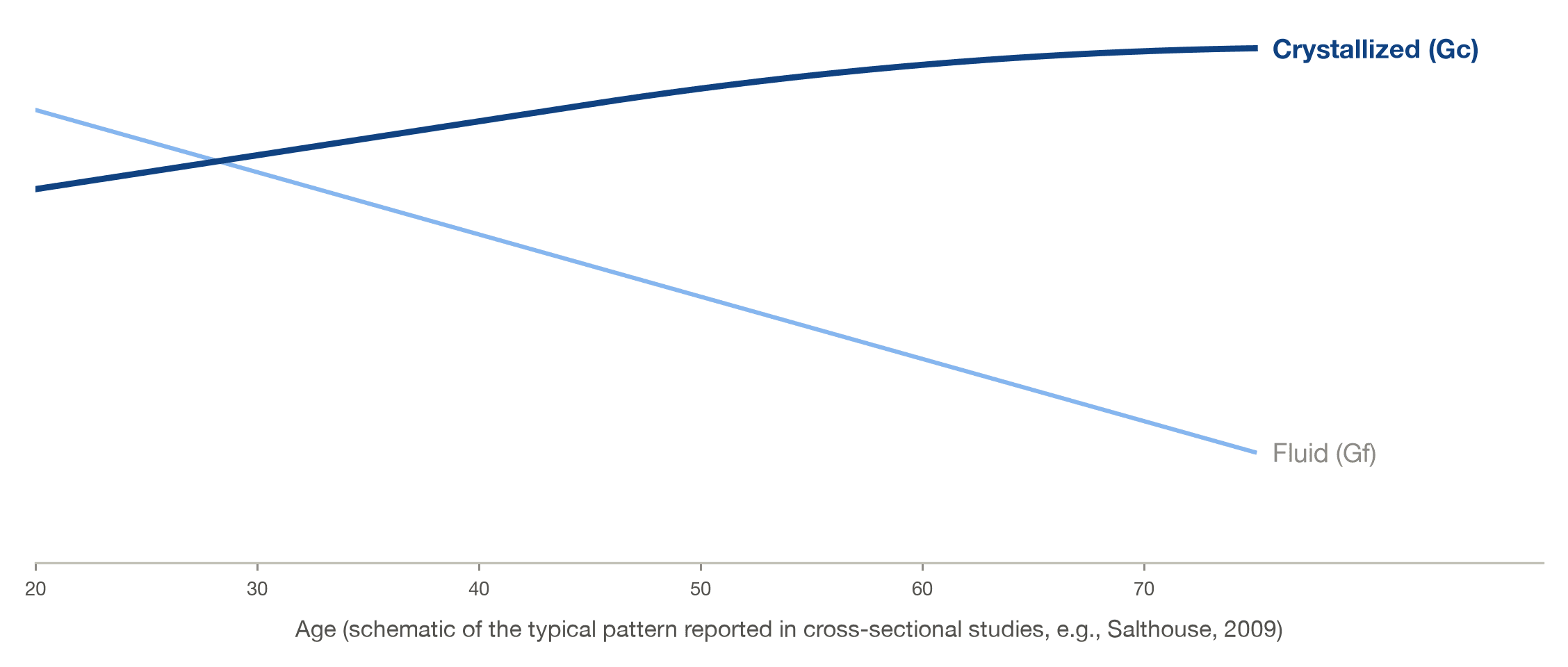
Crystallized intelligence is the good news in cognitive aging. Cross-sectional research, including Timothy Salthouse's influential analyses, shows vocabulary and knowledge scores holding steady or rising into the fifties and sixties, even as speed and novel reasoning decline from the late twenties onward. Everyday expertise often keeps improving because accumulated knowledge substitutes for raw speed.

Schematic chart highlighting crystallized intelligence remaining stable with age while fluid intelligence declines, based on the pattern in Salthouse 2009
This trajectory is why professions that reward accumulated judgment, from medicine to law to management, often see performance peak in middle age, and why an experienced practitioner routinely outperforms a faster but greener colleague. Large web-based studies mapping abilities across the lifespan put the peak for vocabulary remarkably late, with Hartshorne and Germine finding vocabulary performance still climbing into people's late sixties, decades after speed and novel reasoning have crested.


Can You Grow Crystallized Intelligence?

Yes, and unlike fluid training, this one works exactly as advertised: crystallized intelligence grows by learning things. Reading widely, studying deliberately, and practicing skills all add to the store at any age. The catch is specificity. Knowledge grows where you invest, so a lifetime of case law makes you knowledgeable about law, not about everything. The general capacity to learn remains governed by fluid ability and shows in how quickly new domains come to you.


See Both Halves of Your Own Profile

Because the two abilities diverge, a single blended number hides information. The Reasoning and Intelligence Online Test, developed by a team led by intelligence researcher Dr. Russell T. Warne, reports verbal reasoning alongside fluid reasoning, spatial ability, working memory, and processing speed, so you can see your knowledge-driven and novel-reasoning strengths separately. Take the RIOT IQ test.


Frequently Asked Questions

What is crystallized intelligence in simple terms?

Everything you know and can do from learning: vocabulary, facts, language, and practiced skills, available for use when a problem calls for them.

What is an example of crystallized intelligence?

Knowing what “ubiquitous” means, recalling why the seasons change, doing long division, or citing the relevant precedent in a legal argument.

Does crystallized intelligence decline with age?

Much later and less than fluid ability. Knowledge measures typically hold or improve into the fifties and sixties before any gentle decline.

Is crystallized intelligence just memory?

No. Memory systems store it, but Gc refers to organized, usable knowledge and skill, not the general capacity to memorize new material.

How do IQ tests measure crystallized intelligence?

Mostly through vocabulary, verbal comprehension, and general-information items, which correlate strongly with overall verbal ability.


References

1. American Educational Research Association, American Psychological Association, & National Council on Measurement in Education. (2014). Standards for educational and psychological testing. American Educational Research Association. testingstandards.net

2. American Psychological Association. (n.d.). Crystallized intelligence. In APA dictionary of psychology. dictionary.apa.org/crystallized-intelligence

3. Cattell, R. B. (1963). Theory of fluid and crystallized intelligence: A critical experiment. Journal of Educational Psychology, 54(1), 1–22. doi.org/10.1037/h0046743

4. McGrew, K. S. (2009). CHC theory and the human cognitive abilities project: Standing on the shoulders of the giants of psychometric intelligence research. Intelligence, 37(1), 1–10. doi.org/10.1016/j.intell.2008.08.004

5. Hartshorne, J. K., & Germine, L. T. (2015). When does cognitive functioning peak? The asynchronous rise and fall of different cognitive abilities across the life span. Psychological Science, 26(4), 433–443. doi.org/10.1177/0956797614567339

6. Ritchie, S. J., & Tucker-Drob, E. M. (2018). How much does education improve intelligence? A meta-analysis. Psychological Science, 29(8), 1358–1369. doi.org/10.1177/0956797618774253

7. Salthouse, T. A. (2009). When does age-related cognitive decline begin? Neurobiology of Aging, 30(4), 507–514. doi.org/10.1016/j.neurobiolaging.2008.09.023

Take our professional IQ test

Want to know your IQ? Try the first ever professional online IQ test.

Try our IQ test
Author
Dr. Russell T. WarneChief Scientist

Contact

Table of Contents

  • What Counts as Crystallized Intelligence
  • Crystallized and Fluid: A Working Partnership
  • Where Crystallized Intelligence Comes From
  • The Ability That Ages Well
  • Can You Grow Crystallized Intelligence?
  • See Both Halves of Your Own Profile
  • Frequently Asked Questions
  • What is crystallized intelligence in simple terms?
  • What is an example of crystallized intelligence?
  • Does crystallized intelligence decline with age?
  • Is crystallized intelligence just memory?
  • How do IQ tests measure crystallized intelligence?
  • References
Article Categories
All ArticlesUnderstanding IQ ScoresTaking an IQ TestRIOT-Specific InformationGeneral IQ & IntelligenceAdvanced Topics & ResearchIQ Scores & InterpretationMensa & High-IQ SocietiesOnline IQ Tests IQ Test Basics & FundamentalsAverage IQ & DemographicsFamous People & IQHistory & Origins Of IQ TestingAccuracy, Reliability & CriticismSpecial Population & Related ConditionsImproving IQ / PreparationSpecific IQ Tests & FormatsIQ Testing for HR & RecruitmentSkills Assessment
Related Articles
What Is Crystallized Intelligence?What Is Fluid Intelligence?What Are Culture Fair Intelligence Tests?Is Humor a Sign of High IQ?Does Dyslexia Affect IQ Tests?What Raises Your IQ Score the Most?When Is Cognitive Testing Used?What Does a Cognitive Function Test Measure?What Is the Stanford-Binet Test?Is IQ Malleable?Is it Difficult to Measure Intelligence?Are There Multiple Intelligences in the Human Mind?Is Intelligence Too Complex to Summarize with One Number?Is Intelligence Whatever Collection of Tasks a Psychologist Puts on a Test?Breaking the Intelligence & IQ TabooA Comprehensive History of IQ TestsThe Pro-Human Aspects of Intelligence ResearchWhat is an IQ Test? A Beginner's Guide.Resources to Learn About IQ and IntelligenceStudying IQ MattersWhat Is a Cognitive Test?What Is an Aptitude Test?The Search For Albert Einstein’s IQEQ TestEmotional IntelligenceIs Intelligence Hereditary?Multiple IntelligencesThe g FactorTheories of IntelligenceHistory of IQ TestsWhat is IQ? What is Intelligence?Is IQ the Same as Intelligence?
Take our IQ tests

Basic IQ Test

5 subtests + 5 cognitive abilities

Take the IQ test

Features

  • ~13 Minutes
  • IQ score
  • Cognitive abilities breakdown
  • ±5.6 IQ margin of error

5/15 Subtests

Learn more
Vocabulary
Matrix Reasoning
SToVeS
Visual Reversal
Symbol Search
Most comprehensive

Full IQ Test

15 subtests + all cognitive abilities

Take the IQ test

Features

  • ~52 Minutes
  • IQ score
  • Cognitive abilities breakdown
  • ±3.7 IQ margin of error

15/15 Subtests

Learn more
Vocabulary, Information, Analogies
Matrix Reasoning, Visual Puzzles, Figure Weights
Object Rotation, SToVeS, Spatial Orientation
Computation Span, Exposure Memory, Visual Reversal
Symbol Search, Abstract Matching
Simple Reaction Time, Choice Reaction Time
Compare all tests

Measure your
intelligence online.

Google

Assessments

  • All IQ Tests
  • Basic IQ Test
  • Full IQ Test
  • Custom IQ Test
  • Free IQ Test

Our Socials

  • X
  • YouTube
  • Facebook
  • LinkedIn

Other IQ Tests

  • WAIS-V
  • SB-5
  • Raven's 2
  • RIAS-2
  • CogAT 9
  • WISC-V

Community

  • Join Subreddit
  • Join Discord

Other Pages

  • Test Manual
  • Administer IQ Tests
  • About Us
  • Articles
  • Data
  • FAQ

Research

  • What do polygenic scores really predict?
  • Working speed and ability on the RIOT

Intelligence Journals & Organizations

  • Human Intelligence Research & Education (HIRE) Foundation
  • International Society for Intelligence Research (ISIR)
  • Intelligence & Cognitive Abilities Journal (ICA)
  • Intelligence Journal
  • Mensa Foundation

Contact

  • Email
  • Support

News & Press

  • International Society for Intelligence Research
  • American Thinker
  • Mensa Foundation (1/2)
  • Mensa Northern New Jersey
  • The University of Western Australia
  • Prolific
  • Quillette
  • Brainz

Our Articles

  • Comparing Cronbach’s Alpha and McDonald’s Omega Reliability
  • Breaking the Intelligence & IQ Taboo
  • What is the Flynn Effect?
  • A Comprehensive History of IQ Tests
  • The 15 Subtests of the RIOT

Our Articles

  • How to Take an IQ Test
  • How to Calculate IQ
  • What is the RIOT IQ Test?
  • The Pro-Human Aspects of Intelligence Research

Riot IQ © 2026

  • Terms of Service
  • Privacy Policy
  • BAA Agreement
  • Test Administrator Terms
  • Terms of Service
  • •Privacy Policy
  • •BAA Agreement
  • •Test Administrator Terms

Our Articles

  • Gmatclub (1/2)
  • ApolloTechnical
  • LessWrong
  • Psychreg
  • Study in Switzerland
  • SuccessConsciousness
  • Creative Organizational Design (1/2)
  • ABNewsWire
  • Vanderbilt University

Our Articles

  • The Globe and Mail
  • Barchart
  • Journal
  • Mensa Foundation (2/2)
  • Psychologs
  • Creative Organizational Design (2/2)
  • AZBigMedia
  • Thoughts on Life and Love
  • Anxiety and Depression Association of America

Our Articles

  • Before It's News
  • Siglo XXI
  • TechBullion
  • Medium
  • Gmatclub (2/2)
  • MSN
  • National Review
  • Minding the Campus
  • Launching Next
  • What is an IQ Test? A Beginner's Guide.
  • Our Articles

    • 5 Best IQ Tests in 2025
    • Cognitive Profiles on the RIOT IQ Test Results
    • 6 Cognitive Abilities of the RIOT
    • Are There Any Professional and Real Online IQ Tests?

    Our Articles

    • Resources to Learn About IQ and Intelligence
    • Studying IQ Matters
    • The Search for Albert Einstein's IQ
    • Do Non-g Gains from the Flynn Effect Matter?