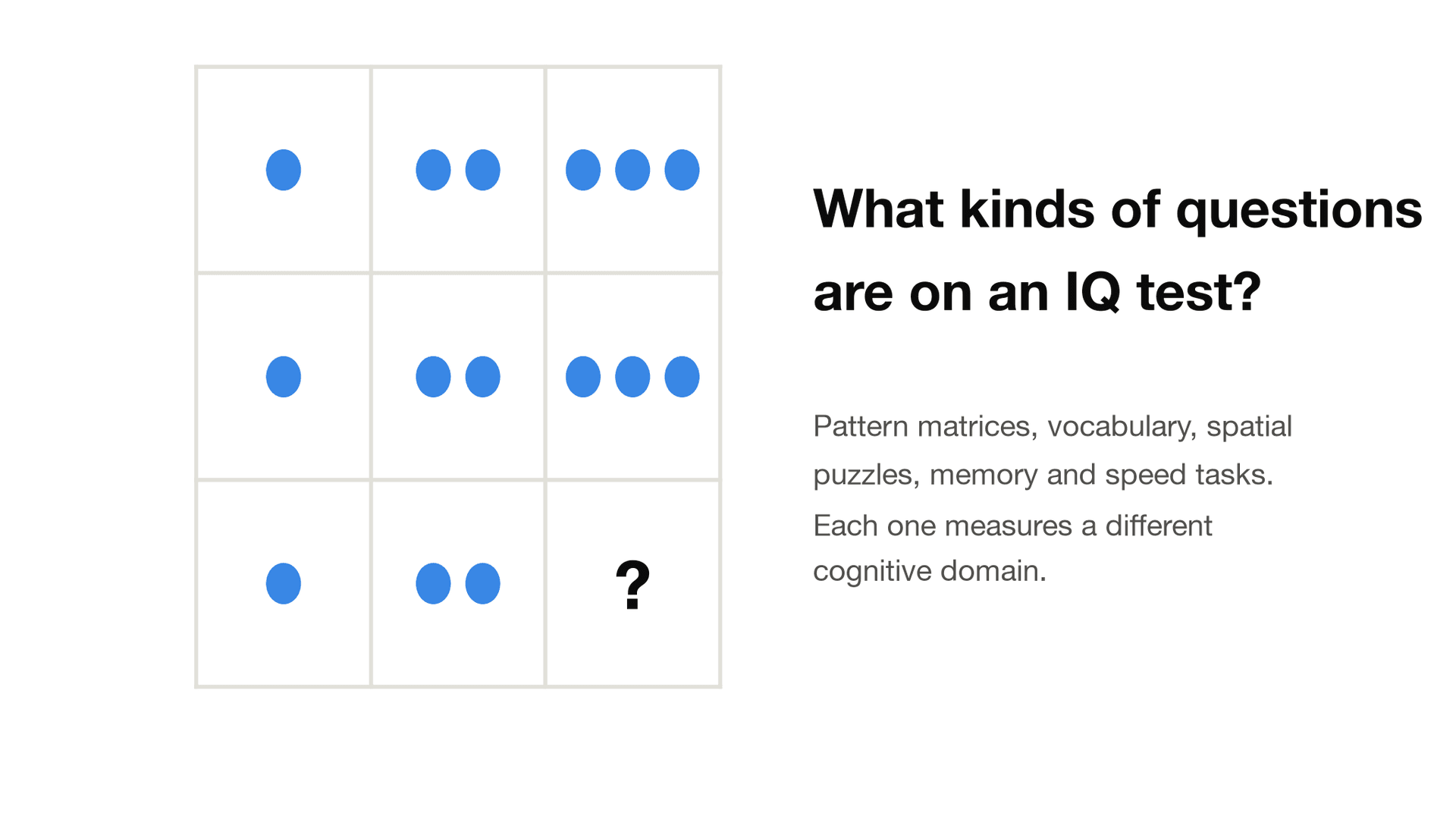
What kinds of questions are on an IQ test? Pattern matrices, vocabulary, spatial puzzles, memory and speed tasks. See examples and what they measure.
Dr. Russell T. WarneChief Scientist
Share
IQ test questions come in a handful of well-established types: pattern matrices that test reasoning with shapes, vocabulary and verbal analogy items, spatial puzzles that involve rotating objects mentally, memory tasks such as repeating sequences, and speed tasks that reward quick, accurate responses to simple problems. Each type exists to measure a specific cognitive ability, and together they build the profile behind a full IQ score. This article walks through each question type, shows a worked example, and explains why tests are built this way.
The Six Kinds of Questions You Will See
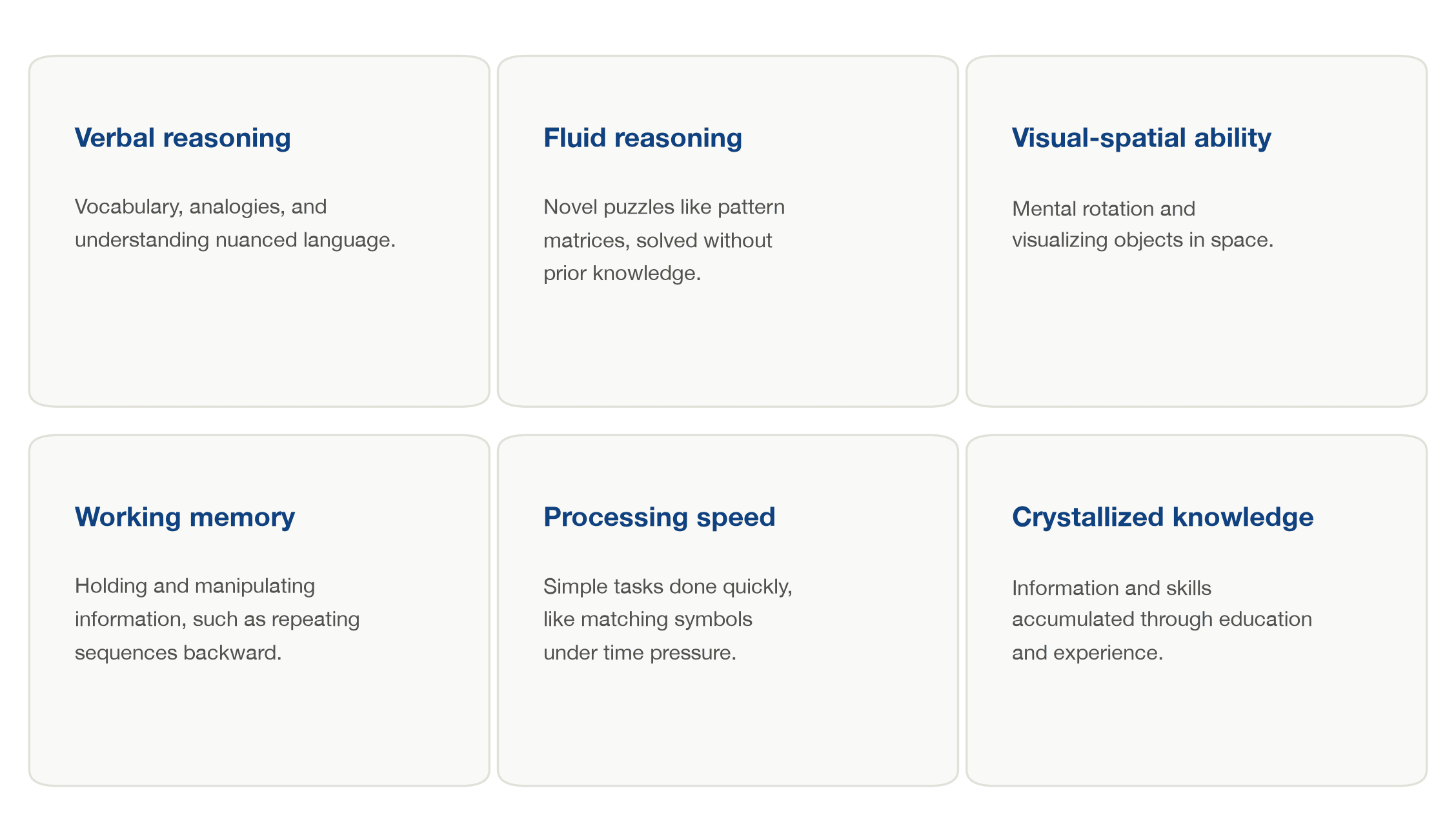
Professionally developed intelligence tests sample several distinct cognitive domains. The names vary between tests, but the underlying categories are remarkably consistent.
• Verbal reasoning: These items ask you to define words, complete analogies, or identify how two concepts relate. They measure how well you understand and manipulate language.
• Fluid reasoning: The classic format is the “pattern matrix,” a grid of shapes with one cell missing. Because these puzzles are novel, they measure your ability to solve new problems rather than recall what you already know.
• Visual-spatial questions: These show you a shape and ask what it would look like rotated, folded, or viewed from another angle.
• Working memory tasks: A common version presents a sequence of digits or items to repeat back, sometimes in reverse order. The measure is how much information you can hold and manipulate at once.
• Processing speed tasks: These are deliberately easy items, such as matching symbols to numbers, scored by how many you complete accurately in a fixed time.
• Crystallized knowledge: Some tests include general information or arithmetic items that draw on what you have learned through education and experience.
A Worked Example: The Pattern Matrix
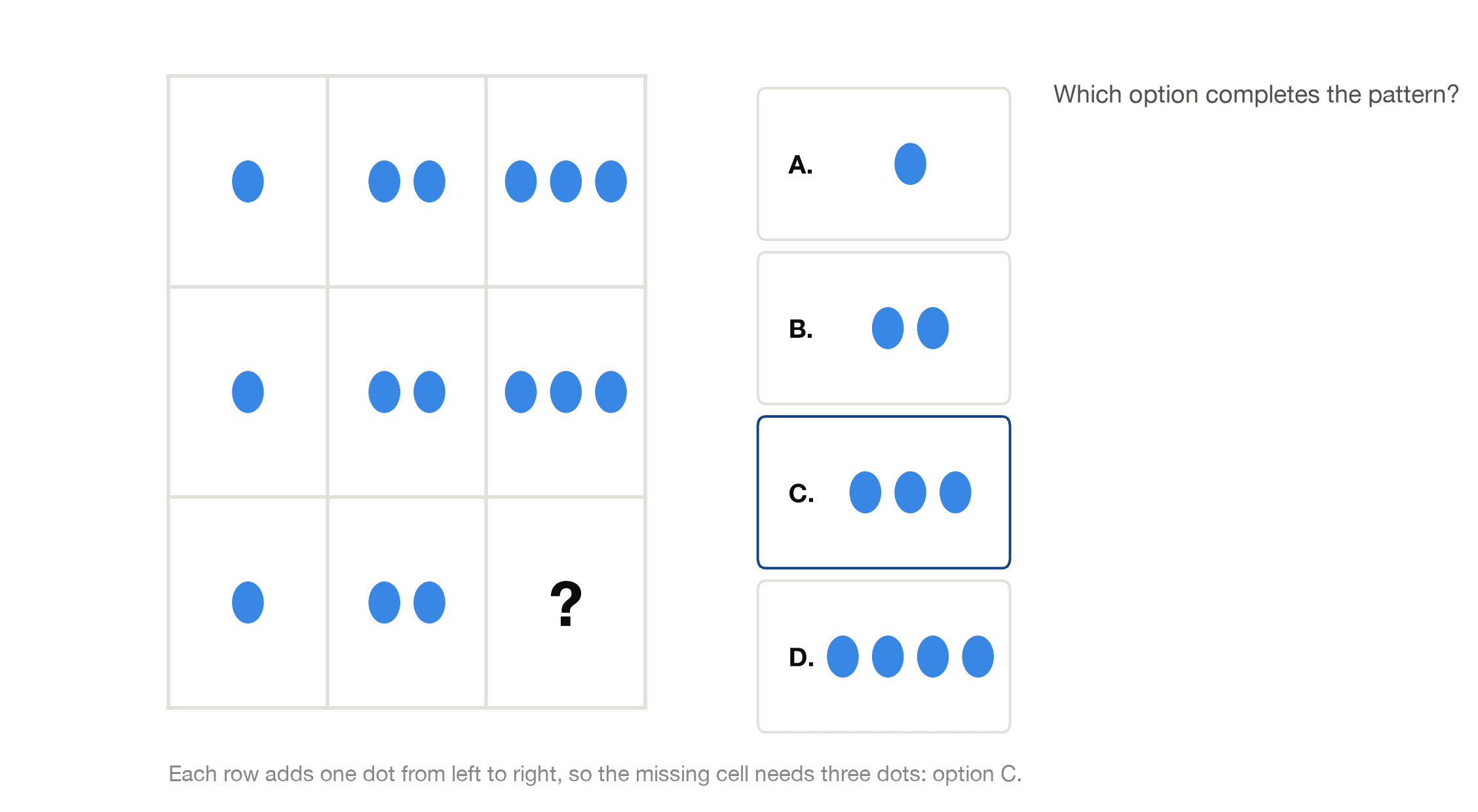
Matrix items are the most recognizable IQ test questions, so it is worth walking through one. Look at the grid below. Each row follows a rule, and your job is to identify it and pick the option that completes the pattern.
Real test items start about this simple and grow harder by layering rules: a shape rule plus a count rule plus a shading rule, all operating at once. Our step-by-step guide to solving 3x3 matrix reasoning puzzles breaks down the common rule types. A harder version of this same puzzle might rotate the shapes as they move across each row, cycle their shading, and vary how many appear, so that three rules must be tracked at once. The reasoning is the same in kind; there is simply more to hold in mind.
Why Tests Ask These Questions and Not Others
The question types survive for a reason. Performance on all of them correlates, a century-old finding that points to a shared factor called “general intelligence.” Sampling several domains lets a test estimate that general factor while also revealing relative strengths, such as stronger verbal than spatial ability. Our explainer on what an IQ test measures covers this in depth.
The shared factor is not unique to Western test-takers either. A 2019 reanalysis of test data from 31 non-Western countries, published in Psychological Bulletin, found the same general factor in almost every sample examined, strong evidence that these question types tap something universal about human cognition. And a well-known 1997 statement signed by 52 intelligence researchers described intelligence as a general ability to reason, plan, solve problems, and learn from experience. That is precisely the ability the item formats above are built to sample.
Just as important is what professionally built tests leave out. Trick riddles, trivia contests, and personality-style questions do not measure cognitive ability well, so they do not appear. If an online quiz asks which historical figure you most admire, it is not an IQ test.
How IQ Test Questions Are Scored
Individual questions do not carry point values that add straight into an IQ. A test first produces a “raw score,” such as the number of items answered correctly under each subtest's rules. That raw score means nothing on its own. It becomes an IQ only by comparison with a “norm group,” a large, representative sample of people who took the same test under the same conditions. The final scale sets the average at 100 with a standard deviation of 15 points.
Question difficulty is part of the design. Items are typically arranged from easy to hard, and the harder items are what separate high scorers from one another. Spreading many items across several domains also makes the total more reliable, because no single question can move it much. Even so, every score carries some measurement error, which is why well-built tests report a confidence band around the number instead of treating it as exact.
For what those numbers mean in practice, from 85 to 115 and beyond, see our guide to the IQ scale.
Can You Practice IQ Test Questions?
Familiarity helps a little, mostly by removing surprise about the formats. But repeated exposure to similar items creates a “practice effect” that inflates scores without raising the underlying ability, which is why test manuals recommend spacing out repeat testing. Understanding the formats before test day is sensible preparation; drilling hundreds of lookalike puzzles mainly teaches you the puzzles. Score gains from drilling near-identical items mainly reflect familiarity with those items rather than growth in the underlying ability.
How the Reasoning and Intelligence Online Test Asks Its Questions
The Reasoning and Intelligence Online Test, developed by a team led by intelligence researcher Dr. Russell T. Warne, uses the same domain structure described above: verbal reasoning, fluid reasoning, spatial ability, working memory, and processing speed, combined into a full-scale score on the standard scale with a mean of 100 and a standard deviation of 15. You see a profile of strengths across domains, not just one number. Take the RIOT IQ test.
Frequently Asked Questions
What kinds of questions are on an IQ test?
Pattern matrices, vocabulary and verbal analogies, mental rotation puzzles, memory-span tasks, and timed processing-speed items. Each maps to a specific cognitive domain.
Are IQ test questions the same on every test?
The specific items differ, but professionally developed tests sample the same core domains, which is why scores from well-built tests can be compared.
Are there math questions on IQ tests?
Some tests include arithmetic or quantitative reasoning items. They measure reasoning with numbers rather than advanced mathematical knowledge.
How many questions does an IQ test have?
It varies by test and format. What matters for a trustworthy score is not the number of items but whether the test is properly normed and covers multiple cognitive domains.
Do IQ test questions change with age?
The domains stay the same, but the items are age-appropriate: children's versions use simpler vocabulary and shorter memory spans. Scores are always calculated relative to same-age peers, so a 10-year-old and an adult are never compared directly.
Can you prepare for IQ test questions?
Learning the formats in advance is reasonable and reduces surprise. Heavy drilling on similar puzzles inflates scores through practice effects without changing underlying ability.
References
1. American Educational Research Association, American Psychological Association, & National Council on Measurement in Education. (2014). Standards for educational and psychological testing. American Educational Research Association. testingstandards.net
4. Gottfredson, L. S. (1997). Mainstream science on intelligence: An editorial with 52 signatories, history, and bibliography. Intelligence, 24(1), 13–23. doi.org/10.1016/S0160-2896(97)90011-8
5. Warne, R. T. (2020). In the know: Debunking 35 myths about human intelligence. Cambridge University Press. doi.org/10.1017/9781108593298
6. Warne, R. T., & Burningham, C. (2019). Spearman’s g found in 31 non-Western nations: Strong evidence that g is a universal phenomenon. Psychological Bulletin, 145(3), 237–272. doi.org/10.1037/bul0000184
Take our professional IQ test
Want to know your IQ? Try the first ever professional online IQ test.