🇺🇸The official website of Riot IQ
Log in
  • Home
  • About

Measure your
intelligence online.

Google

Assessments

  • All IQ Tests
  • Basic IQ Test
  • Full IQ Test
  • Custom IQ Test
  • Free IQ Test

Our Socials

  • X
  • YouTube
  • Facebook
  • LinkedIn

Other IQ Tests

  • WAIS-V
  • SB-5
  • Raven's 2
  • RIAS-2
  • CogAT 9
  • WISC-V

Community

  • Join Subreddit
  • Join Discord

Other Pages

  • Test Manual
  • Administer IQ Tests
  • About Us
  • Articles
  • Data
  • FAQ

Research

  • What do polygenic scores really predict?
  • Working speed and ability on the RIOT

Intelligence Journals & Organizations

  • Human Intelligence Research & Education (HIRE) Foundation
  • International Society for Intelligence Research (ISIR)
  • Intelligence & Cognitive Abilities Journal (ICA)
  • Intelligence Journal
  • Mensa Foundation

Contact

  • Email
  • Support

News & Press

  • International Society for Intelligence Research
  • American Thinker
  • Mensa Foundation (1/2)
  • Mensa Northern New Jersey
  • The University of Western Australia
  • Prolific
  • Quillette
  • Brainz

Our Articles

  • Gmatclub (1/2)
  • ApolloTechnical
  • LessWrong
  • Psychreg
  • Study in Switzerland
  • SuccessConsciousness
  • Creative Organizational Design (1/2)
  • ABNewsWire
  • Vanderbilt University

Our Articles

  • The Globe and Mail
  • Barchart
  • Journal
  • Mensa Foundation (2/2)
  • Psychologs
  • Creative Organizational Design (2/2)
  • AZBigMedia
  • Thoughts on Life and Love
  • Anxiety and Depression Association of America

Our Articles

  • Before It's News
  • Siglo XXI
  • TechBullion
  • Medium
  • Gmatclub (2/2)
  • MSN
  • National Review
  • Minding the Campus
  • Launching Next

Our Articles

  • Comparing Cronbach’s Alpha and McDonald’s Omega Reliability
  • Breaking the Intelligence & IQ Taboo
  • What is the Flynn Effect?
  • A Comprehensive History of IQ Tests
  • The 15 Subtests of the RIOT

Our Articles

  • How to Take an IQ Test
  • How to Calculate IQ
  • What is the RIOT IQ Test?
  • The Pro-Human Aspects of Intelligence Research
  • What is an IQ Test? A Beginner's Guide.

Our Articles

  • 5 Best IQ Tests in 2025
  • Cognitive Profiles on the RIOT IQ Test Results
  • 6 Cognitive Abilities of the RIOT
  • Are There Any Professional and Real Online IQ Tests?

Our Articles

  • Resources to Learn About IQ and Intelligence
  • Studying IQ Matters
  • The Search for Albert Einstein's IQ
  • Do Non-g Gains from the Flynn Effect Matter?

Riot IQ © 2026

  • Terms of Service
  • Privacy Policy
  • BAA Agreement
  • Test Administrator Terms
  • Terms of Service
  • •Privacy Policy
  • •BAA Agreement
  • •Test Administrator Terms

Table of Contents

  • The Origins of "IQ"
  • Why the Quotient Formula Is Outdated
  • Modern IQ Scores 
  • Why IQ Still Matters
Nov 12, 2025·IQ Test Basics & Fundamentals

What Does IQ Mean?

What does IQ mean? It's short for intelligence quotient and shows how well you think, solve problems, and learn compared to others. Discover what IQ truly means.

Dr. Russell T. WarneChief Scientist
Share
What Does IQ Mean?
IQ originally was an abbreviation for "intelligence quotient," though today the term does not stand for anything. An IQ is simply the score that someone receives on an intelligence test. These scores are designed to measure general mental ability, which is a person's capacity to reason, solve problems, think abstractly, and learn from experience.


The Origins of "IQ"

The term "intelligence quotient" was coined by German psychologist Wilhelm Stern in the early 1900s. Stern proposed a formula to score the intelligence tests that Alfred Binet and Theodore Simon had created: (mental age / chronological age) × 100. In this formula, "mental age" referred to the typical age of children who performed as well as the test taker, while "chronological age" was the person's actual age.

For example, if an 8-year-old child performed as well as the average 10-year-old on an intelligence test, their IQ would be calculated as (10 / 8) × 100 = 125. Because this score involved dividing one age by another, it was called an "intelligence quotient."

This quotient method had the advantage of being simple to calculate and interpret. An IQ of 100 was always average, regardless of age. Scores above 100 indicated above-average intelligence, while scores below 100 indicated below-average performance.

For a more detailed look into the development of IQ tests through the years, read A Comprehensive History of IQ Tests. 


Why the Quotient Formula Is Outdated

Despite its simplicity, the quotient formula had serious problems. The most obvious issue is that it doesn't make sense for adults. While it's meaningful to say that a child has a "mental age" that's ahead of or behind their chronological age, this concept breaks down in adulthood. Cognitive growth levels off after adolescence, so it's nonsensical to say that a 40-year-old has the "mental age" of a 50-year-old.

Another critical flaw was that quotient IQs weren't comparable across different ages. Consider a child whose mental age is consistently two years ahead of their chronological age. At age 4, their IQ would be 150. At age 6, it would drop to 133. By age 8, it would be just 125. The child's IQ would appear to decrease over time, even though they remained two years ahead of their peers, which is clearly an absurd result.


Modern IQ Scores 

Today, every professional IQ test uses what's called a "deviation IQ." This method compares a person's performance to others in their age group using statistical procedures. The scores still have an average of 100, but they work equally well for children and adults, and they have the same meaning across all ages.

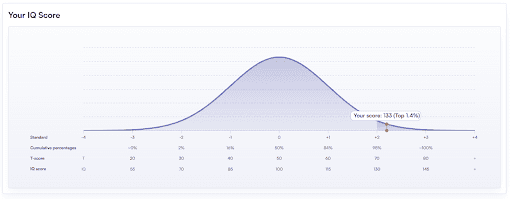
In a deviation IQ system, scores follow a normal distribution (often called a bell curve). About 68% of people score between 85 and 115, and 95% score between 70 and 130. These scores represent how many standard deviations above or below the average a person performed. As an example, here’s how a person’s IQ test results would look like on the RIOT Dashboard. Aside from plotting where your score lies compared to the normed population, the report also produces a detailed breakdown of the examinee’s performance across the different subsections. 


Why IQ Still Matters

Even though "IQ" no longer stands for an actual quotient, the term has stuck around for over a century. That's because IQ scores, when properly measured, provide valuable information. They predict performance in school and the workplace, correlate with health outcomes, and help identify people who may need additional educational support or who might excel in cognitively demanding fields.

The key phrase here is "when properly measured." Not all tests that claim to measure IQ are created equal. Many online tests are created by amateurs without training in psychometrics (the science of psychological testing) and produce meaningless scores. Tests like the Reasoning and Intelligence Online Test allow users to accurately measure their intelligence and receive a detailed assessment of their cognitive strengths.

To learn more about the most advanced online intelligence/IQ test, click here: 


Take our professional IQ test

Want to know your IQ? Try the first ever professional online IQ test.

Try our IQ test
Author
Dr. Russell T. WarneChief Scientist

Contact

Table of Contents

  • The Origins of "IQ"
  • Why the Quotient Formula Is Outdated
  • Modern IQ Scores 
  • Why IQ Still Matters
Article Categories
All ArticlesUnderstanding IQ ScoresTaking an IQ TestRIOT-Specific InformationGeneral IQ & IntelligenceAdvanced Topics & ResearchIQ Scores & InterpretationMensa & High-IQ SocietiesOnline IQ Tests IQ Test Basics & FundamentalsAverage IQ & DemographicsFamous People & IQHistory & Origins Of IQ TestingAccuracy, Reliability & CriticismSpecial Population & Related ConditionsImproving IQ / PreparationSpecific IQ Tests & FormatsIQ Testing for HR & RecruitmentSkills Assessment
Related Articles
What Is Mental Age? What a Mental Age Test Really MeasuresWhat Kinds of Questions Are on an IQ Test?5 Reasons to Take a Professional IQ TestWhat Does IQ Stand For?Is There an Official Online IQ Test?What is Intelligence?What is an IQ Test?What Does IQ Mean?What Does IQ Measure?What is on an IQ Test?
Take our IQ tests

Basic IQ Test

5 subtests + 5 cognitive abilities

Take the IQ test

Features

  • ~13 Minutes
  • IQ score
  • Cognitive abilities breakdown
  • ±5.6 IQ margin of error

5/15 Subtests

Learn more
Vocabulary
Matrix Reasoning
SToVeS
Visual Reversal
Symbol Search
Most comprehensive

Full IQ Test

15 subtests + all cognitive abilities

Take the IQ test

Features

  • ~52 Minutes
  • IQ score
  • Cognitive abilities breakdown
  • ±3.7 IQ margin of error

15/15 Subtests

Learn more
Vocabulary, Information, Analogies
Matrix Reasoning, Visual Puzzles, Figure Weights
Object Rotation, SToVeS, Spatial Orientation
Computation Span, Exposure Memory, Visual Reversal
Symbol Search, Abstract Matching
Simple Reaction Time, Choice Reaction Time
Compare all tests