What is an IQ test? Learn what IQ tests measure (reasoning, memory, speed), types of intelligence tests, and what IQ scores mean.
Dr. Russell T. WarneChief Scientist
Share
An IQ test is a standardized assessment designed to measure human intelligence. The term "IQ" stands for "intelligence quotient," though modern IQ tests no longer calculate scores using the original quotient formula. Today, IQ tests serve as scientific instruments that help psychologists, educators, and researchers understand cognitive abilities and make informed decisions about education, employment, and mental health.
How IQ Tests Measure Intelligence
IQ tests measure intelligence by presenting examinees with a series of tasks that require thinking, reasoning, problem-solving, and judgment.
There is no single task that appears on every IQ test. Instead, test creators select from a wide range of activities: vocabulary questions, pattern completion, math problems, spatial puzzles, and more. As long as a task requires reasoning and problem-solving, it can measure intelligence. This principle, called "the indifference of the indicator," means that different tests with different content can still produce comparable results.
What Questions are Common on IQ Tests?
While IQ tests vary in their specific content, most include some combination of these task types:
• Verbal tasks assess language skills and learned knowledge. These might include defining words, answering general knowledge questions, or identifying similarities between concepts.
• Spatial tasks measure the ability to visualize and manipulate objects mentally. Examples include rotating shapes mentally or identifying which pieces would complete a pattern.
• Memory tasks test a person’s working memory, or the ability to hold and manipulate information temporarily. These might involve remembering sequences of numbers or letters.
• Processing speed tasks measure how quickly someone can complete simple cognitive tasks accurately, such as matching symbols to numbers.
• Mathematical and logical reasoning tasks evaluate the ability to work with numbers, identify rules, and apply logic to solve problems.
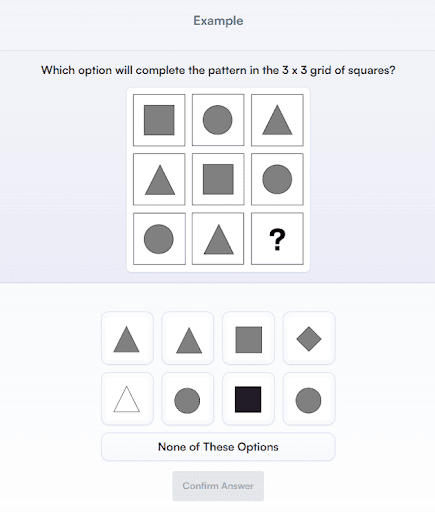
Here is a sample question to test your logical reasoning ability:
Source: The RIOT IQ Test
Types of IQ Tests
IQ tests can be classified by how they're administered:
• Individually administered tests are given one-on-one, usually by a trained psychologist. The Wechsler tests and Stanford-Binet are the most popular examples. These tests allow the examiner to observe the test-taker's approach to problems and ensure optimal testing conditions. However, these are usually expensive, time-consuming, and inaccessible for many people.
• Online tests represent a newer frontier in intelligence testing. While a lot of IQ tests found online are created by non-professionals who lack training in psychometrics and disregard professional standards, there are newer ones, such as the Reasoning and Intelligence Online Test, that meet professional standards for psychological assessment.
IQ tests can also be classified by their content. Some tests are comprehensive batteries that include multiple subtests measuring different abilities. Others are single-format tests that use only one type of task throughout, such as the Raven's Progressive Matrices, which uses only visual pattern completion.
What Do IQ Scores Mean?
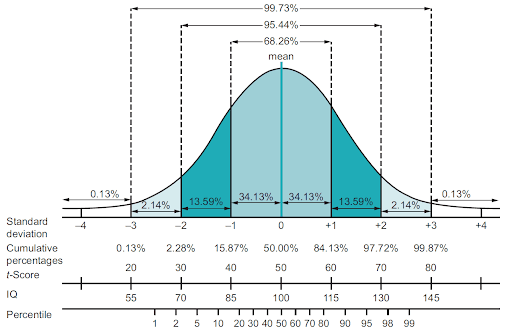
IQ scores follow a normal distribution (sometimes informally called a “bell curve”), with an average of 100. Most tests use a standard deviation of 15 points, meaning that about 68% of people score between 85 and 115, and 95% score between 70 and 130.
IQ scores are relative, not absolute. A score of 115 doesn't mean that a person answered 115 questions correctly or got 115% on a test. Instead, it indicates how well the examinee’s performance compares to others in their same age group. Based on the chart above, an IQ of 115 means that the test taker performed better than about 84.13% of people who are the same age. For a deeper look into what this measures and means, check out: Measurement and IQ Score Properties.
What IQ Tests Don't Measure
While IQ tests are powerful tools, they have limitations. They don't measure creativity, wisdom, emotional intelligence, or practical skills. They also don't capture personality traits like perseverance, curiosity, or conscientiousness, all of which matter for success in life.
IQ tests also require certain conditions to produce accurate results. Test-takers need adequate sleep, motivation to try their best, and familiarity with the testing format. Cultural and linguistic barriers can affect performance, which is why professional tests are designed for specific populations and screened carefully for bias.
Check out this video for a quality conversation about the impact of culture on the accuracy of intelligence testing:
The Importance of Professional Standards for IQ Tests
The quality of IQ tests varies dramatically. Professional IQ tests undergo rigorous development processes that include expert review, pilot testing, statistical analysis, and validation studies. They're created by psychologists with advanced training in psychometrics and are designed to meet strict ethical and technical standards. Before taking any IQ test, it's worth investigating who created it and whether it has been independently evaluated by experts.
If you are curious about what an IQ test looks like in action, check out the Sample RIOT Free IQ Test. This test received the same rigorous development process as traditional in-person IQ tests used by psychologists. It is also the first online IQ test to meet the professional standards for educational and psychological testing standards established by the American Psychological Association, American Educational Research Association, and the National Council for Measurement in Education.
Take our professional IQ test
Want to know your IQ? Try the first ever professional online IQ test.