Feb 19, 2025·Understanding IQ ScoresHow To Calculate IQ
Learn how IQ is calculated, from Stern’s quotient IQ to modern deviation IQ, using z-scores and standard deviation for accurate results.
Dr. Russell T. WarneChief Scientist
One common question that people have about intelligence tests is how IQ is calculated. This is an important question because the most important result of an intelligence test is the IQ. Having a transparent process for calculating the score is important for building trust.
In the Olden Days . . .
The original equation for calculating IQ was created by German psychologist Wilhelm Stern over 100 years ago: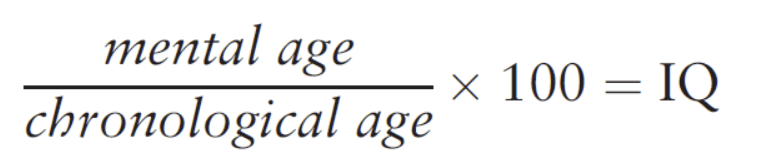
In this equation, the “chronological age” was the examinee’s actual age (in years). The “mental age” was the age of the average person who performed as well on the test as the examinee. If, for example, a 10-year-old performed as well as the average 9-year-old on the test, then the child’s IQ would be 9 / 10 x 100 = 90.
Because the most important part of the equation uses division, Stern called this score the “intelligence quotient,” or IQ. Today, we call this score a “quotient IQ” to distinguish it from the IQs calculated with modern methods (more on that later).
Problems with Stern’s IQ
Stern’s IQ equation was quickly adopted by intelligence test creators, and it persisted for decades. However, it had problems. One was that IQs were generally not comparable across ages. For example, if a child was two years ahead of her peers’ mental development, she would have an IQ of 140 at age 5 (because 7 / 5 x 100 = 140) and an IQ of 125 at age 8 (because 10 / 8 x 100 = 125). Even though she is still two years ahead of her classmates, her IQ decreased from age 5 to age 8!
Stern’s IQ also did not apply well to adults. After all, we expect children’s cognitive abilities to improve with age. We don’t really expect that from adults. Most psychologists accommodated this by standardizing the “chronological age” to 16 or 18 for all adults, but this was unsatisfactory. There is strong evidence that people’s mental abilities continue to increase past that age--especially if they attend school.
Calculating Modern IQs
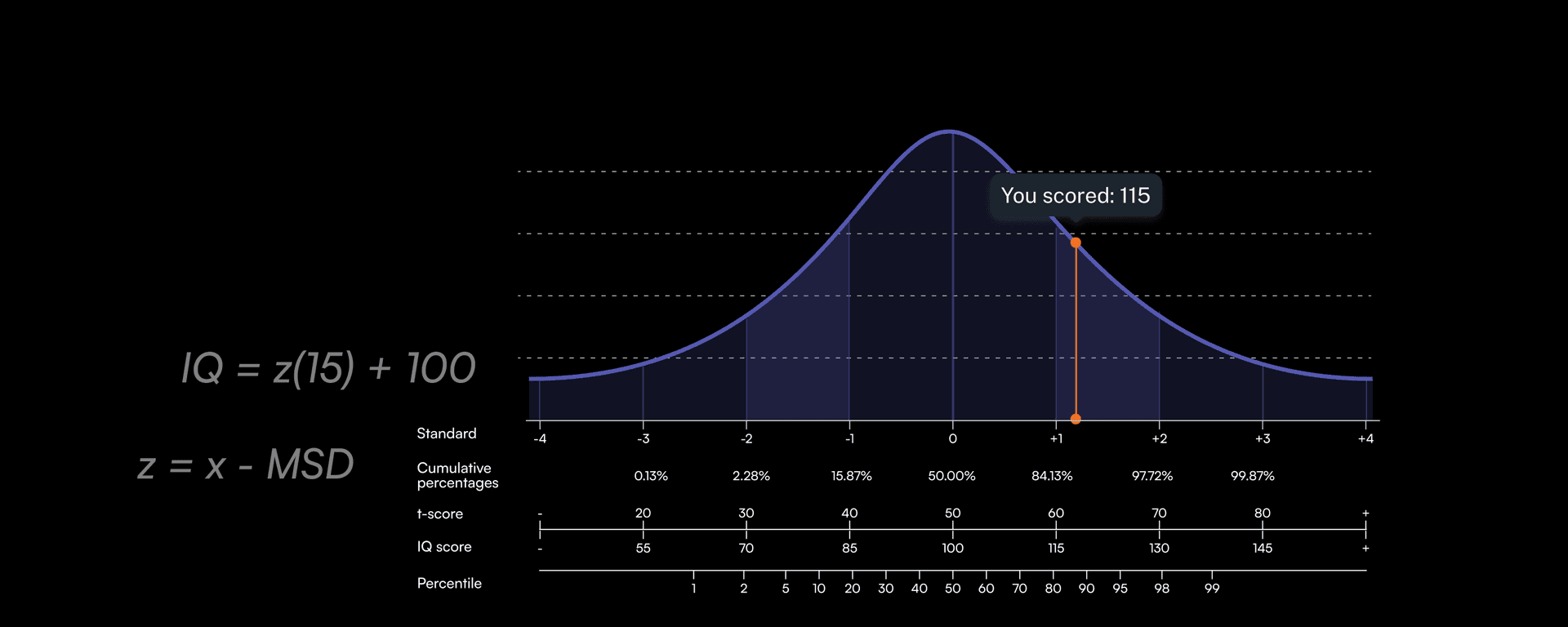
Modern IQs are not calculated with Stern’s equation any more. A new method has replaced quotient IQs. It is more complicated than Stern’s formula, but it solves the problems of the old quotient IQs.The first step to calculating a modern IQ is to calculate the average and standard deviation for a subtest. Many people learn the two-step formula for calculating averages in school: add up the scores and then divide by the number of scores. The average is a measure of the midpoint of a group of scores and is also called the mean.The standard deviation is more complicated, but a description is available in any introductory statistics textbook. In short, the standard deviation is a measure of how spread out scores are around the average. Small standard deviations indicate that scores are bunched up around the average. Large standard deviations occur when scores are very spread out.After calculating the mean and standard deviation for a subtest, we can use that information to calculate a z-score for each person. The formula is:z = x-MSDIn this formula, “x” is the person’s score on the subtest, “M” is the norm sample’s average or mean for that subtest, and “SD” is the norm sample’s standard deviation for that subtest. The advantage of z-scores is that they allow scores from different variables (like subtests on the RIOT) to be combined. This is because z-scores always have a mean of zero and a standard deviation of 1. This property makes z-scores like a “universal language” of variables.This process is repeated for every subtest. On the full version of the RIOT, a person will have 15 z-scores at this stage because they took 15 subtests.After those z-scores have been calculated, they are then added together. This can be a simple sum, or (as in the case of the RIOT and some other intelligence tests), subtests that are better measures of intelligence are given more “weight” in calculating this sum. Because the sum of the z-scores will have a new average and standard deviation, it is necessary to calculate a new z-score for this sum. This resets the sum’s mean back to zero and the standard deviation to 1.The final step is to convert this z-score to the IQ scale. This is done with the following formula:IQ = z (15) + 100And that’s the modern process of calculating an IQ score! Because this procedure uses the standard deviation so much, it is often called the “deviation IQ” to distinguish it from Stern’s “quotient IQ.” But because quotient IQs were phased out decades ago, you can assume that the phrase “IQ” refers to deviation IQs. This is always how the term is used with the RIOT.The deviation IQ calculation procedure sounds very complicated. But it, essentially, applies some algebra to a set of scores. With computers, this is a very easy and quick process. And it avoids the problems of the old quotient IQs.Additional details about the calculation of IQ (and other scores) on the RIOT are available in the RIOT’s technical manual.
Take our professional IQ test
Want to know your IQ? Try the first ever professional online IQ test.
AuthorDr. Russell T. WarneChief Scientist
