Dec 16, 2025·Understanding IQ ScoresThe Complete Guide to IQ Score Calculation
Discover how IQ calculation evolved from the simple mental age formula to modern deviation scoring. Learn what IQ ranges mean, how tests measure intelligence, and how to evaluate score accuracy.
Dr. Russell T. WarneChief Scientist
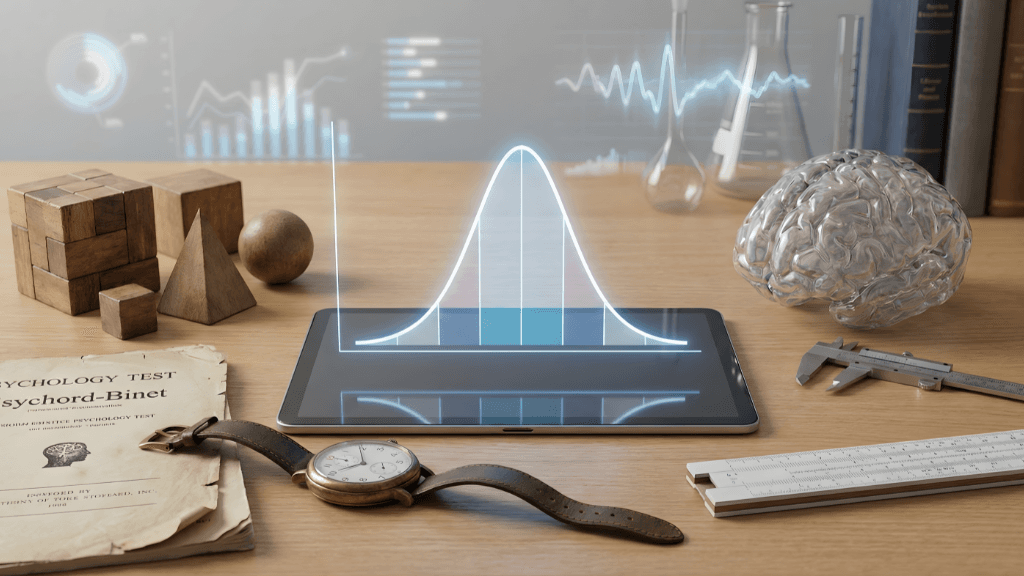
The formula for calculating IQ has changed dramatically since psychologists first attempted to quantify intelligence over a century ago. What started as a simple mathematical equation has evolved into a sophisticated statistical scale for describing a person’s intelligence level. This guide covers both the historical formula and modern deviation scoring methods, explains what different IQ ranges actually mean, and helps you evaluate whether any given IQ score is worth taking seriously.
What is an intelligence quotient?
Originally, IQ was calculated through the formula (mental age ÷ chronological age) ✕ 100. In other words, it was a ratio between a person’s “mental age” (which was the average age of a person who performed as well on the test as they did) and their chronological age (which was the test taker’s actual age). This was then multiplied by 100 for convenience. Because a “quotient” is the answer in a division problem, the result was called an “intelligence quotient,” which was abbreviated to “IQ.”
This formula is now obsolete, but the term “IQ” remains. Today, the abbreviation does not stand for anything because modern tests use a different mathematical procedure to calculate IQ. This procedure depends on comparison to a norm sample—a large group of people who have already taken the same test under controlled conditions. Therefore, a modern IQ score represents where your cognitive abilities fall relative to others, with 100 set as the average and a standard deviation of 15 points.
How modern IQ tests use deviation scores
Standard deviation measures how spread out the scores are from the average. On the IQ scale, one standard deviation equals 15 points. Roughly 68% of people score within one standard deviation of the mean (between 85 and 115), while approximately 95% fall within two standard deviations (70 to 130). This statistical framework creates the familiar normal distribution (commonly called a “bell curve”). In a normal distribution, most scores are near the average, while scores become rarer as they move further from 100 in either direction.
How normative samples affect your score
An IQ score depends entirely on how a test taker performs, compared to the norm sample. Test publishers administer their assessments to a representative sample of people to establish what a typical level of performance looks like. The IQ is then calculated based on how close the test taker’s score is to the average for this norm sample.
A well-constructed normative sample matches the broader population in age, education, geographic distribution, and other relevant characteristics. Tests normed on unrepresentative samples produce misleading scores, which is why reputable test publishers disclose detailed information about their norming procedures.
IQ score ranges and what they mean
IQ classifications provide a framework for interpreting scores, though the boundaries between categories are arbitrary. Different test publishers use slightly different labels, but the underlying distribution remains consistent.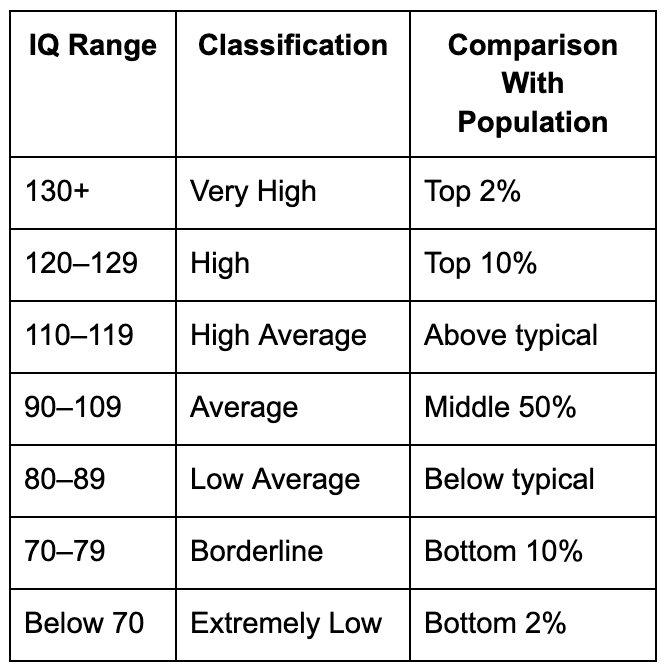
Very High IQ (130+)
Scores of 130 and above place someone in the top 2% of the population. People in this range often qualify for gifted programs or high-IQ societies like Mensa. That said, a very high IQ does not guarantee success in any particular field. But it does say that the person has enough baseline ability to learn the skills and information needed to success in a wide variety of fields. High IQ (120-129)
The 120–129 range represents the next tier down, roughly the top 10% of test-takers. Many professionals in intellectually demanding careers score here, though plenty of successful people score lower, and plenty of high scorers work in all kinds of fields.
High Average IQ (110-119)
Scores between 110 and 119 reflect above-typical cognitive functioning. This range often goes unnoticed because it doesn't qualify for special programs or labels, yet it represents meaningfully stronger reasoning and learning abilities than the population average. Many people who graduate from college and are successful in business and other endeavors have scores in this range.
Average IQ (90-109)
The 90–109 range is where about half the population scores. "Average" is a statistical term here, not a value judgment. It means typical performance compared to same-age peers who took the same test under similar conditions. Many aspects of society are designed for people in the average range of IQ, and most semi-skilled jobs are obtainable by people with IQs between 90 and 109.
Low Average IQ (80-89)
Scores of 80–89 are below average but still normal cognitive functioning. People in this range live independently, hold jobs, and manage daily responsibilities without difficulty. The "low" in "low average" refers only to position on the normal distribution.
Borderline IQ (70-79)
The 70–79 range sometimes warrants further evaluation, particularly if someone is experiencing difficulties in school or daily life. However, a score in this range alone does not indicate disability or predict life outcomes with any certainty. That being said, many aspects of life are more challenging to people with IQs in this range, and these people are more likely to succeed when everyday tasks (e.g., caring for their health) are simplified.
Extremely Low IQ (below 70)
Scores below 70 fall in the extremely low range and many people with scores this low have an intellectual disability. Clinical diagnosis of intellectual disability requires more than just an IQ score, though. Psychologists also assess adaptive functioning (which is the practical skills needed for daily life) before making any diagnosis.
Gifted classifications
Educational giftedness thresholds vary considerably by program and location. Some states and school districts use IQ cutoffs of 120 or 130 as a minimum for program admission. Others purposely avoid using IQ tests and instead base admission decisions on criteria like achievement tests, teacher recommendations, or creativity assessments. The meaning of "gifted" matters here. “Gifted” is an educational classification that states that the typical educational program is not challenging enough for the child. It does not refer to an innate, unchanging ability in the child.
What IQ tests actually measure
IQ tests are excellent measures of intelligence, but a pure measure of intelligence is not possible to create. That is because the tasks on intelligence tests measure a mix of general intelligence and specific cognitive abilities. Still, a diverse mix of cognitive tasks can produce an excellent estimate of general intelligence (as an IQ score) and scores for more specific cognitive abilities.
Modern tests based on the Cattell-Horn-Carroll (CHC) model measure multiple distinct abilities. Some of these include: • Verbal ability: The ability to understand, master, and use the nuances of language
• Fluid reasoning: Solving novel problems without relying on prior knowledge
• Crystallized intelligence: Accumulated knowledge and verbal abilities
• Working memory: Holding and manipulating information mentally
• Processing speed: Quickly and accurately completing cognitive tasks
• Visual-spatial processing: Understanding and manipulating visual information
A comprehensive IQ assessment examines several of these domains rather than relying on a single task. The RIOT IQ test, for instance, uses 15 subtests to measure multiple CHC abilities, providing a more complete picture than tests focusing on just one or two areas.
Types of IQ tests and how they calculate scores
Not all IQ tests are created equal. The method of administration and the rigor of test development dramatically affect whether a score is reliable.
Clinical IQ tests
Gold-standard assessments like the Wechsler Adult Intelligence Scale (WAIS) and Stanford-Binet require individual administration by trained professionals, usually in person (though sometimes via a video call). These tests have extensive normative data, well-documented reliability, and decades of validation research. They're also expensive and time-consuming.
Research-based online IQ tests
Some online assessments follow proper psychometric standards, including appropriate norming and adherence to professional testing guidelines. These can provide valid scores when built on established theoretical models, like CHC theory, and validated against clinical measures. The key is examining whether the test publisher discloses their methodology and normative data. Before taking an online IQ test, ensure that it was created by trained testing professional and that it has been evaluated by other experts in psychology. It should also be clear that technical documentation for the test exists.
How to know if your IQ score is accurate
Several markers distinguish legitimate IQ assessments from unreliable ones.
Check the norm sample
Valid tests are normed on representative populations, and reputable publishers disclose information about their norming process. How many people were in the sample? Were they demographically representative? When was the norming conducted? Tests normed decades ago may produce inflated scores due to the Flynn effect, which is the observed rise in IQ scores over generations. Look for the margin of error reporting
All psychological measurements contain some error. Reputable tests report confidence intervals, showing a range within which your "true" score likely falls. A test reporting an exact IQ without any margin of error is oversimplifying what the data can actually say.
Verify adherence to psychometric standards
Professional organizations, including the American Educational Research Association (AERA), American Psychological Association (APA), and National Council on Measurement in Education (NCME) have established standards for psychological testing. Legitimate test creators strive to meet these standards and have documentation describing this.
Limitations of IQ score calculations
Even well-constructed IQ tests have boundaries on what they can tell you.
• Point-in-time measurement: IQ scores reflect cognitive abilities at a specific moment, not fixed potential
• Cultural and linguistic factors: Tests developed in one cultural context may not translate perfectly to others; if a test taker does not belong to the culture the test is designed for, then their score may not be accurate.
• Situational influences: Test anxiety, fatigue, and motivation all affect performance
IQ scores are useful tools, but they are not destiny. They measure certain cognitive abilities reasonably well while remaining silent on creativity, social skills, personality traits, and other important aspects of a person.
Why scientifically valid IQ calculation matters
The difference between a well-constructed IQ test and a poorly designed one affects whether a score means anything at all. Accurate scores can inform educational planning, career decisions, and self-understanding. Inaccurate scores from unreliable tests can mislead test takers about their abilities.
When seeking an IQ assessment, look for tests created by experts, grounded in established theory, normed on appropriate populations, and transparent about their methodology.
Take our professional IQ test
Want to know your IQ? Try the first ever professional online IQ test.
AuthorDr. Russell T. WarneChief Scientist
