🇺🇸The official website of Riot IQ
Log in
  • Home
  • About

Measure your
intelligence online.

Google

Assessments

  • All IQ Tests
  • Basic IQ Test
  • Full IQ Test
  • Custom IQ Test
  • Free IQ Test

Our Socials

  • X
  • YouTube
  • Facebook
  • LinkedIn

Other IQ Tests

  • WAIS-V
  • SB-5
  • Raven's 2
  • RIAS-2
  • CogAT 9
  • WISC-V

Community

  • Join Subreddit
  • Join Discord

Other Pages

  • Test Manual
  • Administer IQ Tests
  • About Us
  • Articles
  • Data
  • FAQ

Research

  • What do polygenic scores really predict?
  • Working speed and ability on the RIOT

Intelligence Journals & Organizations

  • Human Intelligence Research & Education (HIRE) Foundation
  • International Society for Intelligence Research (ISIR)
  • Intelligence & Cognitive Abilities Journal (ICA)
  • Intelligence Journal
  • Mensa Foundation

Contact

  • Email
  • Support

News & Press

  • International Society for Intelligence Research
  • American Thinker
  • Mensa Foundation (1/2)
  • Mensa Northern New Jersey
  • The University of Western Australia
  • Prolific
  • Quillette
  • Brainz

Our Articles

  • Gmatclub (1/2)
  • ApolloTechnical
  • LessWrong
  • Psychreg
  • Study in Switzerland
  • SuccessConsciousness
  • Creative Organizational Design (1/2)
  • ABNewsWire
  • Vanderbilt University

Our Articles

  • The Globe and Mail
  • Barchart
  • Journal
  • Mensa Foundation (2/2)
  • Psychologs
  • Creative Organizational Design (2/2)
  • AZBigMedia
  • Thoughts on Life and Love
  • Anxiety and Depression Association of America

Our Articles

  • Before It's News
  • Siglo XXI
  • TechBullion
  • Medium
  • Gmatclub (2/2)
  • MSN
  • National Review
  • Minding the Campus
  • Launching Next

Our Articles

  • Comparing Cronbach’s Alpha and McDonald’s Omega Reliability
  • Breaking the Intelligence & IQ Taboo
  • What is the Flynn Effect?
  • A Comprehensive History of IQ Tests
  • The 15 Subtests of the RIOT

Our Articles

  • How to Take an IQ Test
  • How to Calculate IQ
  • What is the RIOT IQ Test?
  • The Pro-Human Aspects of Intelligence Research
  • What is an IQ Test? A Beginner's Guide.

Our Articles

  • 5 Best IQ Tests in 2025
  • Cognitive Profiles on the RIOT IQ Test Results
  • 6 Cognitive Abilities of the RIOT
  • Are There Any Professional and Real Online IQ Tests?

Our Articles

  • Resources to Learn About IQ and Intelligence
  • Studying IQ Matters
  • The Search for Albert Einstein's IQ
  • Do Non-g Gains from the Flynn Effect Matter?

Riot IQ © 2026

  • Terms of Service
  • Privacy Policy
  • BAA Agreement
  • Test Administrator Terms
  • Terms of Service
  • •Privacy Policy
  • •BAA Agreement
  • •Test Administrator Terms

Table of Contents

  • Characteristics of IQ
  • IQ score ranges
  • What does my IQ score mean?
Sep 10, 2025·Understanding IQ Scores

Interpretation of an IQ Score

Learn how to interpret IQ scores, from the bell curve and average range to score labels, cutoff points, and what different ranges mean for daily life outcomes.

Dr. Russell T. WarneChief Scientist
Share
Interpretation of an IQ Score
IQ scores get a lot of attention, but there people unfamiliar with IQ tests often do not know how to interpret them. That’s because IQ scores are not like school test scores. (If someone obtains an IQ score of 80, that does not mean that the person answered 80% of questions correctly!) This is a simple guide to help examinees understand IQ scores.


Characteristics of IQ


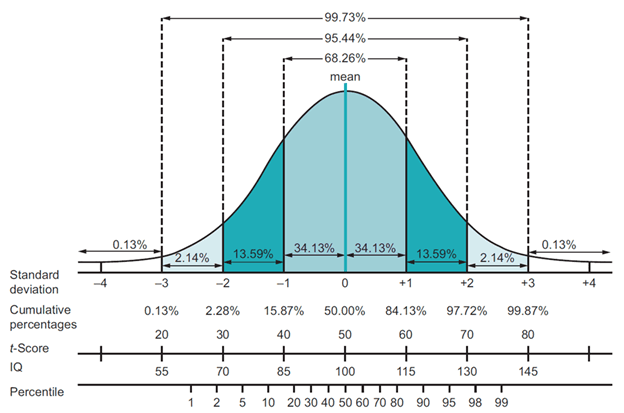
When graphed, IQ scores generally form a shape called a “normal distribution” (also informally called a “bell curve”), where the average is in the middle, and most examinees’ scores are near the middle. The further from the average a score is, the fewer people obtain that score. A picture of a normal distribution is shown below.


Most IQ tests have a scale that sets the average at 100 and a standard deviation of 15. (The standard deviation is a measure of how much scores are spread out from the average.) This means that 68% of the population has an IQ between 85 and 115 (that is, plus or minus 15 points from the average). 95% of the population has an IQ between 70 and 130, and almost everyone (99.73%) has an IQ between 55 and 145. In theory, IQ scores do not have a minimum or maximum, but functionally, there is little need for most IQ tests to measure IQ beyond 150 or so.
There is an important implication of using the normal distribution to interpret IQs: it means that IQ score is a relative measure of intelligence, not an absolute one. In other words,  scores take their meaning from how well a person performs, compared to others from their same age group.


IQ score ranges


For over 100 years, IQ test creators have proposed labels for ranges of IQ scores, and these are changed periodically. The table below displays the traditional labels for different IQ ranges and the current labels for the Wechsler tests:
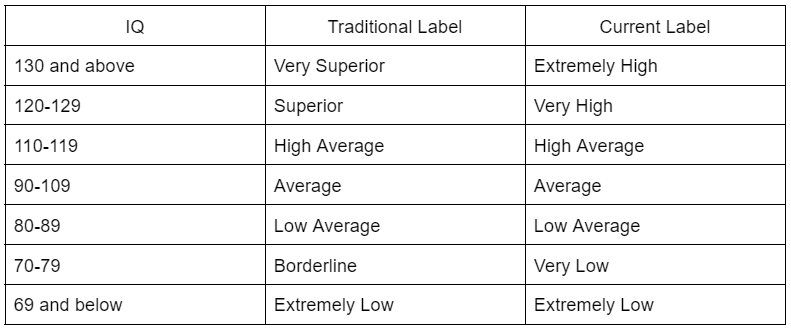
The change shown in the table is a good illustration of how the labels are arbitrary. The same is true with cutoffs for the ranges. In the past, other systems used different cutoffs and labels, such as “gifted” or “disabled.” Regardless of the system used, it is important to understand that it is the score receiving the label -- not the person.


What does my IQ score mean?


The score ranges and labels are helpful, but they are just a starting point. A reputable test will provide a detailed score report for examinees that help them gain an in-depth understanding of their IQ score and the other scores that a good test provides. If the IQ test is administered individually by a psychologist or clinician, then the examinee can realistically expect a verbal explanation and a chance to ask questions.

It is helpful to remember a few principles, though:

• The average IQ score is 100.

• About 2/3 of people have scores between 85 and 115. (Scoring within this range is typical.)

• 95% of people have scores between 70 and 130.

• A score of about 70 to 75 is the cutoff for an intellectual disability. Below this threshold, people have difficulty living independently.

• The minimum IQ for obtaining stable employment and functioning well in society is about 80 to 85.

• Professional jobs that require advanced education almost always have a minimum IQ of 110.

Higher scores are, generally, associated with better life outcomes.

Take our professional IQ test

Want to know your IQ? Try the first ever professional online IQ test.

Try our IQ test
Author
Dr. Russell T. WarneChief Scientist

Contact

Table of Contents

  • Characteristics of IQ
  • IQ score ranges
  • What does my IQ score mean?
Article Categories
All ArticlesUnderstanding IQ ScoresTaking an IQ TestRIOT-Specific InformationGeneral IQ & IntelligenceAdvanced Topics & ResearchIQ Scores & InterpretationMensa & High-IQ SocietiesOnline IQ Tests IQ Test Basics & FundamentalsAverage IQ & DemographicsFamous People & IQHistory & Origins Of IQ TestingAccuracy, Reliability & CriticismSpecial Population & Related ConditionsImproving IQ / PreparationSpecific IQ Tests & FormatsIQ Testing for HR & RecruitmentSkills Assessment
Related Articles
How Do People With High IQ Behave?IQ vs. Creativity: Does a High IQ Make a Person More Creative?Can a Person Have a High IQ and Low Emotional Intelligence?How to Interpret IQ Test ResultsRaw Score vs. Scaled Score on an IQ TestUnderstanding IQ Test Results: A Comprehensive GuideHow Do I Know My IQ Level?Why did my IQ score change?Measurement and IQ Score PropertiesAre Intelligence Tests Perfect?Are Intelligence Tests' Contents Trivial?The Impact of Motivation on IQ: Going… Going… (almost) GoneHow To Calculate IQThe Complete Guide to IQ Score CalculationImportance of a High IQHigh Giftedness and PersonalityHigh GiftednessIQ Scores and Differences Between GroupsInterpretation of an IQ Score
Take our IQ tests

Basic IQ Test

5 subtests + 5 cognitive abilities

Take the IQ test

Features

  • ~13 Minutes
  • IQ score
  • Cognitive abilities breakdown
  • ±5.6 IQ margin of error

5/15 Subtests

Learn more
Vocabulary
Matrix Reasoning
SToVeS
Visual Reversal
Symbol Search
Most comprehensive

Full IQ Test

15 subtests + all cognitive abilities

Take the IQ test

Features

  • ~52 Minutes
  • IQ score
  • Cognitive abilities breakdown
  • ±3.7 IQ margin of error

15/15 Subtests

Learn more
Vocabulary, Information, Analogies
Matrix Reasoning, Visual Puzzles, Figure Weights
Object Rotation, SToVeS, Spatial Orientation
Computation Span, Exposure Memory, Visual Reversal
Symbol Search, Abstract Matching
Simple Reaction Time, Choice Reaction Time
Compare all tests