Jun 26, 2026·Understanding IQ ScoresCan a Person Have a High IQ and Low Emotional Intelligence?
Does a high IQ mean low EQ? Uncover the science behind cognitive ability, emotional skills, and the genius myth. Read the guide and try the RIOT test!
Dr. Russell T. WarneChief Scientist
As someone who has spent over 15 years researching intelligence and creating the Reasoning and Intelligence Online Test (RIOT), I encounter this question regularly. The short answer is yes, it is entirely possible to score very well on an IQ test while struggling with recognizing, understanding, or managing emotions. IQ and what researchers call "emotional intelligence" are not the same construct, and they do not always move together. But the longer answer is more interesting, and it requires understanding what IQ actually measures, what emotional intelligence claims to measure, and how much these two constructs overlap according to the research. A lot of misinformation circulates on this topic, including exaggerated claims about emotional intelligence and unfounded stereotypes about people with high IQs. Separating fact from fiction is essential.
What Does IQ Actually Measure?
IQ tests measure general cognitive ability, which involves reasoning, problem solving, abstract thinking, learning quickly, and applying knowledge. According to a consensus statement signed by over 50 leading intelligence researchers, intelligence is "a very general mental capability that, among other things, involves the ability to reason, plan, solve problems, think abstractly, comprehend complex ideas, learn quickly and learn from experience" (Gottfredson, 1997, p. 13). Most modern IQ tests are based on the Cattell-Horn-Carroll (CHC) theory, which organizes cognitive abilities into a hierarchy with a general factor (g) at the top and more specific abilities below it. The content of IQ tests varies widely from one test to another, and no single task appears on all tests. Charles Spearman recognized this over a century ago with his principle of "the indifference of the indicator," which holds that it does not matter what tasks appear on a test, as long as they require thinking, reasoning, and judgment (Johnson et al., 2004). What IQ tests are not designed to measure is how well a person recognizes facial expressions, manages frustration, or navigates a socially complex meeting. Those abilities fall outside the scope of cognitive testing, and every major test creator acknowledges this limitation openly.
What Is Emotional Intelligence?
The concept of emotional intelligence (EI) gained widespread attention after Daniel Goleman's 1995 bestseller Emotional Intelligence: Why It Can Matter More Than IQ. But the scientific concept predates the popular book. Psychologists John Mayer and Peter Salovey first proposed a formal model in 1990, defining EI as a set of abilities involving the capacity to perceive emotions accurately, use emotions to facilitate thought, understand emotions, and manage emotions.
Since then, the field has split into multiple competing frameworks, which is part of what makes evaluating EI so complicated. There are three main approaches: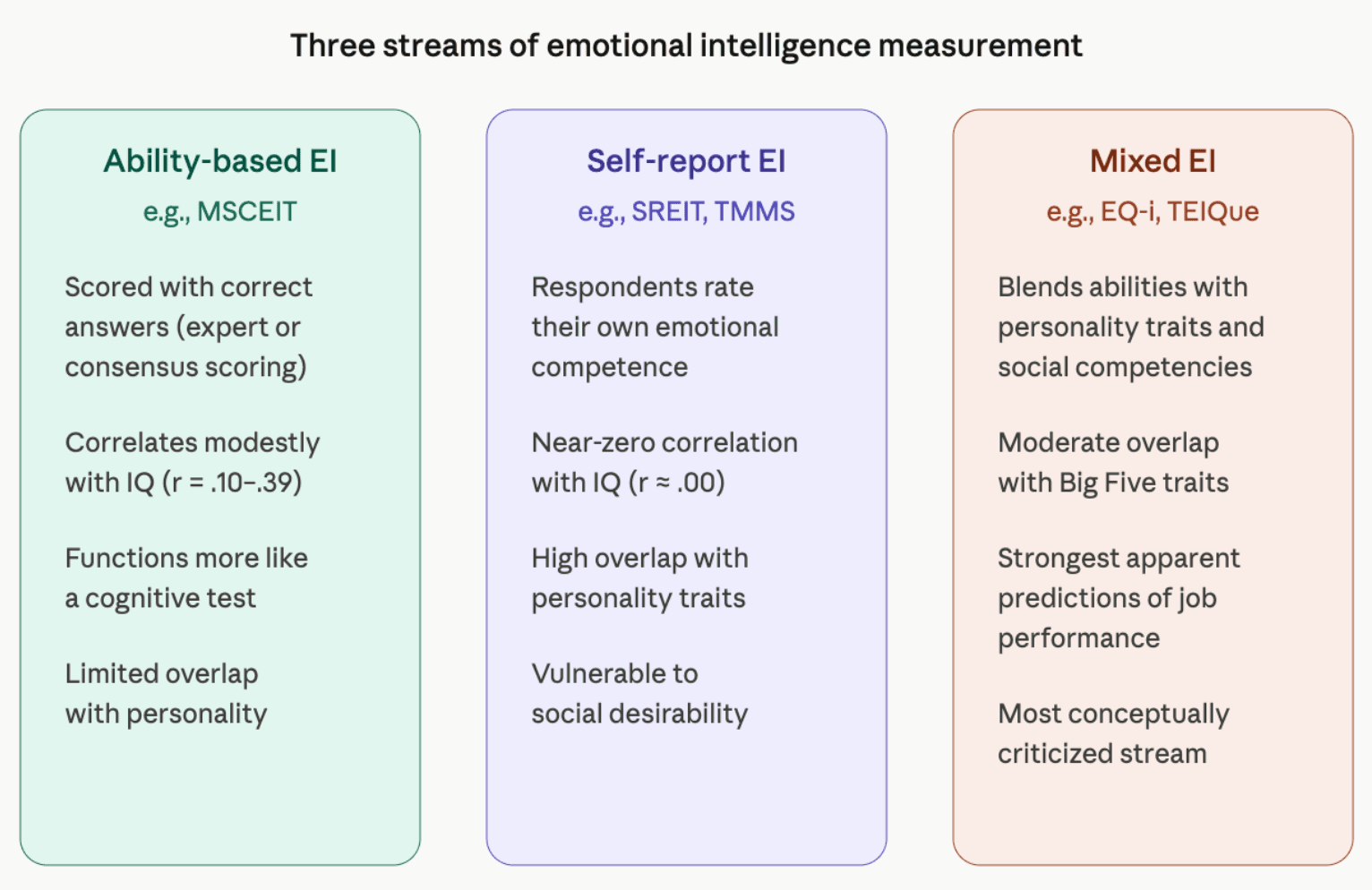
The distinction among these three streams matters enormously for answering the question of whether IQ and EI can diverge. A meta-analysis by Joseph and Newman (2010) in the Journal of Applied Psychology found that correlations between MSCEIT scores and cognitive ability ranged from r = .10 to .39, depending on the specific EI branch being measured. That is a real correlation, but it is far from perfect. Self-report EI, by contrast, showed a correlation of r = .00 with IQ in the same meta-analysis. A person's belief about their emotional competence has almost nothing to do with how quickly they can solve abstract problems.
Can IQ and Emotional Intelligence Diverge?
The data makes the answer clear. Because IQ and EI are only weakly correlated at best, there is plenty of room for divergence. A person can have very high cognitive ability while scoring low on EI measures, and vice versa.
The key reason is that IQ and EI tap into different psychological systems. IQ tests measure cognitive processing: reasoning through novel problems, holding information in working memory, detecting patterns, and retrieving learned knowledge. Ability-based EI tests measure a narrower set of skills involving the processing of emotional information specifically, such as identifying what emotion a face is displaying or predicting how a person's feelings might change after receiving bad news. These tasks have a cognitive component (which explains the modest correlation with IQ), but they also draw on emotional knowledge and social experience that traditional IQ tests do not assess.
Self-report EI captures something different still: a person's subjective assessment of their own emotional functioning, which overlaps heavily with personality traits, particularly agreeableness, extraversion, and low neuroticism (Miao et al., 2017). A person who is introverted, high in neuroticism, or simply not very self-aware might score low on a self-report EI measure regardless of their cognitive ability.
The "Troubled Genius" Stereotype
One reason this question is so popular is the widespread cultural belief that very smart people are socially awkward, emotionally stunted, or psychologically troubled. The "mad scientist" and "absent-minded professor" stereotypes are deeply embedded in popular culture. Some writers have even claimed that high IQ creates its own emotional and psychological problems, such as heightened sensitivity or social isolation.
The research does not support this narrative. A large meta-analysis by Fries and colleagues (2025) published in Communications Psychology examined 49 studies with a combined sample of over 2.9 million participants. The findings showed that lower IQ in early life was associated with a 22% higher risk of later mental and physical illness. Higher intelligence was protective, not harmful. That result aligns with decades of prior research showing that people with higher IQ scores generally have better mental health, lower rates of depression, and greater psychological adjustment. There is no compelling evidence that high IQ leads to a unique "inner psychological experience" that makes people more emotionally fragile. Claims about "overexcitabilities" in gifted populations are popular in some educational circles, but the data from population-representative studies (as opposed to self-selected samples of Mensa members or clinic referrals) consistently shows that high IQ is associated with better adjustment, not worse.
This matters for the question at hand. If someone has a high IQ and struggles with emotional regulation, the explanation is unlikely to be their intelligence itself. More likely, the explanation lies in personality traits, life experiences, social skill development, or clinical factors like autism spectrum traits or attention difficulties, all of which can co-occur with high IQ but are not caused by it.
What the Overlap (and Lack Thereof) Tells Us
The statistical relationship between IQ and emotional intelligence is informative. Let me put the numbers in perspective: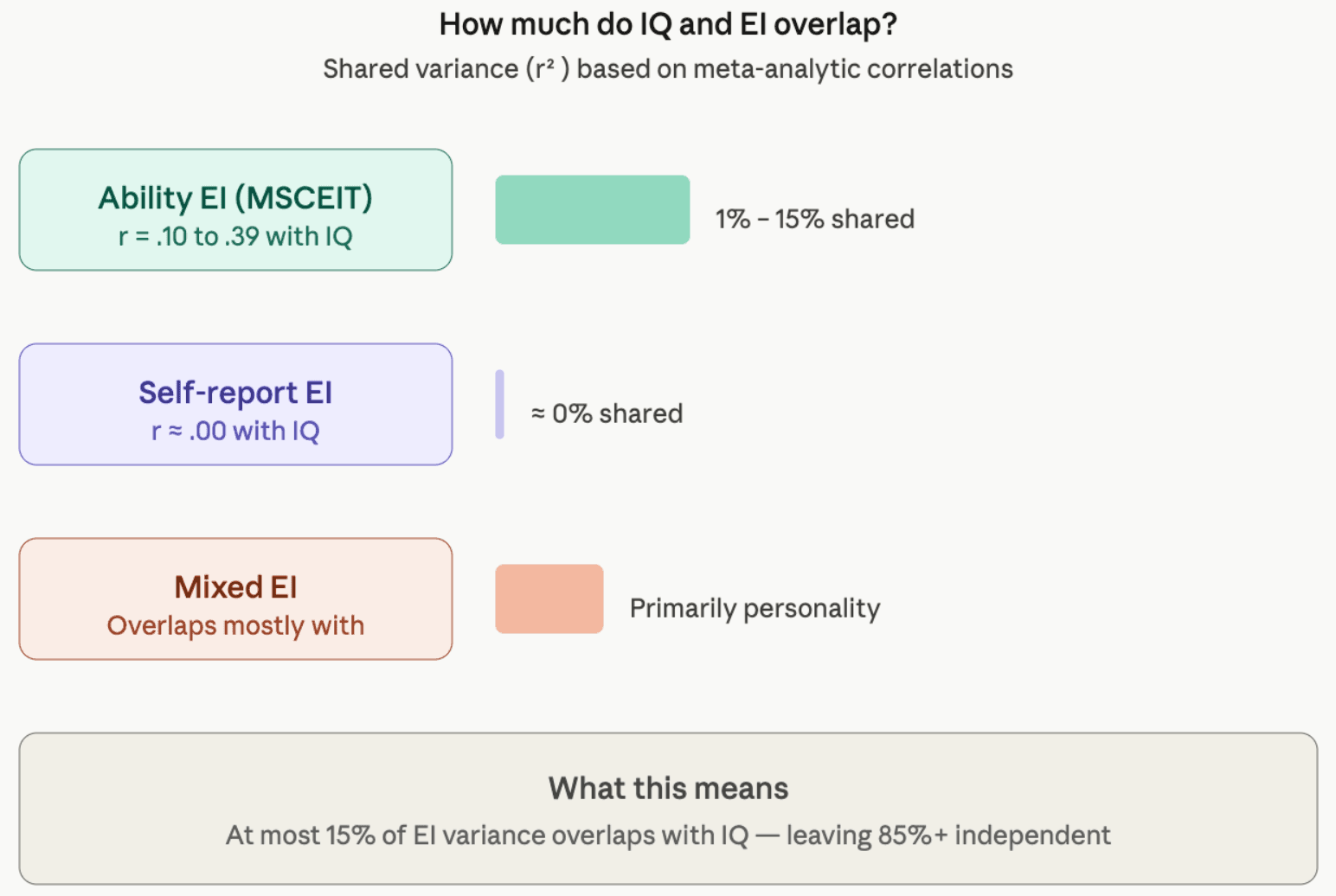 When the highest reported correlation between ability-based EI and IQ translates to roughly 15% shared variance, the practical implication is straightforward: the vast majority of what an EI test measures has nothing to do with performance on an IQ test. Having a high IQ provides no guarantee of high emotional intelligence, and scoring low on EI does not imply low cognitive ability.
Does High IQ Compensate for Low Emotional Intelligence?
This is a separate question, but an important one. If a person has high IQ but low EI, does the IQ make up for the deficit? The answer depends on the context.
In academic settings, IQ is one of the strongest predictors of performance. A meta-analysis by MacCann and colleagues (2020) published in Psychological Bulletin found that ability-based EI predicted academic performance with a corrected correlation of ρ = .24, while self-report EI showed a weaker association (ρ = .12). After controlling for IQ and Big Five personality traits, ability EI explained an additional 1.7% of variance in academic outcomes, and mixed EI contributed 2.3%. These are statistically significant contributions, but they are small. IQ remains the dominant cognitive predictor in educational settings, and a student with high IQ but low EI will almost always outperform academically compared to a student with the reverse profile. In the workplace, the picture is somewhat more complicated. O'Boyle and colleagues (2011) published a meta-analysis in the Journal of Organizational Behavior finding that all three streams of EI showed corrected correlations with job performance ranging from .24 to .30. However, the extent to which EI predicts performance beyond IQ and personality remains disputed. Some researchers have shown that EI has incremental validity after controlling for personality (Andrei et al., 2016), while others have found that the apparent predictive power of mixed EI is largely attributable to its overlap with well-established personality traits and cognitive ability. In jobs requiring frequent emotional labor, such as customer service, counseling, or sales, emotional competencies may matter more. In jobs that are primarily cognitive, such as software engineering, research, or financial analysis, IQ dominates, and lower EI is less consequential.
The Measurement Problem
One of the most important points to understand about emotional intelligence is that the measurement challenges are far more significant than those facing IQ testing. IQ tests have been refined for over 120 years, have robust psychometric properties, and produce scores that are stable, reliable, and predictive of real-world outcomes across education, employment, health, and other domains.
EI measurement is much younger and much less settled. A meta-analysis by Van Rooy and Viswesvaran (2004) found that the MSCEIT correlated only r = .14 with self-report EI measures across 13 studies. If two types of test that claim to measure the same construct correlate at .14, it raises serious questions about whether they are measuring the same thing at all. For comparison, different IQ tests typically correlate with each other in the range of r = .70 to .90. This measurement fragmentation means that when someone is told they have "low emotional intelligence," the meaning of that label depends entirely on which test was used. A low score on a self-report measure might reflect introversion or high neuroticism rather than any deficit in emotional processing. A low score on the MSCEIT might reflect limited social exposure or unfamiliarity with the test format. Neither result carries the same interpretive clarity as a professionally administered IQ test.
Why This Question Matters
Beyond academic curiosity, this question has practical implications. Some employers and educational programs have adopted EI assessments with the assumption that EI captures something IQ misses, and that a high-IQ employee with low EI might be a poor hire. The research suggests caution with that reasoning.
The incremental prediction that EI provides above and beyond IQ and personality is, in most contexts, small. The measurement of EI is inconsistent across instruments, making it difficult to compare scores from different tests or to build a coherent evidence base. None of this means that social and emotional skills are unimportant. They clearly matter in daily life, interpersonal relationships, and many occupational roles. But the scientific construct of "emotional intelligence" is still maturing, and it does not yet rest on the same empirical foundation as cognitive intelligence. Treating a low EI score as if it carries the same diagnostic weight as a low IQ score is not supported by the evidence.
Putting It All Together
Can a person have a high IQ and low emotional intelligence? Absolutely. The statistical independence between IQ and most EI measures means this combination is routine in the data, not exceptional. A person who excels at abstract reasoning and verbal comprehension can simultaneously struggle with reading other people's emotions or managing stress.
But this combination does not mean what popular culture often implies. When a particular high-IQ individual does struggle emotionally, the cause is more likely attributable to personality traits, clinical conditions, or life circumstances than to their intelligence itself. IQ tests are designed to measure one important domain of human functioning, cognitive reasoning, and they do it very well. Understanding how well a person perceives or manages emotions requires different tools, and those tools are still being refined by the scientific community.
Take the First-Ever Professional Online IQ Test
For anyone interested in a scientifically grounded assessment of their cognitive abilities, the Reasoning and Intelligence Online Test (RIOT) is the first online IQ test that meets professional standards for psychological assessment. It was created by Dr. Russell Warne, who has over 15 years of experience in intelligence research and is the author of In the Know: Debunking 35 Myths about Human Intelligence (Cambridge University Press). What makes the RIOT different from the countless online IQ tests found with a quick internet search? Most of those tests are created by amateurs without proper training in psychometrics. The RIOT clearly stands out as the first-ever professional online IQ test. The RIOT underwent the same rigorous development process as traditional in-person IQ tests used by psychologists, including expert review, the first-ever proper U.S.-based online norm sample, and compliance with educational and psychological testing standards from APA, AERA, and NCME.
References
Andrei, F., Siegling, A. B., Aloe, A. M., Baldaro, B., & Petrides, K. V. (2016). The incremental validity of the Trait Emotional Intelligence Questionnaire (TEIQue): A systematic review and meta-analysis. Journal of Personality Assessment, 98(3), 261–276. https://doi.org/10.1080/00223891.2015.1084630 Fries, J., Oberleiter, S., Bodensteiner, F. A., Fries, N., & Pietschnig, J. (2025). Multilevel multiverse meta-analysis indicates lower IQ as a risk factor for physical and mental illness. Communications Psychology, 3, 74. https://doi.org/10.1038/s44271-025-00245-2 Gottfredson, L. S. (1997). Mainstream science on intelligence: An editorial with 52 signatories, history, and bibliography. Intelligence, 24(1), 13–23. https://doi.org/10.1016/S0160-2896(97)90011-8 Joseph, D. L., & Newman, D. A. (2010). Emotional intelligence: An integrative meta-analysis and cascading model. Journal of Applied Psychology, 95(1), 54–78. https://doi.org/10.1037/a0017286 MacCann, C., Jiang, Y., Brown, L. E. R., Double, K. S., Bucich, M., & Minbashian, A. (2020). Emotional intelligence predicts academic performance: A meta-analysis. Psychological Bulletin, 146(2), 150–186. https://doi.org/10.1037/bul0000219 Miao, C., Humphrey, R. H., & Qian, S. (2017). Are the emotionally intelligent good citizens or counterproductive? A meta-analysis of emotional intelligence and its relationships with organizational citizenship behavior and counterproductive work behavior. Personality and Individual Differences, 116, 144–156. https://doi.org/10.1037/bul0000078 O'Boyle, E. H., Humphrey, R. H., Pollack, J. M., Hawver, T. H., & Story, P. A. (2011). The relation between emotional intelligence and job performance: A meta-analysis. Journal of Organizational Behavior, 32(5), 788–818. https://doi.org/10.1002/job.714 Warne, R. T. (2020). In the know: Debunking 35 myths about human intelligence. Cambridge University Press. https://doi.org/10.1017/9781108593298
Take our professional IQ test
Want to know your IQ? Try the first ever professional online IQ test.
AuthorDr. Russell T. WarneChief Scientist
