Stop relying on fake online quizzes. Learn exactly what an IQ score measures, how it is calculated, and how to find a legitimate online IQ test like RIOT IQ.
Dr. Russell T. WarneChief Scientist
Share
Knowing your actual IQ level begins with a simple reality: it is not self-evident. You cannot accurately estimate it from your academic grades, career success, or informal self-reflection. The only reliable way to determine your cognitive baseline is to take a properly developed intelligence test. Everything else—from guessing based on standardized test scores to taking informal online quizzes—produces a vague impression rather than a scientific measurement. Understanding what an IQ score actually represents, how it is calculated, and what it means for your life requires a look at the science of psychological testing.
What does an IQ score actually measure?
IQ, short for "intelligence quotient," is the numerical score produced by an intelligence test. It is crucial to recognize that the score is not the exact same thing as intelligence itself, just as a temperature reading on a thermometer is not the same thing as heat.
Leading researchers define intelligence as a very general mental capability that involves the ability to reason, plan, solve problems, think abstractly, comprehend complex ideas, and learn from experience. IQ is simply the metric used to express how much of that general capability you demonstrate relative to other people your age.
This relative nature is the core of the measurement. Most professional tests set the average score at 100 with a standard deviation of 15 points. This statistical framework means that roughly two-thirds of the population will score between 85 and 115. A score above 100 indicates above-average cognitive performance relative to your peers, while a score below 100 indicates below-average performance. The result does not represent an absolute limit on your cognitive abilities; it simply maps where you fall in the general distribution.
How is an IQ score calculated?
Modern assessments use what is known as a deviation IQ. Instead of dividing mental age by chronological age—which was the original formula used in the early twentieth century—today's tests compare your raw performance on a battery of cognitive tasks against a large reference group known as a norm sample.
The number of standard deviations you score above or below that sample's average is then converted to the standard IQ scale. Because this comparison is always made within your specific age group, your score translates directly to a percentile. For instance, scoring better than 84 out of 100 people your age places you in the 84th percentile, yielding an IQ of approximately 115. Scoring in the 98th percentile results in an IQ of approximately 130. This means a twenty-five-year-old and a fifty-year-old can both have an IQ of 100, despite having vastly different levels of accumulated life experience and knowledge.
What methods are used to measure IQ?
Intelligence is generally measured in one of three contexts: individual clinical administration, group testing, and online assessment.
Individually administered tests, such as the Wechsler Adult Intelligence Scale (WAIS) and the Stanford-Binet Intelligence Scales, are widely considered the gold standard. A trained clinical psychologist administers the test face-to-face, ensuring optimal testing conditions and observing your problem-solving behaviors. These assessments are incredibly comprehensive, but they are also expensive and require scheduling time with a qualified professional.
Group-administered tests are frequently used in educational placement or corporate employment screening. While they are efficient and allow organizations to evaluate many people at once, they sacrifice the depth and nuance of a one-on-one clinical evaluation.
Online IQ tests represent a modern category that varies wildly in quality. The vast majority of internet quizzes are created by individuals with no formal training in psychometrics, lacking documented reliability or a valid norm sample. However, professional-grade exceptions exist. The Reasoning and Intelligence Online Test (RIOT) is the first digital assessment designed to meet the rigorous joint standards of the American Educational Research Association, the American Psychological Association, and the National Council on Measurement in Education. Developed by Dr. Russell Warne, an expert with over fifteen years of intelligence research experience, the RIOT was normed on a representative United States sample. It provides an overall IQ alongside specific index scores across domains like Fluid Reasoning, Spatial Ability, and Working Memory.
How can one tell if an IQ test is legitimate?
Because not every test that claims to measure IQ actually does so reliably, you must evaluate the source before trusting the score.
First, look at who created the instrument. Professional test developers are trained in the science of psychological measurement and proudly attach their names and credentials to their work. Anonymous tests should be avoided, as anonymity eliminates any accountability for the accuracy of the data.
Second, verify that the test utilizes a representative norm sample. Because IQ is a relative metric, your score is only meaningful when compared against an appropriate group. Free quizzes that norm their scores based on whoever happens to visit their website produce highly distorted, untrustworthy comparisons.
Finally, check if the test was developed to meet recognized professional standards. Legitimate assessments will explicitly document their adherence to guidelines published by organizations like the APA, ensuring the test demonstrates proven reliability, validity, and fairness.
What do the numbers actually mean?
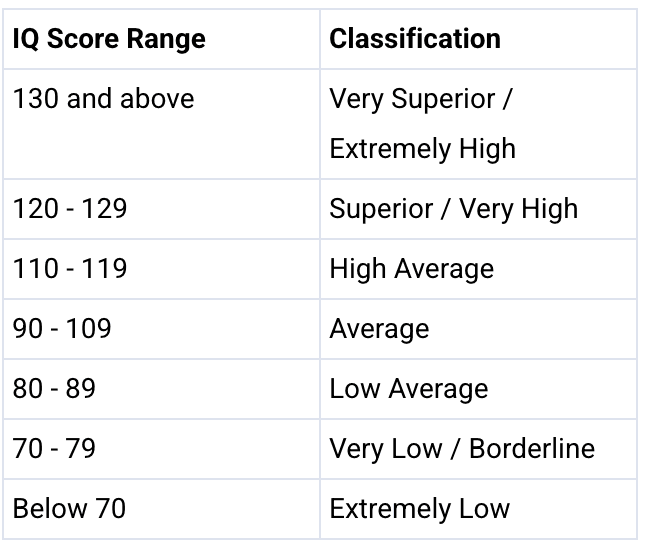
Once you obtain a legitimate score, interpreting it requires context. Professional psychologists typically classify IQ scores using the following ranges:
While these labels are useful reference points, they come with caveats. The boundaries are statistically arbitrary; a score of 109 and a score of 111 are not meaningfully different in the real world because they fall within each other's margin of error. Furthermore, a single IQ score is best understood as a point estimate rather than a permanent, immutable brand. Scores can fluctuate slightly across different testing days due to testing conditions, natural measurement error, and practice effects.
Does knowing one's IQ level have practical value?
For most people, obtaining a professional IQ score provides profound and practical self-knowledge. Intelligence is one of the most heavily researched traits in psychology, showing well-documented correlations with academic performance, occupational outcomes, and various life circumstances. Understanding your specific cognitive profile—meaning the unique pattern of your mental strengths and weaknesses—helps you make highly informed decisions about your career path, your educational pursuits, and the types of environments where you will naturally thrive.
However, an IQ score does not determine your destiny. It is a statistical predictor of tendencies, not a hard ceiling on your individual potential. Motivation, conscientiousness, domain-specific knowledge, and opportunity all play massive roles in shaping what you ultimately accomplish. The true value of knowing your IQ lies in having an accurate map of your cognitive baseline, allowing you to navigate your life with clarity rather than treating the number as a final verdict.
Watch “What Does an IQ Test Measure?” with Dr. Russell T. Warne on the Riot IQ YouTube channel to understand how IQ levels are determined through structured cognitive testing.
Take our professional IQ test
Want to know your IQ? Try the first ever professional online IQ test.