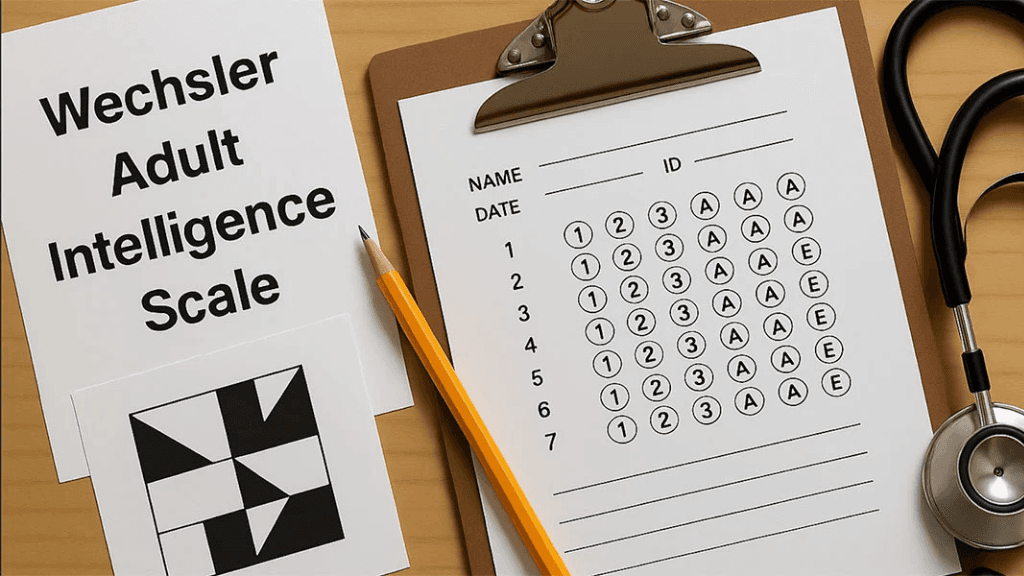
Created by David Wechsler in 1955, the WAIS introduced the deviation IQ. Learn how this gold standard test replaced the Stanford-Binet and evolved into the WAIS-V.
Dr. Russell T. WarneChief Scientist
Share
The Wechsler Adult Intelligence Scale (WAIS) is one of the most widely used individually administered IQ tests for adults. Developed in the mid-20th century by psychologist David Wechsler, the WAIS has undergone multiple revisions and remains a gold standard in clinical and research settings.
Who Created the WAIS?
David Wechsler (1896-1981) was a Romanian-American psychologist who made foundational contributions to intelligence testing. After working with the U.S. Army during World War I, administering group intelligence tests, Wechsler pursued graduate studies and eventually became chief psychologist at Bellevue Psychiatric Hospital in New York City.
Wechsler grew dissatisfied with existing intelligence tests, particularly the Stanford-Binet, which he felt was too heavily weighted toward verbal abilities and designed primarily for children. In 1939, he published the Wechsler-Bellevue Intelligence Scale, designed specifically for adults and introducing several innovations that would shape intelligence testing for decades.
The Wechsler-Bellevue was revised and renamed the Wechsler Adult Intelligence Scale in 1955. Subsequent revisions appeared in 1981 (WAIS-R), 1997 (WAIS-III), 2008 (WAIS-IV), and 2024 (WAIS-V), with each version updating norms, refining theoretical foundations, and improving psychometric properties. For more on how IQ testing developed, see our article on thehistory of IQ tests.
What Innovations Did Wechsler Introduce?
Wechsler's most significant contribution was the deviation IQ scoring system that is now universal. Earlier tests used the "quotient IQ" formula (mental age divided by chronological age, multiplied by 100), which worked poorly for adults. Wechsler's approach instead compares an individual's performance to others of the same age, expressing the result as a score with an average of 100 and a standard deviation of 15. Our article on how to calculate IQ explains this scoring system in detail.
Wechsler also created separate verbal and nonverbal (performance) scales within a single test, allowing clinicians to compare an individual's abilities across domains and identify patterns that might indicate learning disabilities, brain injuries, or other conditions. This distinction between verbal and nonverbal intelligence remains central to modern cognitive assessment.
Additionally, Wechsler designed tests specifically for the populations they would assess. The WAIS was created for adults, while separate tests, such as the Wechsler Intelligence Scale for Children (WISC) and the Wechsler Preschool and Primary Scale of Intelligence (WPPSI), were developed for younger age groups, recognizing that appropriate content and norms differ across developmental stages.
What Does the WAIS Measure?
The current version (WAIS-V, released in 2024) is grounded in the Cattell-Horn-Carroll (CHC) theory of intelligence, which organizes cognitive abilities into a hierarchy. The test produces a Full Scale IQ (FSIQ) representing overall cognitive ability, along with index scores measuring specific cognitive domains.
Verbal Comprehension assesses the ability to understand and express verbal information through subtests like Similarities (identifying how two concepts are alike) and Vocabulary (defining words). Fluid Reasoning measures the ability to solve novel problems without relying on prior knowledge through Matrix Reasoning (identifying patterns in visual grids) and Figure Weights (determining which option balances a scale based on quantitative relationships).
Visual Spatial abilities are assessed through Block Design (arranging blocks to match a pattern) and Visual Puzzles (identifying which pieces combine to form a target image). Working Memory is measured through Digit Span (repeating number sequences forward, backward, and in ascending order) and Picture Span (remembering sequences of images). Processing Speed is assessed through Coding (matching symbols to numbers using a key) and Symbol Search (indicating whether target symbols appear in a search group).
How Is the WAIS Administered?
The WAIS requires individual administration by a trained examiner working one-on-one with the examinee. Administration typically takes 60 to 90 minutes for the core battery, with additional time required if supplemental subtests are included. The examiner presents tasks verbally or visually, records responses, follows standardized procedures to ensure consistency, and observes the examinee's behavior and problem-solving approach.
Only qualified professionals can administer the WAIS, usually licensed psychologists or supervised trainees with appropriate graduate-level training in psychological assessment. The test materials are restricted and unavailable for purchase by the general public. After administration, the examiner scores responses according to detailed criteria, converts raw scores to scaled scores using age-appropriate norms, calculates index scores and Full Scale IQ, and prepares a comprehensive report interpreting the results.
Who Takes the WAIS?
The WAIS is designed for adults aged 16 to 90 years and serves different purposes across various settings. In clinical contexts, psychologists administer it as part of comprehensive psychological evaluations to diagnose intellectual disabilities, identify cognitive effects of brain injuries or neurological conditions, assess cognitive changes associated with aging or dementia, and evaluate functioning in individuals with psychiatric conditions.
Educational settings use the WAIS to assess adults seeking accommodations for learning disabilities or to evaluate cognitive abilities in college students and adults returning to education. In forensic contexts, the test frequently appears in legal proceedings, determining competency to stand trial, assessing intellectual disability in capital cases, evaluating cognitive functioning for disability claims, or providing evidence in civil litigation. Researchers also use the WAIS as a criterion measure for validating other cognitive tests and for studying intelligence across the lifespan.
What Are the Strengths of the WAIS?
The WAIS benefits from an extensive research base, having been used in thousands ofstudies over decades. This vast literature on psychometric properties, clinical applications, and relationships with other variables provides confidence in interpreting scores.
Each revision is normed on a large, representative sample carefully selected to match U.S. Census demographics for age, sex, race/ethnicity, education level, and geographic region. This rigorous norming ensures that scores accurately reflect standing relative to the population.
The combination of global and specific scores provides clinical utility by identifying cognitive patterns associated with various conditions: discrepancies between index scores can suggest specific learning disabilities, neurological conditions, or other clinically relevant patterns. Detailed standardized procedures ensure that all examinees receive the same testing experience, making scores comparable across individuals, settings, and time points.
What Alternatives Exist for Adults Seeking IQ Testing?
Adults interested in measuring cognitive abilities have options beyond the WAIS. Clinical evaluation by a psychologist provides the most comprehensive assessment, including not only IQ testing but also evaluation of personality, emotional functioning, and other relevant factors. This option is appropriate when diagnostic questions are involved or when results will be used for clinical, educational, or legal purposes.
For individuals seeking accurate IQ measurement without clinical evaluation, theReasoning and Intelligence Online Test (RIOT) measures the same cognitive domains as the WAIS (verbal reasoning, fluid reasoning, spatial ability, working memory, and processing speed) using task formats with strong research support. Developed by Dr. Russell T. Warne with over 15 years of experience in intelligence research, the RIOT meets professional standards established by the American Educational Research Association, American Psychological Association, and the National Council on Measurement in Education.
The RIOT uses a representative U.S. norm sample, reports confidence intervals acknowledging measurement precision, and provides detailed cognitive profiles across multiple ability domains.
Watch “IQ Explained in 8 Minutes: The Truth About IQ (And Why It Matters)” on the Riot IQ YouTube channel to understand where the WAIS fits within modern intelligence testing.
Take our professional IQ test
Want to know your IQ? Try the first ever professional online IQ test.