IQ tests for kids: Discover how real children’s IQ tests (WISC, Stanford-Binet) work, why they compare kids only to same-age peers, and the best age to test for accurate results. No online quiz can replace a professional assessment.
Dr. Russell T. WarneChief Scientist
Share
IQ tests measure how well a person reasons, learns, and solves problems compared to others of the same age. This is true for children and adults. These abilities are widely accepted by most psychologists as some of the most important components of general intelligence, or g. Because children’s minds develop rapidly, their performance on cognitive tasks changes as they grow, which makes the comparison with same-age peers particularly important for children.
The first intelligence tests, developed by Alfred Binet and Théodore Simon in the early 1900s, were created to identify children who might need extra academic support. Binet’s key insight was that children’s mental abilities improved with age, and that a child performing like younger peers were likely having more difficulty learning than typical. This principle remains central today, even though the scoring system has changed.
How Children’s IQ Is Measured Today
Professional IQ tests for children, such as the Wechsler Intelligence Scale for Children (WISC) or the Stanford-Binet, include a range of subtests that measure reasoning, vocabulary, working memory, and processing speed. Each subtest contributes to an overall IQ score while also providing specific insights into a child’s cognitive strengths and weaknesses. For example, a child might excel in reasoning tasks but find verbal comprehension more challenging.
These results help psychologists, educators, and parents understand how a child learns best. IQ scores can inform educational planning, identify giftedness, or help diagnose learning difficulties. Yet they are only part of a larger picture. Emotional maturity, motivation, and other factors all influence how children perform at school, and none of these are captured by an IQ score alone.
The Role of Development and Environment
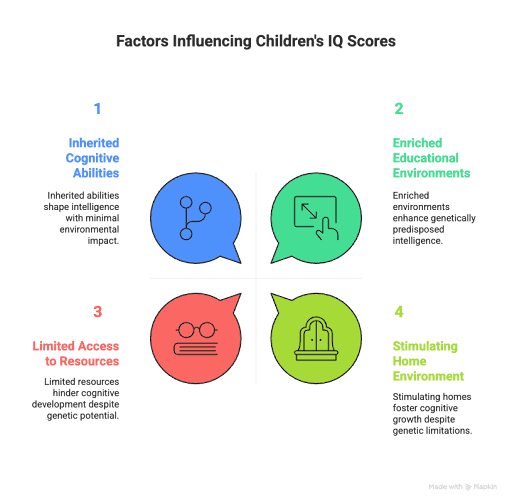
Children’s IQ scores are influenced by both genetics and environment. Research in behavioral genetics consistently shows that intelligence is partly heritable, but environmental quality, especially during early childhood, has a major impact. Access to good nutrition, reading materials, and cognitively stimulating home environments all support the development of reasoning skills that IQ tests measure.
One surprising finding has been that environment tends to matter less (and genes matter more) as children age. In early childhood (before about age 8), environmental influences dominate in determining children’s IQ. By adolescence, genes are the more powerful influence on IQ. This is one of the reasons why IQ tends to be less stable in early childhood than it is later, and it is why children tested at young ages should be retested a few years later.
Using IQ Tests Responsibly
Professional IQ testing follows strict ethical and scientific standards established by organizations like the American Psychological Association (APA) and the American Educational Research Association (AERA). Currently, there is no online IQ test that meets professional standards for measuring IQ in children. Only tests administered by qualified professionals and/or school personnel should be used to estimate IQ in children.
A valid IQ assessment also depends on comparing the child’s score to a properly selected norm sample. If the reference group is not representative of the child’s population, the resulting score loses its meaning. This is why legitimate test developers publish technical documentation showing how their norm groups were chosen and how the tests were standardized.
Ultimately, IQ tests for kids provide valuable information about how children think, learn, and reason. They are not ironclad predictors that determine a child’s life path. But they are scientific tools that help professionals understand developmental strengths and challenges. When administered properly and interpreted responsibly, they can guide decisions that support each child’s growth.
Watch “The Hidden Problem in Every Classroom: Why Teaching by Age Doesn’t Work” with Karen Rambo-Hernandez on the Riot IQ YouTube channel to see how intelligence testing can reveal overlooked potential in children.
Take our professional IQ test
Want to know your IQ? Try the first ever professional online IQ test.