🇺🇸The official website of Riot IQ
Log in
  • Home
  • About

Measure your
intelligence online.

Google

Assessments

  • All IQ Tests
  • Basic IQ Test
  • Full IQ Test
  • Custom IQ Test
  • Free IQ Test

Our Socials

  • X
  • YouTube
  • Facebook
  • LinkedIn

Other IQ Tests

  • WAIS-V
  • SB-5
  • Raven's 2
  • RIAS-2
  • CogAT 9
  • WISC-V

Community

  • Join Subreddit
  • Join Discord

Other Pages

  • Test Manual
  • Administer IQ Tests
  • About Us
  • Articles
  • Data
  • FAQ

Research

  • What do polygenic scores really predict?
  • Working speed and ability on the RIOT

Intelligence Journals & Organizations

  • Human Intelligence Research & Education (HIRE) Foundation
  • International Society for Intelligence Research (ISIR)
  • Intelligence & Cognitive Abilities Journal (ICA)
  • Intelligence Journal
  • Mensa Foundation

Contact

  • Email
  • Support

News & Press

  • International Society for Intelligence Research
  • American Thinker
  • Mensa Foundation (1/2)
  • Mensa Northern New Jersey
  • The University of Western Australia
  • Prolific
  • Quillette
  • Brainz

Our Articles

  • Gmatclub (1/2)
  • ApolloTechnical
  • LessWrong
  • Psychreg
  • Study in Switzerland
  • SuccessConsciousness
  • Creative Organizational Design (1/2)
  • ABNewsWire
  • Vanderbilt University

Our Articles

  • The Globe and Mail
  • Barchart
  • Journal
  • Mensa Foundation (2/2)
  • Psychologs
  • Creative Organizational Design (2/2)
  • AZBigMedia
  • Thoughts on Life and Love
  • Anxiety and Depression Association of America

Our Articles

  • Before It's News
  • Siglo XXI
  • TechBullion
  • Medium
  • Gmatclub (2/2)
  • MSN
  • National Review
  • Minding the Campus
  • Launching Next

Our Articles

  • Comparing Cronbach’s Alpha and McDonald’s Omega Reliability
  • Breaking the Intelligence & IQ Taboo
  • What is the Flynn Effect?
  • A Comprehensive History of IQ Tests
  • The 15 Subtests of the RIOT

Our Articles

  • How to Take an IQ Test
  • How to Calculate IQ
  • What is the RIOT IQ Test?
  • The Pro-Human Aspects of Intelligence Research
  • What is an IQ Test? A Beginner's Guide.

Our Articles

  • 5 Best IQ Tests in 2025
  • Cognitive Profiles on the RIOT IQ Test Results
  • 6 Cognitive Abilities of the RIOT
  • Are There Any Professional and Real Online IQ Tests?

Our Articles

  • Resources to Learn About IQ and Intelligence
  • Studying IQ Matters
  • The Search for Albert Einstein's IQ
  • Do Non-g Gains from the Flynn Effect Matter?

Riot IQ © 2026

  • Terms of Service
  • Privacy Policy
  • BAA Agreement
  • Test Administrator Terms
  • Terms of Service
  • •Privacy Policy
  • •BAA Agreement
  • •Test Administrator Terms

Table of Contents

  • Procedure for assigning people to profiles:
May 1, 2025·RIOT-Specific Information

Cognitive Profiles on the RIOT IQ Test Results

Explanation of the RIOT IQ test results cognitive profiles
Robert Co-Founder
Share
Cognitive Profiles on the RIOT IQ Test Results
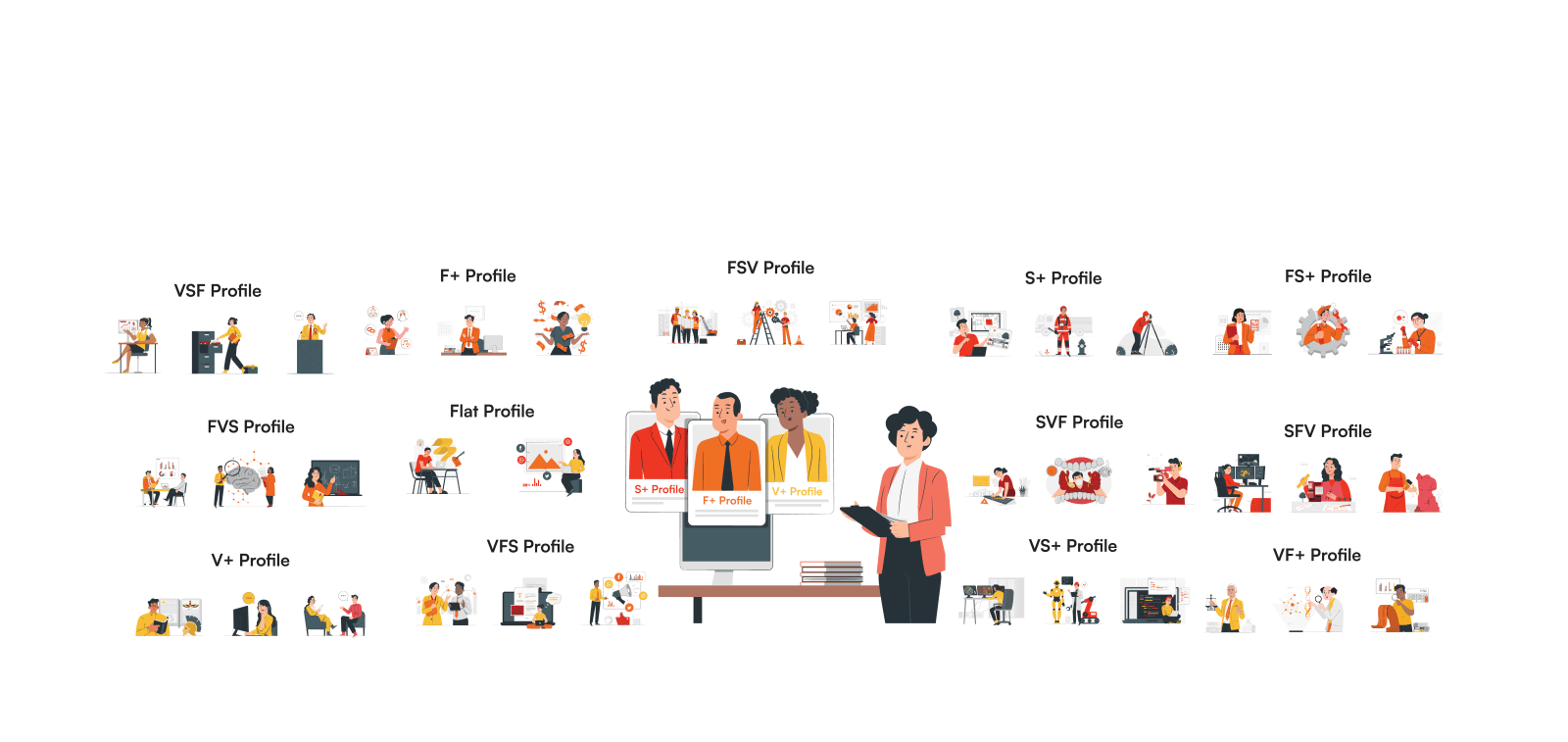
For many years, test developers have recognized that IQ is not the only important score to interpret. Scores from narrower cognitive abilities matter a great deal, too, because they reveal more information than an overall IQ can. This pattern of scores--called a "cognitive profile"--describes a person's relative strengths and weaknesses. As such, we included cognitive profiles in the RIOT IQ test results. Here is a list of all cognitive profiles you might see within those results.

In the table below, V = Verbal Ability, F = Fluid Reasoning, and S = Spatial Ability

ProfileExplanationSubject alignment
V ≈ F ≈ SYou have a flat profile, meaning that you are equally strong in the three most important cognitive abilities. This is the most common profile, found in 23.0% of American adults. This profile is similar to people who work in multidisciplinary jobs, such as technical writing, or marketing.Design, teaching, marketing
V > F ≈ SYou have a V+ profile, which means that your verbal ability is higher than your fluid reasoning and spatial ability. This profile is found in 14.9% of American adults. This profile is typical for people who work in jobs that require a lot of reading and writing, such as an historian, customer service agent, and mental health counselor. Writing and editing, communications, law, teaching, foreign languages, medicine, biology, business, psychology
V < F ≈ SYou have a FS+ profile, which means that you have strengths in both fluid reasoning and spatial ability. This profile is found in 17.3% of American adults. This profile is typical for people who work in jobs that require problem solving and thinking about two- or three-dimensional space, such as logistics manager, mechanic, and laboratory technician.Engineering, physics, chemistry, trades
F > V ≈ SYou have a F+ profile, which means that fluid reasoning is higher than your verbal and spatial abilities. This profile is found in 10.3% of American adults.This profile is typical for people in jobs that require solving problems that may not have a clear solution, such as event planners, managers, and entrepeneurs.Business, computer science, psychology, communications
F < V ≈ SYou have a VS+ profile, which means that you have strengths in both verbal and spatial ability. This profile is found in 9.4% of American adults. This profile is common in people who work in jobs that require them to communicate about two- and three-dimensional space, such as air traffic controller, robot operator, and desktop publishers.Design, business, medicine, teaching
S > V ≈ FYou have a S+ profile, which means that your spatial ability is stronger than your verbal ability and fluid reasoning. This profile is found in 7.2% of American adults. This profile is common in people working jobs that rely heavily on thinking about objects in two- and three-dimensional space, such as landscape architects, firefighters, and surveyors.Engineering, physics, chemistry, architecture, visual art, geography
S < V ≈ FYou have a VF+ profile, which means that you have strengths in both verbal ability and fluid reasoning. This profile is found in 7.4% of American adults. This profile is common in people who work in jobs that require them to explain their problem solving to others, such as lawyers, genetic counselors, and actuaries.Humanities, medicine, biology, law
V > F > SYou have a VFS profile, which means that your verbal ability is noticeably stronger than your fluid reasoning, which is stronger than your spatial ability. This profile is found in 1.2% of American adults. This profile is common in people who work in jobs like human resources manager, copywriter, and public relations specialist.Social sciences, foreign languages, medicine, biology, teaching, writing and editing
V > S > FYou have a VSF profile, which means that your verbal ability is noticeably stronger than your spatial ability, which is stronger than your fluid reasoning. This profile is found in 2.9% of American adults. This profile is common in people who work in jobs like sales representative, archivist, and public speaker.Foreign languages, business, marketing, teaching
F > V > SYou have a FVS profile, which means that your fluid reasoning is noticeably stronger than your verbal ability, which is stronger than your spatial ability. This is the rarest profile, found in 0.7% of American adults. This profile is common in people who work in jobs like consultant, research psychologist, and math teacher.Law, business, computer science, psychology
F > S > VYou have a FSV profile, which means that your fluid reasoning is noticeably stronger than your spatial ability, which is stronger than your verbal ability ability. This profile is found in 2.6% of American adults. This profile is common in people who work in jobs like civil engineer, repair technician, and data analyst.Engineering, physics, chemistry, trades, computer science
S > V > FYou have a SVF profile, which means that your spatial ability is noticeably stronger than your verbal ability, which is stronger than your fluid reasoning. This profile is found in 1.4% of American adults. This profile is common in people who work in jobs like architect, dentist, and cameraman.Architecture, trades, geography
S > F > VYou have a SFV profile, which means that your spatial ability is noticeably stronger than your fluid reasoning, which is stronger than your verbal ability. This profile is found in 1.7% of American adults. This profile is common in people who work in jobs like video game designer, urban planner, and sculptor.Engineering, physics, chemistry, architecture, visual art


Below is the minimum difference between two index T-scores that must be present for the index scores to be different:

• Verbal vs. Fluid: 5.54 T-score points or greater
• Verbal vs. Spatial: 5.54 T-score points or greater
• Fluid vs. Spatial: 6.14 T-score points or greater

Procedure for assigning people to profiles:


1. Compute absolute differences and normalized ratios:
• diff_VF = |Verbal_T - Fluid_T|, ratio_VF = diff_VF / 5.54
• diff_VS = |Verbal_T - Spatial_T|, ratio_VS = diff_VS / 5.54
• diff_FS = |Fluid_T - Spatial_T|, ratio_FS = diff_FS / 6.14

2. Check whether all three index scores are equal:
• If ratio_VF < 1 & ratio_VS < 1 & ratio_FS < 1, classify as "Verbal_T = Fluid_T = Spatial_T".

3. Check if two index scores are equal with one outlier:
• Identify the pair with the smallest ratio (most similar relative to its critical value).
• If that ratio < 1, classify that pair as equal and the third score as the outlier.
• Determine the direction: The outlier is ">" if it's greater than both scores in the pair; "<" if less than both. (By construction, since the pair is the most equal and we're not in the all-equal case, the outlier will always be significantly different from at least one in the pair, and the direction will be unambiguous.)
• If ratios are tied for smallest, arbitrarily prioritize in a fixed order (e.g., check VF first, then VS, then FS) to ensure mutual exclusivity.

4. Otherwise, all scores are different can be assigned to one of the last 6 profiles.

Here are some examples below:


Verbal TFluid TSpatial TProfile
44.6847.2243.78V = F = S (because none of the profiles are significantly different from one another)
58.2663.7068.92V < F = S (both F and S are statistically higher than V, but they do not differ from one another)
57.0453.8860.2F < S = V (fluid is statistically lower than S and V, which are equal to each other)
50.0255.9662.44V < F < S (all three index scores are statistically different from one another)

Take our professional IQ test

Want to know your IQ? Try the first ever professional online IQ test.

Try our IQ test
Author
Robert Co-Founder

Contact

Table of Contents

  • Procedure for assigning people to profiles:
Article Categories
All ArticlesUnderstanding IQ ScoresTaking an IQ TestRIOT-Specific InformationGeneral IQ & IntelligenceAdvanced Topics & ResearchIQ Scores & InterpretationMensa & High-IQ SocietiesOnline IQ Tests IQ Test Basics & FundamentalsAverage IQ & DemographicsFamous People & IQHistory & Origins Of IQ TestingAccuracy, Reliability & CriticismSpecial Population & Related ConditionsImproving IQ / PreparationSpecific IQ Tests & FormatsIQ Testing for HR & RecruitmentSkills Assessment
Related Articles
RIOT IQ: A New Wave in IQ TestingAvailable now: The Reasoning and Intelligence Online TestThe 15 Subtests of the RIOTWhat is the RIOT IQ Test?Cognitive Profiles on the RIOT IQ Test Results6 Cognitive Abilities of the RIOTRIOT Test Flags ExplainedRaven’s IQ Test
Take our IQ tests

Basic IQ Test

5 subtests + 5 cognitive abilities

Take the IQ test

Features

  • ~13 Minutes
  • IQ score
  • Cognitive abilities breakdown
  • ±5.6 IQ margin of error

5/15 Subtests

Learn more
Vocabulary
Matrix Reasoning
SToVeS
Visual Reversal
Symbol Search
Most comprehensive

Full IQ Test

15 subtests + all cognitive abilities

Take the IQ test

Features

  • ~52 Minutes
  • IQ score
  • Cognitive abilities breakdown
  • ±3.7 IQ margin of error

15/15 Subtests

Learn more
Vocabulary, Information, Analogies
Matrix Reasoning, Visual Puzzles, Figure Weights
Object Rotation, SToVeS, Spatial Orientation
Computation Span, Exposure Memory, Visual Reversal
Symbol Search, Abstract Matching
Simple Reaction Time, Choice Reaction Time
Compare all tests