Jun 17, 2026·RIOT-Specific InformationRIOT IQ: A New Wave in IQ Testing
Stop relying on fake online quizzes. Discover how the RIOT IQ test brings clinical-level psychometrics online. Read the article and try the RIOT test!
Dr. Russell T. WarneChief Scientist
Intelligence testing has a long history. For over a century, the tools psychologists use to measure cognitive ability have been refined, validated, and debated. They have also been largely inaccessible — locked behind clinic appointments, waiting lists, and the significant expense of a face-to-face professional assessment. For most of that century, that was simply the cost of doing things right.
I have spent more than 15 years studying intelligence and psychometrics, and I have always believed that the quality standards that govern clinic-based testing should not disappear just because a test is delivered online. That belief is what led me to develop the Reasoning and Intelligence Online Test (RIOT) — a test designed to meet the same professional standards as traditional assessments while being available to anyone with an internet connection. This article tells the story of why that matters, what those standards actually require, and how the RIOT represents something genuinely new in the landscape of IQ testing.
The long road to reliable intelligence measurement
The first serious attempt to measure intelligence scientifically was Alfred Binet and Theodore Simon's 1905 scale, developed at the request of the French Ministry of Education to identify children who needed additional support in school. Binet was careful about the limits of his test — he intended it as a practical tool for identifying educational need, not as a fixed measure of innate capacity.
From that modest beginning, intelligence testing grew quickly. Lewis Terman adapted Binet's test for American use in 1916, creating the Stanford-Binet Intelligence Scale. During World War I, a committee of psychologists created the Army Alpha and Army Beta tests — the first mass-administered intelligence assessments — and administered them to over 2 million recruits. The data from those assessments established that intelligence, as measured by tests, was meaningfully related to real-world performance.
David Wechsler's contribution in 1939 was a second major turning point. His Wechsler-Bellevue Scale was designed specifically for adults, introduced separate verbal and performance indices alongside a full-scale IQ, and replaced the ratio IQ formula with deviation scoring — comparing examinees to age-based norms rather than computing a mental-age ratio. That deviation IQ framework, with its mean of 100 and standard deviation of 15, is the basis of virtually every professional IQ test in use today.
The graphic below maps the key milestones in that development: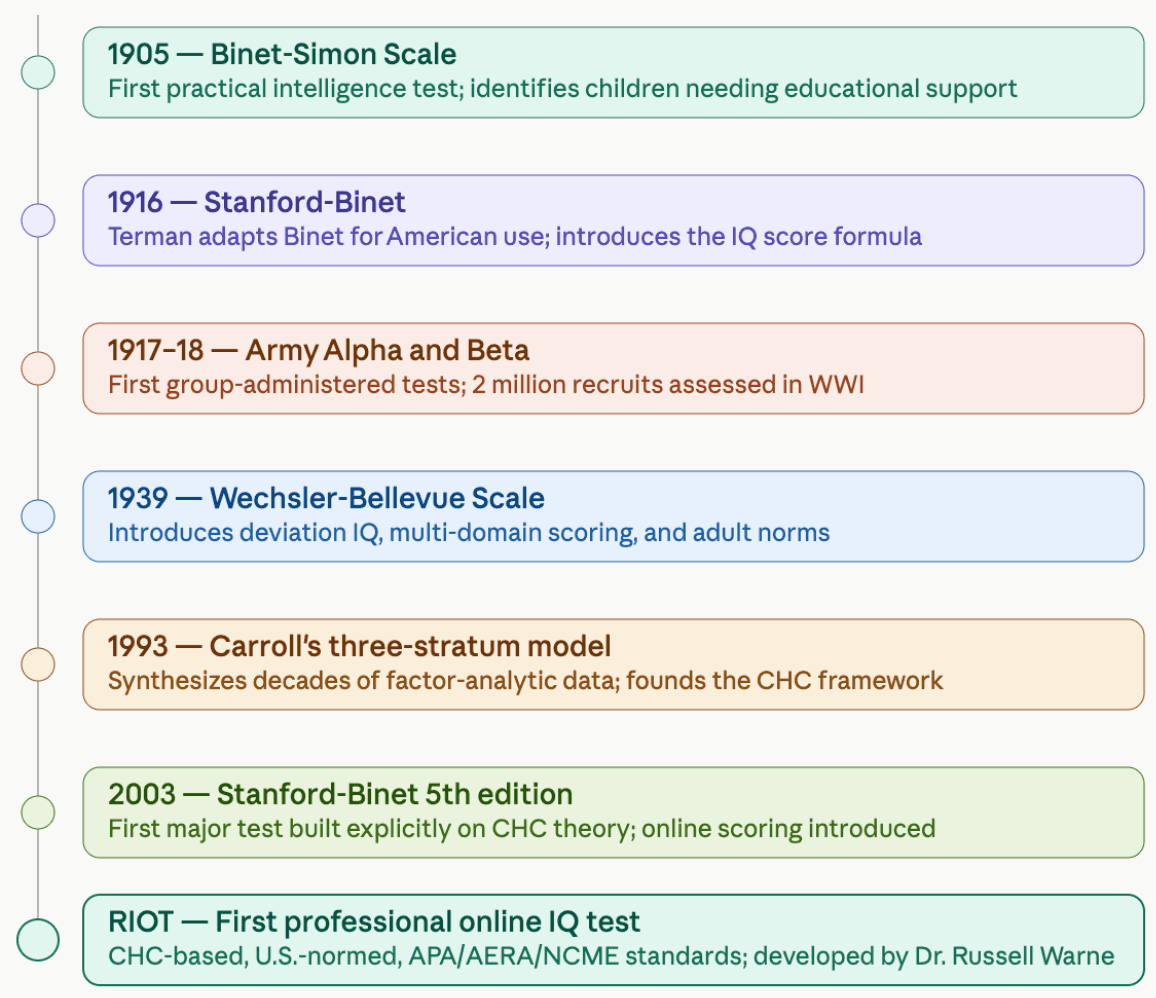 Each of these milestones built on the one before it. The measurement science that underpins any modern professional IQ test — deviation scoring, representative norming, multi-domain subtest structure — was not invented all at once. It accumulated across more than a century of research, error, and refinement.
The theoretical foundation: why CHC theory matters
Behind every professionally developed IQ test is a theory of what intelligence is. Without a theory, a test is simply a collection of tasks with no principled basis for claiming it measures anything coherent.
The dominant theoretical framework in modern psychometrics is the Cattell-Horn-Carroll (CHC) theory. It emerged from the integration of two earlier traditions: Raymond Cattell and John Horn's distinction between fluid intelligence (the capacity to solve novel problems through reasoning) and crystallized intelligence (accumulated knowledge and verbal ability), and John Carroll's reanalysis in his 1993 book Human Cognitive Abilities of more than 400 factor-analytic datasets spanning nearly a century of research. Carroll identified a three-level hierarchy: a general factor (g) at the top, approximately 10 broad cognitive abilities at the second level, and more than 70 narrow abilities at the third. The importance of CHC theory for test development is hard to overstate. Research involving nearly 4,000 children across six independently normed intelligence batteries has confirmed that the CHC broad-ability structure holds up across different tests — meaning that when different tests claim to measure fluid reasoning or working memory, they are measuring the same underlying constructs. That kind of cross-test validity evidence is only possible because there is an agreed theoretical framework that allows comparisons to be made.
 The RIOT is built on the CHC model. Its 15 subtests span six cognitive indices — Verbal Reasoning, Fluid Reasoning, Spatial Ability, Working Memory, Processing Speed, and Reaction Time — along with a global IQ score.
What professional standards actually require
One of the most consequential facts about online IQ testing is that anyone can post a test on the internet and call it an IQ test. There is no certification process, no licensing board, and no legal requirement for the creator to have any training in psychometrics. This has produced a landscape where hundreds of tests exist, most of which share none of the properties that make a psychological test scientifically defensible.
Professional psychological testing in the United States is governed by the Standards for Educational and Psychological Testing, a joint publication of the American Educational Research Association (AERA), the American Psychological Association (APA), and the National Council on Measurement in Education (NCME). These standards define what evidence a test must provide before its scores can be used for any meaningful purpose.
These requirements exist because IQ scores are not trivial data. They are used in educational placement decisions, clinical assessments, and employment contexts. A test that produces inaccurate or misleading scores in those settings causes real harm. The standards are designed to ensure that before any test is used for consequential decisions, the evidence for its accuracy has been assembled and disclosed.
The norm sample problem: why most online tests fail immediately
Of all the technical requirements a professional test must meet, the norm sample requirement is the one that most online tests fail most obviously. Understanding why it matters requires understanding what an IQ score actually is.
An IQ score is not an absolute measure. It does not tell an examinee how many questions were answered correctly. Instead, it expresses how an examinee performed relative to a reference group — the norm sample. A score of 100 means the examinee performed at the median of the norm sample. A score of 115 means the examinee performed better than approximately 84% of the norm sample. Every interpretation depends entirely on who is in that reference group.
If the norm sample is not representative of the intended population, the scores it produces are distorted. Consider a test that uses, as its norm group, the self-selected group of people who sought out and paid to take that test. That group is almost certainly not representative of the general adult population — it likely skews toward higher education, higher motivation, and certain demographic characteristics. Comparing examinees to that group produces IQ scores that mean something different from what they are claimed to mean.
The RIOT's norm sample was recruited specifically to be representative of U.S. adults, matching census proportions on age, sex, race, ethnicity, education level, and geographic region. That is the same approach used by the Wechsler tests and the Stanford-Binet — the benchmark professional assessments used in clinical practice.
What IQ actually predicts — and why that justifies the effort
Part of what motivates the standards described above is the recognition that IQ scores, when derived from well-constructed tests, are among the most predictively powerful data points in all of social science.
Meta-analytic research across hundreds of studies involving millions of participants has established that general cognitive ability is the single strongest predictor of both job training success and job performance across all occupational categories. For high-complexity roles — professions requiring extensive reasoning, decision-making, and problem-solving — the correlation between IQ and job performance reaches as high as .70. Even in low-complexity jobs, the correlation remains meaningful, typically between .30 and .40. These correlations are not incidental. Research on the stability of cognitive ability as a predictor across different levels of job experience — using large-scale military datasets spanning 31 diverse occupational categories — has found that the predictive validity of general cognitive ability remains stable even as employees gain years of on-the-job experience. Intelligence is not a one-time advantage that fades as workers learn their roles; it continues to influence performance throughout a career. Beyond the workplace, intelligence scores are associated with better physical health outcomes, lower rates of chronic disease, and longer life. The relationship between IQ and health is not mediated entirely by socioeconomic status — even controlling for income and education, higher IQ is associated with healthier behaviors and better medical decision-making.
The online testing frontier: what separates professional tests from the rest
The existence of professional standards has not prevented the proliferation of amateur online IQ tests. If anything, the internet has accelerated it. A quick search returns hundreds of tests, most of which share certain characteristics: anonymous creators, no documented norm samples, no reliability data, and score reports that typically inflate results to retain user engagement and encourage purchases.
The academic validation of online testing as a legitimate administration format is itself an important development. Research on the online administration of established cognitive tests — including a large-scale study of 4,100 children completing an online version of the Culture Fair Intelligence Test — has found acceptable internal consistency and construct validity, with correlations to academic outcomes in the expected range. The online format does not compromise psychometric quality when the underlying test is properly designed. That distinction is crucial. The medium of delivery is not the problem. The problem is when tests lack the psychometric infrastructure that makes scores meaningful in the first place. Format is irrelevant if there is no norm sample, no validity evidence, and no identified creator accountable for the test's quality.
The RIOT: what makes it different
The Reasoning and Intelligence Online Test was designed from the ground up to meet the same professional standards as traditional face-to-face assessments. That was not a small undertaking. Before a single item was written, I spent more than 15 years studying intelligence and psychometrics, publishing dozens of peer-reviewed articles, and completing a book on the topic for Cambridge University Press.
The development process followed the same stages as any major clinical assessment: theoretical grounding in the CHC model, item development and expert review, pilot testing, iterative item revision, and a full norming study with a deliberately recruited, demographically representative sample of U.S. adults. The RIOT's content was evaluated by a panel of specialists in cognitive, educational, and developmental psychology before the test was released.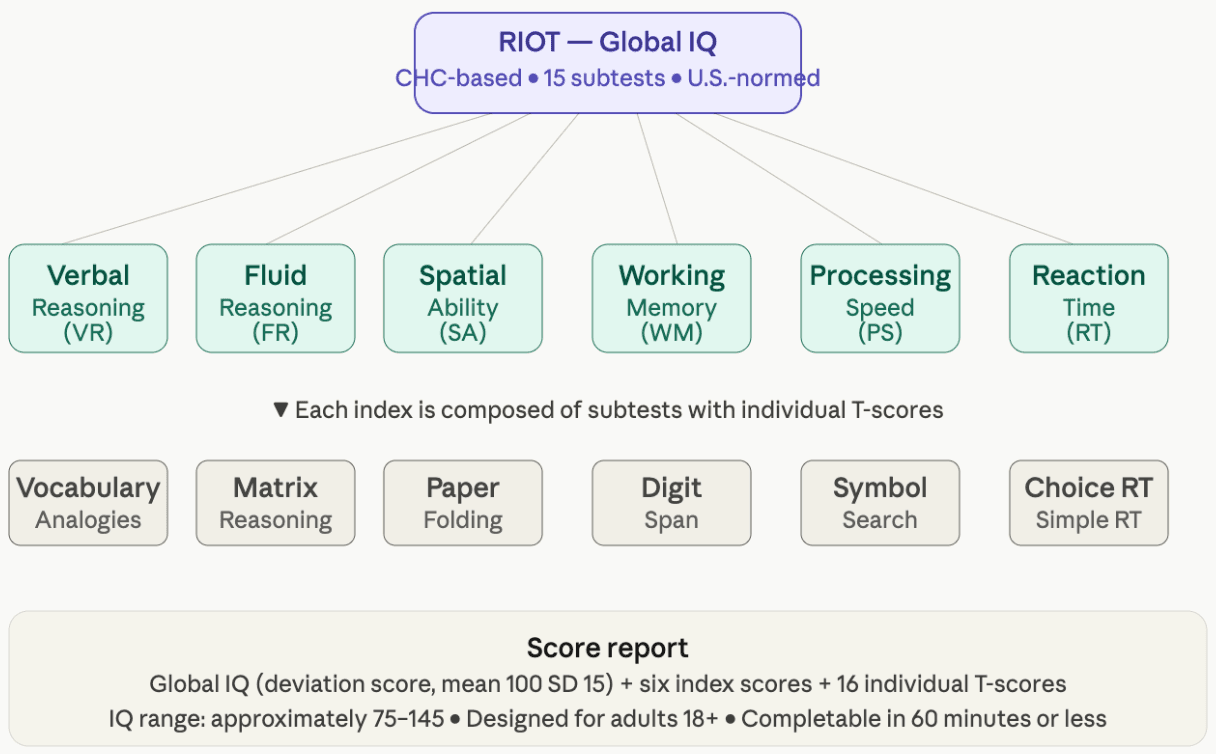 The score report the RIOT provides goes considerably beyond a single IQ number. Each of the six index scores reflects a distinct cognitive domain identified by CHC theory, and each of the 15 subtests has its own T-score (mean of 50, standard deviation of 10). That granularity matters. General intelligence predicts broad life outcomes, but specific cognitive abilities add precision in applied contexts — understanding whether an examinee's relative strengths lie in verbal reasoning versus spatial ability versus working memory is diagnostically useful in ways that a single number cannot capture.
 This is consistent with what researchers working in both school and workplace contexts have found: general intelligence is a powerful predictor, but domain-specific abilities contribute additional variance in predicting performance on specific types of tasks. A test that reports only a global IQ score is leaving information on the table.
What accurate online IQ testing makes possible
The practical significance of a professionally developed online test extends beyond technical compliance. It is about access.
Before the RIOT existed, the only way to obtain a professionally validated IQ score was through a clinical assessment — a process that typically involves scheduling with a licensed psychologist, completing a two-to-four-hour face-to-face evaluation, and paying several hundred to several thousand dollars for the results. That process is genuinely valuable when clinical decisions are involved, and nothing here suggests otherwise. But for the large number of people who want to understand their cognitive profile for personal or professional reasons, that process has always been inaccessible.
A test administered online removes the scheduling and geographic barriers. It does not remove the psychometric requirements — the RIOT's development and validation procedures are held to the same standards as clinic-based assessments. What it removes is the requirement that professional-quality measurement exist only within the walls of a psychologist's office.
A note on what IQ scores do and do not tell us
What an accurate IQ score provides is genuine self-knowledge. Understanding one's cognitive profile — where the relative strengths and weaknesses lie across different domains of reasoning and processing — is information that can guide decisions about education, career, and personal development.
The relationship between IQ and outcomes is real and well-documented, but it is probabilistic rather than deterministic. Higher scores are associated with better average outcomes across populations, but individual outcomes depend on many factors that IQ does not capture — motivation, conscientiousness, opportunity, social support, and specific skills developed through experience. A high IQ opens doors; it does not guarantee that anyone walks through them. A lower IQ does not foreclose achievement; it raises the difficulty, sometimes considerably, but it does not determine outcomes for any individual.
That is the purpose the RIOT is designed to serve: not to label people, but to give them an accurate, scientifically grounded understanding of their own cognitive functioning.
Taking the first professional online IQ test
The Reasoning and Intelligence Online Test is the first online IQ test designed to meet the full set of professional standards for psychological assessment. It was developed by a researcher with over 15 years of experience in intelligence and psychometrics, independently reviewed by specialists across cognitive and developmental psychology, and grounded in the theoretical framework that underpins the major clinical intelligence batteries.
For anyone who has wondered what a genuine, professionally validated IQ assessment looks like — and what it can tell them about their own cognitive profile — the RIOT offers something that did not exist before: professional-quality intelligence measurement without the barriers of clinical access. A free sample version is available at riotiq.com for those who want to experience the format before committing to the full assessment.
References
Carroll, J. B. (1993). Human cognitive abilities: A survey of factor-analytic studies. Cambridge University Press. https://doi.org/10.1017/CBO9780511571312 Cattell, R. B., & Horn, J. L. (1966). Refinement and test of the theory of fluid and crystallized general intelligences. Journal of Educational Psychology, 57(5), 253–270. https://doi.org/10.1037/h0023816 Flanagan, D. P., & Dixon, S. G. (2014). The Cattell-Horn-Carroll theory of cognitive abilities. In Encyclopedia of Special Education. Wiley. https://onlinelibrary.wiley.com/doi/full/10.1002/9781118660584.ese0431 Gottfredson, L. S. (1997). Why g matters: The complexity of everyday life. Intelligence, 24(1), 79–132. https://doi.org/10.1016/S0160-2896(97)90014-3 Gottfredson, L. S., & Deary, I. J. (2004). Intelligence predicts health and longevity, but why? Current Directions in Psychological Science, 13(1), 1–4. https://doi.org/10.1111/j.0963-7214.2004.01301001.x Keith, T. Z., & Reynolds, M. R. (2010). Cattell-Horn-Carroll abilities and cognitive tests: What we've learned from 20 years of research. Psychology in the Schools, 47(7), 635–650. https://doi.org/10.1002/pits.20496 Reynolds, M. R., & Keith, T. Z. (2020). Beyond individual intelligence tests: Application of Cattell-Horn-Carroll theory. Intelligence, 79, 101433. https://doi.org/10.1016/j.intell.2020.101427 Schmidt, F. L., & Hunter, J. E. (2002). The validity and utility of selection methods in personnel psychology. Personnel Psychology, 55(1), 232–256. https://doi.org/10.1080/08959285.2002.9668091 Warne, R. T. (2020). In the know: Debunking 35 myths about human intelligence. Cambridge University Press. https://doi.org/10.1017/9781108593298 Warne, R. T. (2025). Technical manual for the Reasoning and Intelligence Online Test, version 1.0. RIOT IQ. https://riotiq.com American Educational Research Association, American Psychological Association, & National Council on Measurement in Education. (2014). Standards for educational and psychological testing. https://www.testingstandards.net Deary, I. J., Strand, S., Smith, P., & Fernandes, C. (2007). Intelligence and educational achievement. Intelligence, 35(1), 13–21. https://doi.org/10.1016/j.intell.2006.02.001 Kuncel, N. R., Hezlett, S. A., & Ones, D. S. (2004). Academic performance, career potential, creativity, and job performance. Journal of Personality and Social Psychology, 86(1), 148–161. https://doi.org/10.1037/0022-3514.86.1.148 Rode, J. C., Arthaud-Day, M. L., Mooney, C. H., Near, J. P., & Baldwin, T. T. (2010). Ability and personality predictors of salary, perceived job success, and perceived career success in the initial career stage. International Journal of Selection and Assessment, 18(2), 173–187. https://doi.org/10.1111/j.1468-2389.2010.00495.x Strenze, T. (2007). Intelligence and socioeconomic success: A meta-analytic review of longitudinal research. Intelligence, 35(5), 401–426. https://doi.org/10.1016/j.intell.2007.02.003
Take our professional IQ test
Want to know your IQ? Try the first ever professional online IQ test.
AuthorDr. Russell T. WarneChief Scientist
