May 30, 2025·Understanding IQ ScoresThe Impact of Motivation on IQ: Going… Going… (almost) Gone
How much does motivation affect IQ test scores? Discover the truth about motivation and intelligence testing validity.
Dr. Russell T. WarneChief Scientist

One frequent claim that people make about IQ scores is that they’re highly susceptible to motivation. In a way, this is obviously true: a bored examinee who answers randomly just to rush through the test-taking experience is going to bomb the test. A highly motivated examinee is going to score higher.
But how common is unmotivated test taking, and does it lower IQ noticeably? This question is a concern for intelligence testers because if a significant number of examinees are unmotivated, then IQ is a measure of a mix of intelligence and motivation. This situation would also mean that IQ scores can be easily raised by increasing motivation, which would be a major threat to the validity of IQ as a measure of intelligence.
For over a decade,
one article seemed to answer this question: Duckworth et al.’s (2011) “Role of test motivation in intelligence testing,” published in the
Proceedings of the National Academy of Sciences. In that article, which was a meta-analysis that combined results of previous studies, the result indicated that high motivation increased IQ by 9.6 points, with stronger increases for people who scored lower initially. This is a massive gain in IQ, which means that there was a legitimate question about what intelligence tests measure.
Garbage In, Garbage Out
One criticism of meta-analyses is “garbage in, garbage out.” In other words, a meta-analysis is only as good as the underlying studies that were included in it. Unfortunately, the Duckworth et al. (2011) meta-analysis had a major flaw in it: its most important study was fraudulent and never happened!
Previously,
I have written about Stephen Breuning, a known scientific fraudster who was exposed in the 1980s. Investigations into Breuning’s work only covered his federally funded research.
When I looked into Breuning’s non-funded research on intelligence, I uncovered substantial evidence that it was also fraudulent.
After I was finished gathering evidence, I petitioned the editor of one of the journals that published
one of Breuning’s major studies (Breuning & Zella, 1978) and asked for a retraction. In January of 2025, the study was retracted for fraud. This undermined the Duckworth et al. (2011) meta-analysis because Breuning’s article provided almost one-fourth of the data in Duckworth et al.’s meta-analysis. Moreover, the reported effects of motivation from the Breuning article were stronger than almost all of the other studies in the meta-analysis. Both of these characteristics meant that the fraudulent data greatly inflated the results of the meta-analysis.
Because Duckworth et al.’s (2011) study had been substantially undermined, I contacted the editors of the Proceedings of the National Academy of Sciences on January 3, 2025, and asked for an Expression of Concern to be applied to the meta-analysis so that Duckworth and her colleagues could remove the Breuning data from their work and correct the results. (An Expression of Concern is a note applied to an article that indicates that there are possible issues with the article and that it should be cited with caution.)
On May 27, 2025, I was surprised to learn that Angela Duckworth and her coauthors requested a retraction of their article.
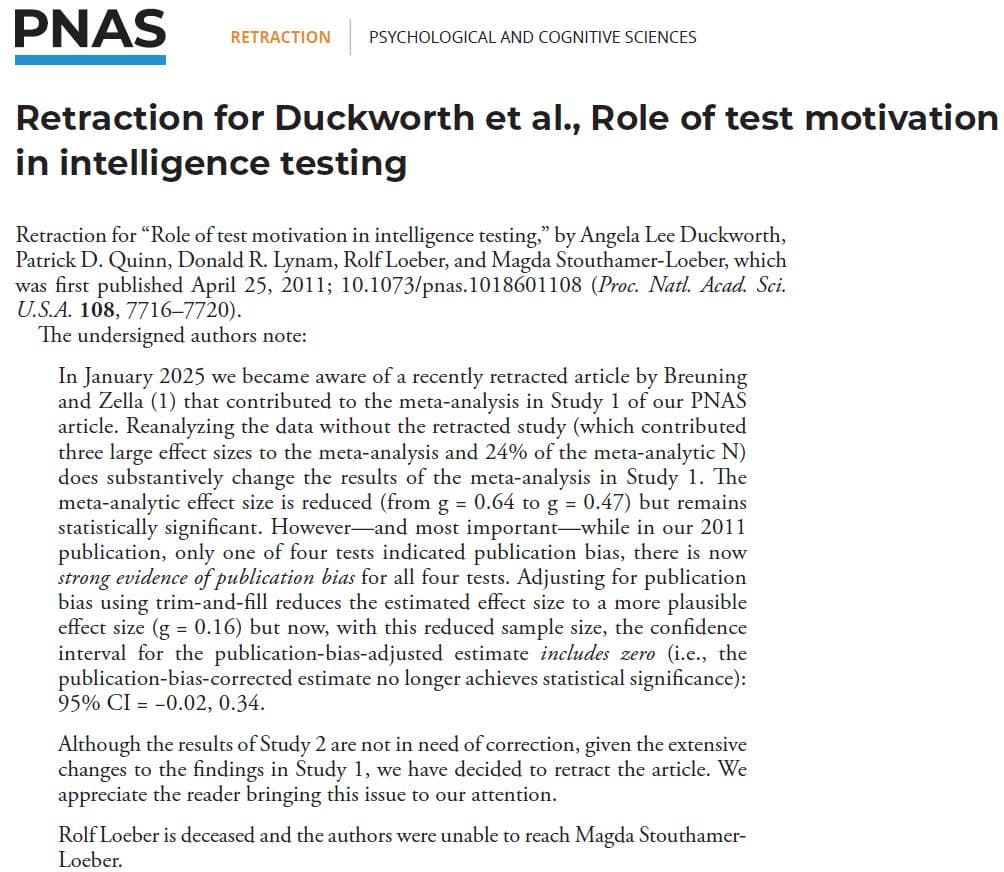
The retraction notice is below.
As the retraction notice states, removing Breuning’s data drops the effect from g = .64 to .47, which is the equivalent of dropping from 9.6 to 7.1 IQ points. But with the fraudulent data removed, there is strong evidence that the results are inflated by publication bias (which is the tendency for studies showing a stronger effect to get published more often, while studies showing no or weak effects are not published). Taking this into account, Duckworth and her colleagues estimate that the true impact of motivation on IQ is g = .16, or 2.4 IQ points.
Other Evidence
There is independent corroborating evidence that this lower estimate is much more accurate. In 2022, Timothy Bates and Gilles Gignac published an article that reported three studies on the impact of motivation on IQ scores. Even when they offered money for large IQ increases, the increased motivation raised scores by about 2.5 IQ points (Bates & Gignac, 2022). This almost exactly matches Duckworth and her coauthors’ new estimate.
Bates and Gignac’s (2022) work is better evidence than a meta-analysis, anyway. The studies in the meta-analysis all pre-date the reforms of that psychology made in response to the replication crisis. (The most recent was published in 1994.) In contrast, Bates and Gignac engaged in many new practices that increase the credibility and quality of their research. Because of the “garbage in, garbage out” principle, a collection of mediocre studies
can’t provide stronger evidence than pre-registered studies with
open data and syntax. Additionally, the Bates and Gignac studies total 1,351 participants, which is almost as large as the number of individuals (1,523) in Duckworth et al.’s (2011) meta-analysis after the fraudulent data are excluded. Because of these characteristics, the Bates and Gignac (2022) studies are the best evidence currently available about the impact of motivation on IQ.
Implications
What does this mean for intelligence tests? Practically, a 2.4- or 2.5-point increase on IQ caused by increasing motivation is small. For most tests, it’s within the margin of error. Apparently, most examinees taking low-stakes tests are sufficiently motivated to do well on an intelligence test and increasing their motivation has a minor effect. Thus, unmotivated examinees are not a threat to the validity of IQ as a measure of intelligence. IQ is not just a measure of motivation to take a test.
The Bates and Gignac (2022) studies are particularly relevant to the
Reasoning and Intelligence Online Test (RIOT) because all of the tests that Bates and Gignac administered were online. Therefore, there is no need to be concerned that low motivation is a major problem with online tests, like the RIOT.
Coda
Duckworth told me in an email that she and her co-authors are working on updating and expanding their meta-analysis in the hopes it can be published again. I hope it is because the relationship between motivation and IQ is an important topic; the validity of IQ scores needs to be subjected to close scrutiny like this.
Finally, this saga teaches that the consequences of scientific fraud reverberate for many years. Duckworth and her colleagues were victims of Breuning’s deceit, and so were the people who read or cited the meta-analysis. When scientific fraud is suspected, it should be investigated swiftly so that the consequences are minimized.
References
Bates, T. C., & Gignac, G. E. (2022). Effort impacts IQ test scores in a minor way: A multi-study investigation with healthy adult volunteers.
Intelligence, 92, Article 101652.
https://doi.org/10.1016/j.intell.2022.101652
Breuning, S. E., & Zella, W. F. (1978). Effects of individualized incentives on norm-referenced IQ test performance of high school students in special education classes.
Journal of School Psychology, 16(3), 220-226.
https://doi.org/10.1016/0022-4405(78)90004-3 [
Retraction notice]
Duckworth, A. L., Quinn, P. D., Lynam, D. R., Loeber, R., & Stouthamer-Loeber, M. (2011). Role of test motivation in intelligence testing.
Proceedings of the National Academy of Sciences, 108(19), 7716-7720.
https://doi.org/10.1073/pnas.1018601108 [
Retraction notice]
Take our professional IQ test
Want to know your IQ? Try the first ever professional online IQ test.
AuthorDr. Russell T. WarneChief Scientist