Jun 30, 2026·Understanding IQ ScoresIQ vs. Creativity: Does a High IQ Make a Person More Creative?
Do intelligence and creativity always go hand in hand? Discover the truth about the IQ threshold. Read the full article and take the RIOT IQ test today!
Dr. Russell T. WarneChief Scientist
Creativity is one of the most valued human traits. It drives scientific discovery, artistic expression, technological innovation, and everyday problem solving. Because both creativity and intelligence are so highly prized, it is natural to wonder whether they go hand in hand. Does a high IQ make a person more creative? And can someone with an average IQ be truly creative?
I have spent over 15 years studying intelligence and developing the Reasoning and Intelligence Online Test (RIOT), so I encounter this question often. The relationship between IQ and creativity is one of the most studied topics in psychology, and the findings are more nuanced than most people expect. The answer is not a simple yes or no. It depends on what is meant by "creativity," how it is measured, and what level of intelligence is being discussed.
What Is Creativity?
Before examining how creativity relates to IQ, it is important to define what researchers mean by creativity. In everyday language, "creativity" can refer to almost anything from painting a portrait to coming up with an unusual solution for a business problem. In psychology, the term has a more specific meaning, though not all researchers agree on a single definition.
Most psychologists distinguish between two related concepts. The first is creative potential, which is the cognitive capacity to generate novel and useful ideas. This is most commonly measured through "divergent thinking" tests, which ask examinees to produce as many responses as possible to an open-ended prompt (for example, "List all the possible uses for a brick"). Responses are scored for fluency (how many ideas are generated), flexibility (how many different categories of ideas appear), and originality (how uncommon the ideas are compared to those produced by other people).
The second concept is creative achievement, which refers to recognized creative accomplishments in the real world, such as publishing a novel, obtaining a patent, composing a piece of music, or making a scientific discovery. Creative achievement is typically measured through self-report questionnaires or biographical inventories that catalog a person's creative output across different domains.
This distinction matters because, as the research shows, IQ relates differently to creative potential than it does to creative achievement.
How Strongly Do IQ and Creativity Correlate?
The most comprehensive answer comes from a meta-analysis by Kim (2005) published in the Journal of Secondary Gifted Education, which examined 21 studies with a combined sample of 45,880 participants. The average correlation between IQ scores and creativity test scores was r = .17. That is a positive relationship, but it is small. In practical terms, IQ explains approximately 3% of the variation in divergent thinking scores. The remaining 97% is attributable to other factors.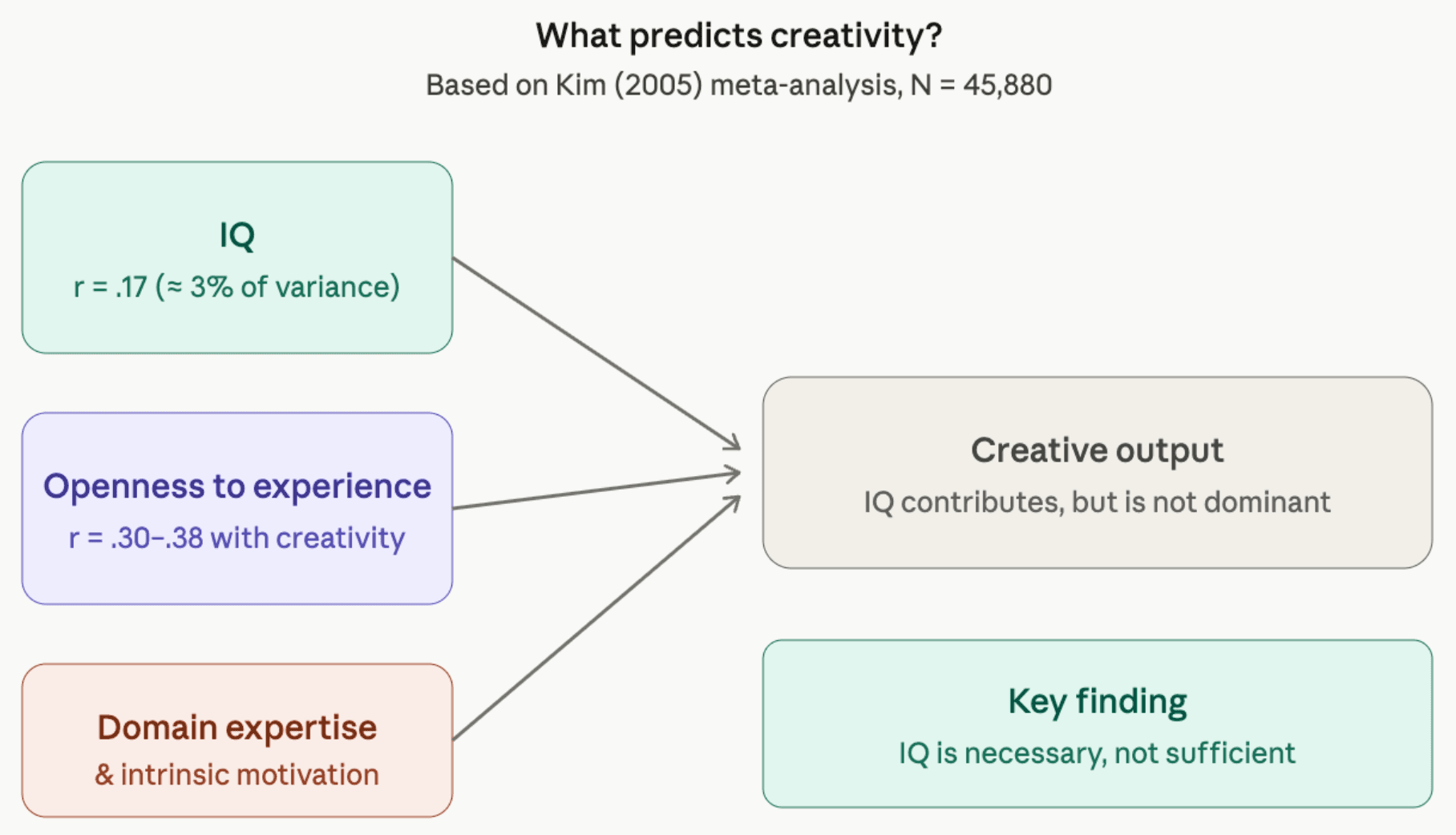 To put these numbers in context, the personality trait of openness to experience, which reflects curiosity, imagination, and a willingness to explore novel ideas, correlates with divergent thinking at approximately r = .30 to .38 across multiple studies (McCrae, 1987; King, Walker, & Broyles, 1996; Carson, Peterson, & Higgins, 2005). A meta-analysis by Feist (1998) in Personality and Social Psychology Review found that creative scientists and artists scored above average on IQ, but their elevated openness to experience carried roughly three to five times the predictive weight. In other words, who a person is temperamentally matters substantially more for creative output than how high they score on an IQ test.
The Threshold Hypothesis
One of the most discussed ideas in the IQ-creativity literature is the "threshold hypothesis," which dates back to J. P. Guilford's work in the 1960s. The core claim is that IQ and creativity are positively correlated up to a certain IQ level, typically set at around 120, and that above that threshold, additional IQ points contribute little or nothing to creativity. In this view, intelligence is a necessary but not sufficient condition for creative work: a person needs a certain baseline of cognitive ability to engage in creative thinking, but beyond that baseline, non-cognitive factors become the primary drivers.
The most rigorous test of this hypothesis was conducted by Jauk, Benedek, Dunst, and Neubauer (2013) and published in the journal Intelligence. Using segmented regression analysis on a sample of 297 adults, they found that the threshold varied depending on which aspect of creativity was being measured. For sheer ideational fluency (how many ideas a person generates), the threshold was quite low, around IQ 86. For originality assessed by a liberal scoring method, it was approximately IQ 104. For high-quality originality, the kind of sustained, genuinely novel thinking that characterizes impressive creative work, the threshold rose to approximately IQ 120. Importantly, for creative achievement, which Jauk and colleagues measured using a questionnaire cataloging real-world creative accomplishments, no threshold was detected at all. Higher intelligence continued to predict more creative achievements even at relatively high IQ levels. This finding suggests that the threshold applies primarily to the cognitive potential for generating ideas, not to the translation of that potential into recognized creative work in the real world, where factors like perseverance, domain expertise, and opportunity also play critical roles.
Why IQ Helps but Does Not Guarantee Creativity
The question of why IQ contributes to creativity is fairly straightforward. Creative thinking requires cognitive resources. Generating original solutions to a problem demands working memory capacity to hold multiple ideas simultaneously, fluid reasoning to detect novel relationships among concepts, and verbal ability to articulate and refine ideas. All of these abilities are measured by IQ tests. A person with low cognitive ability may struggle to acquire the domain knowledge needed to be creative in a field, or may not have the processing capacity to manipulate complex ideas in novel ways.
But the question of why IQ does not guarantee creativity is equally important. A highly intelligent person who lacks curiosity or who is uncomfortable with uncertainty may produce technically proficient but unremarkable work. A person with more moderate IQ who is deeply curious, willing to experiment, and persistent in refining ideas may produce far more original contributions. Non-cognitive traits like intrinsic motivation, tolerance for ambiguity, and willingness to take intellectual risks all contribute to creative output independently of cognitive ability.
The Measurement Problem with Creativity
It is worth pausing to note that creativity is far more difficult to measure than intelligence. IQ tests have been developed and refined for over 120 years, and they produce scores that are stable across time, consistent across different tests, and predictive of important real-world outcomes. Creativity tests have none of these advantages.
The most widely used creativity tests are the Torrance Tests of Creative Thinking (TTCT), developed by E. Paul Torrance in the 1960s. These tests ask examinees to complete tasks like listing unusual uses for common objects or finishing incomplete drawings. While the Torrance Tests have some predictive validity, they have been criticized on several grounds. Fluency and originality scores are confounded: a person who generates more ideas will almost automatically produce more unusual ones simply by chance. The tests also measure divergent thinking in very specific, narrow contexts, and there is limited evidence that performance on a "uses for a brick" task translates to creative accomplishment in science, music, business, or any other domain. The domain-specificity of creativity is a particularly important contrast with IQ. Being highly creative in music does not necessarily predict creativity in engineering or business strategy. IQ, by contrast, is general: a person with high IQ will tend to perform well across a wide range of cognitive tasks regardless of their content. These measurement limitations mean that the research on the IQ-creativity relationship should be interpreted with some caution, since much of it reflects associations between IQ and performance on narrow laboratory tasks rather than the full scope of what most people mean when they talk about creativity.
What About Real-World Creative Achievement?
When researchers move beyond laboratory creativity tests and examine actual creative accomplishments, the role of IQ becomes more interesting. A study by Karwowski, Kaufman, Lebuda, Szumski, and Firkowska-Mankiewicz (2017) published in Intelligence used a Necessary Condition Analysis (NCA) on longitudinal data linking childhood IQ to middle-age creative achievements. They found that high creative achievement in cognitively demanding domains, such as science, writing, architecture, and invention, was very unlikely among individuals who had low IQ scores in childhood. The IQ floor was higher for cognitively intensive fields than for artistic or everyday creativity, consistent with the idea that different creative domains place different cognitive demands on the creator.
Convergent and Divergent Thinking: Two Sides of Cognition
J. P. Guilford, in his 1950 presidential address to the American Psychological Association, introduced the distinction between convergent and divergent thinking that has shaped creativity research ever since. Convergent thinking is the cognitive process of narrowing down possibilities to arrive at a single correct solution. Divergent thinking is the process of generating multiple possible solutions to an open-ended problem. IQ tests primarily measure convergent thinking. Creativity tests primarily measure divergent thinking.
This distinction helps explain why the correlation between IQ and creativity is positive but modest. Both forms of thinking rely on the same underlying cognitive machinery: working memory, fluid reasoning, and the ability to retrieve and manipulate stored knowledge. That shared cognitive foundation produces the positive correlation. But convergent and divergent thinking also diverge in important ways. Divergent thinking rewards the generation of unusual, far-flung associations, tolerance for ambiguity, and willingness to explore paths that may not lead anywhere. Convergent thinking rewards precision, logical elimination of alternatives, and identification of the optimal answer. A person can be outstanding at one without being equally strong at the other.
This is not to say that convergent and divergent thinking are opposed. Real-world creative work requires both. A scientist generating hypotheses needs divergent thinking, but testing those hypotheses requires convergent thinking. An architect brainstorming building designs draws on divergent processes, but ensuring the building stands up demands rigorous convergent analysis. The most impressive creative achievers likely excel at switching between both modes.
Putting It All Together
Does a high IQ make a person more creative? It helps, but not as much as most people assume.
IQ provides the cognitive raw material that creative thinking depends on: working memory, fluid reasoning, and the ability to learn and retrieve domain knowledge. Below a certain cognitive threshold, creative potential is meaningfully constrained. Above that threshold, how far a person goes creatively depends increasingly on temperament, expertise, and motivation. The relationship also depends on the type of creativity being assessed: for generating a high volume of ideas, even a modest level of intelligence suffices, while producing genuinely original work in cognitively demanding fields raises the bar considerably.
IQ tests are excellent tools for measuring cognitive ability, and understanding that ability is an important piece of the creativity puzzle. But it is not the entire picture. The most creative people tend to combine above-average intelligence with deep curiosity, sustained effort in a specific domain, and a willingness to pursue ideas that others overlook.
Take the First-Ever Professional Online IQ Test
For anyone interested in a scientifically grounded assessment of their cognitive abilities, the Reasoning and Intelligence Online Test (RIOT) is the first online IQ test that meets professional standards for psychological assessment. It was created by Dr. Russell Warne, who has over 15 years of experience in intelligence research and is the author of In the Know: Debunking 35 Myths about Human Intelligence (Cambridge University Press). What makes the RIOT different from the countless online IQ tests found with a quick internet search? Most of those tests are created by amateurs without proper training in psychometrics. The RIOT clearly stands out as the first-ever professional online IQ test. The RIOT underwent the same rigorous development process as traditional in-person IQ tests used by psychologists, including expert review, the first-ever proper U.S.-based online norm sample, and compliance with educational and psychological testing standards from APA, AERA, and NCME.
References
Feist, G. J. (1998). A meta-analysis of personality in scientific and artistic creativity. Personality and Social Psychology Review, 2(4), 290–309. https://doi.org/10.1207/s15327957pspr0204_5 Jauk, E., Benedek, M., Dunst, B., & Neubauer, A. C. (2013). The relationship between intelligence and creativity: New support for the threshold hypothesis by means of empirical breakpoint detection. Intelligence, 41(4), 212–221. https://doi.org/10.1016/j.intell.2013.03.003 Karwowski, M., Kaufman, J. C., Lebuda, I., Szumski, G., & Firkowska-Mankiewicz, A. (2017). Intelligence in childhood and creative achievements in middle-age: The necessary condition approach. Intelligence, 64, 36–44. https://doi.org/10.1016/j.intell.2017.05.004 Kim, K. H. (2005). Can only intelligent people be creative? A meta-analysis. Journal of Secondary Gifted Education, 16(2–3), 57–66. https://doi.org/10.4219/jsge-2005-473 Silvia, P. J., Winterstein, B. P., Willse, J. T., Barona, C. M., Cram, J. T., Hess, K. I., Martinez, J. L., & Richard, C. A. (2008). Assessing creativity with divergent thinking tasks: Exploring the reliability and validity of new subjective scoring methods. Psychology of Aesthetics, Creativity, and the Arts, 2(2), 68–85. https://doi.org/10.1037/1931-3896.2.2.68 Warne, R. T. (2020). In the know: Debunking 35 myths about human intelligence. Cambridge University Press. https://doi.org/10.1017/9781108593298
Take our professional IQ test
Want to know your IQ? Try the first ever professional online IQ test.
AuthorDr. Russell T. WarneChief Scientist
