Jun 5, 2026·Understanding IQ ScoresHow to Interpret IQ Test Results
Confused by your IQ score? Learn what your numbers mean, explore IQ score ranges, and understand your cognitive profile. Read our guide and try the RIOT test!
Dr. Russell T. WarneChief Scientist
An IQ score is one of the most information-dense numbers in psychology. It summarizes how a person performed on a carefully designed set of cognitive tasks relative to a representative sample of their age group. But a score sitting on a page, without context or understanding of how it was derived, is easy to misread. People misinterpret scores by comparing scores across tests without accounting for scale differences. Some interpret it as a fixed, permanent truth, rather than a statistically informed estimate.
This article is meant to close that gap. Whether an IQ test was taken recently or years ago, what follows explains what the numbers mean, how they are derived, how confident one can be in them, what they predict, and where their limits are.
What does an IQ score actually represent?
An IQ score is a standardized, relative measure. It describes how a person's cognitive performance on a test compares to others in the same age group, not how many questions they answered correctly. A score of 80 does not mean 80% accuracy or 80 questions answered correctly.
The term "IQ" originally stood for "intelligence quotient," a reference to the ratio formula used in the early 20th century: mental age divided by chronological age, multiplied by 100. That formula has been obsolete for decades. Every modern IQ test uses what is called a "deviation IQ," a score that expresses how far above or below the average a person's performance falls (with the average is set to 100).
Test developers administer a test to a large, representative sample of the population (called the norm sample) and then transform the raw score distribution so that the average performance in that sample equals exactly 100. The spread of scores is anchored so that one standard deviation corresponds to 15 IQ points. This produces a clean, predictable scoring system in which most people score between 85 and 115, and the further a score is from 100, the rarer it is.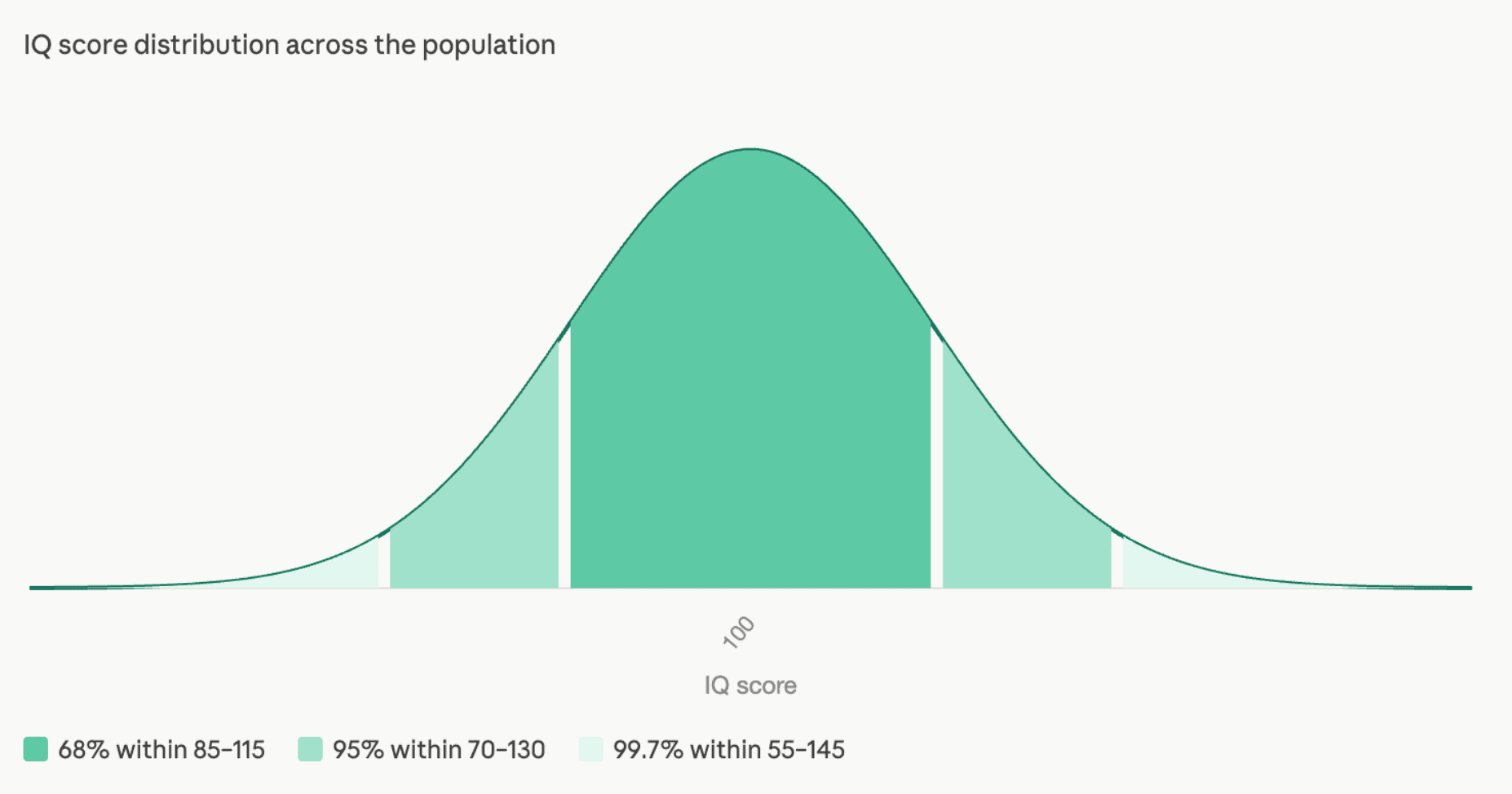 An important implication of this structure is that IQ is a relative measure, not an absolute one. A score of 100 does not represent a fixed amount of cognitive ability. Instead, it represents average performance in the specific norm sample against which the test was calibrated. This matters when comparing scores across tests normed for different age groups and when distinguishing what a score means at the population level versus what it means for any individual.
What do score ranges and labels mean?
IQ test creators have long attached descriptive labels to score ranges. These labels serve a communication function. They translate a number into language that is easier to discuss. The labels are conventions, though, not scientific classifications. Different publishers use different cutoffs and different terminology. The underlying score is what matters.
The table below shows the most widely used classification system.
| IQ Range | Traditional Label | Current Wechsler Label | Percentile Range | % of Population |
| 130 and above | Very Superior | Extremely High | 98th+ | -2.3% |
| 120-129 | Superior | Very High | 91st-97th | -6.7% |
| 110-119 | High Average | High Average | 75th-90th | -15.9% |
| 90-109 | Average | Average | 25th-74th | -50% |
| 80-89 | Low Average | Low Average | 9th-24th | -15.9% |
| 70-79 | Borderline | Very Low | 2nd-8th | -6.7% |
| Below 70 | Extremely Low | Extremely Low | Below 2nd | -2.3% |
A score of 109 and a score of 111 are nearly, and their margins of error will overlap considerable. That means that intelligence differences among people who score near a category boundary should not be treated as meaningful in most contexts.
A few thresholds do carry practical significance, however. Research has consistently shown that the functional threshold for independent living is approximately 70 to 75, which is why that boundary is used in the clinical diagnosis of intellectual disability (alongside an assessment of adaptive functioning). The approximate minimum for stable employment in most occupational settings is around 80 to 85. Most professional roles requiring advanced education have an implicit minimum closer to 110, because the cognitive demands of training and daily performance in those fields tend to filter for higher performance. These thresholds are not strict cutoffs, though. They are fuzzy boundaries that have matter in daily life.
Why a score is a range, not a point
No psychological test measures a trait with perfect precision. Every score contains some degree of measurement error. This is not error in the sense of a mistake, but in the statistical sense of natural variability that occurs any time a construct is measured.
The standard error of measurement (SEM) quantifies this variability. For a test with a standard deviation of 15 and a reliability of .97 — which is within the range of well-designed professional IQ tests — the SEM is approximately 2.6 points. This means that the person’s true underlying score measured without error is most likely within 2.6 points of the score they obtained.
Most professional IQ tests report a range of scores alongside the overall score. This can take on the form of the SEM, or it can be converted to a wider range called a confidence interval. Regardless of the form that this range of score takes, it is an important feature of technically sound test reports. When a test does not provide a confidence interval, it implies a level of exactness that is not possible with psychological tests.
How stable are IQ scores over time?
IQ is one of the most stable psychological traits that psychologists have measured. A 2024 meta-analysis by Breit, Scherrer, Tucker-Drob, and Preckel synthesized data from 205 longitudinal studies involving more than 87,000 participants. The findings showed that IQ stability is low in early childhood, increases rapidly through the school years, and reaches consistently high levels from late adolescence through most of adulthood. For adults tested five years apart, the average rank-order stability was .76, meaning a person's standing relative to age peers tends to remain consistent over years and decades. The famous Scottish Mental Surveys found a test-retest correlation of .67 spanning 59 years, from childhood testing at age 11 to retesting near age 70. For a test taken in adulthood, the score is a durable summary of cognitive standing. It does not need to be retaken frequently to remain informative. Some variation across testing occasions is normal and expected — and the confidence interval discussed above captures that variability.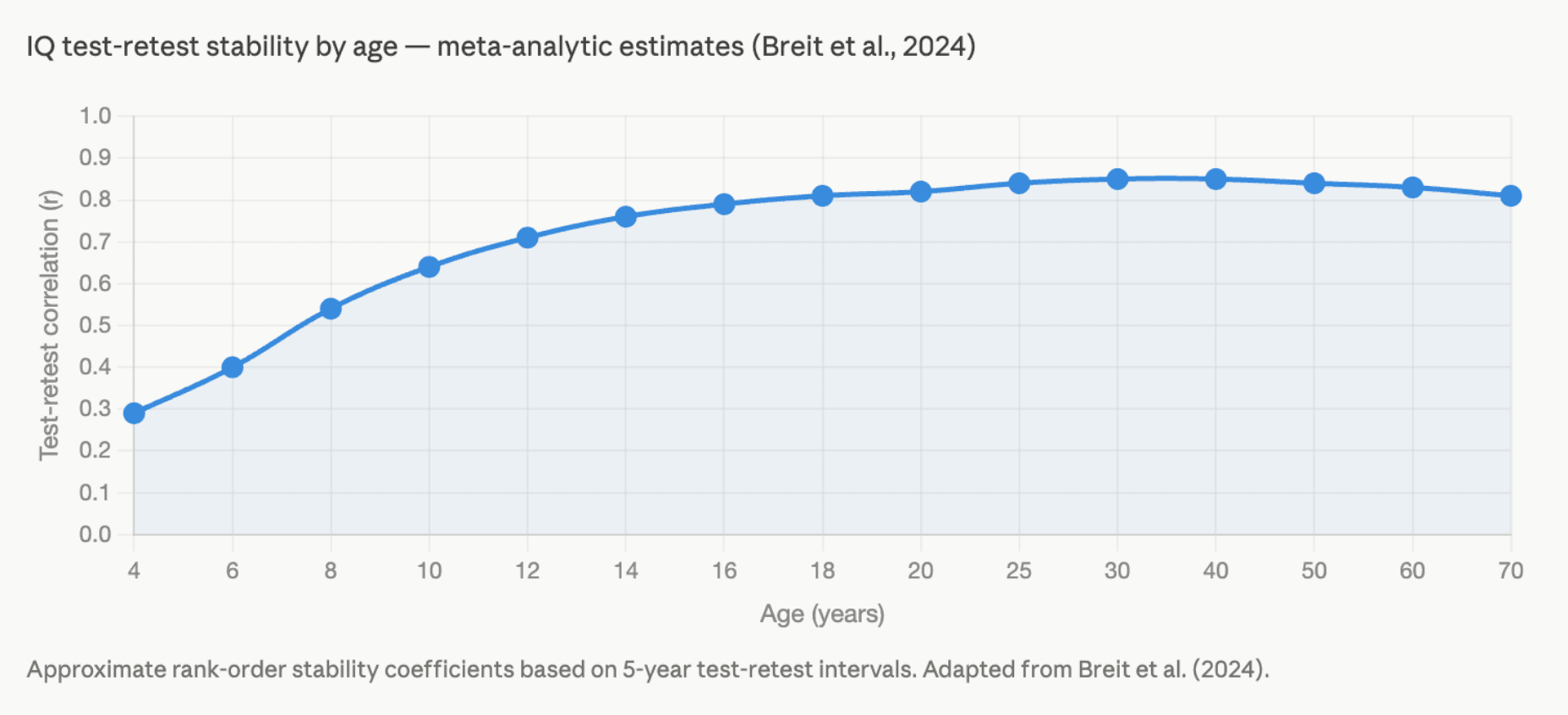
How to read subscores and index scores
Most professional IQ tests produce more than a single number. They report a global IQ alongside a set of index scores that describe performance in specific cognitive domains.
This structure reflects the Cattell-Horn-Carroll (CHC) theory of intelligence, the dominant scientific model in modern psychometrics. CHC theory organizes cognitive abilities into a hierarchy. At the top is g, the general factor that corresponds to general intelligence. Below g are several broad ability domains: fluid reasoning, comprehension-knowledge (crystallized intelligence), working memory, processing speed, spatial ability, and others.
A test built on the CHC model — like the Reasoning and Intelligence Online Test (RIOT) — reports both a global IQ and scores for the broad domains it measures. The RIOT provides index scores for Verbal Reasoning, Fluid Reasoning, Spatial Ability, Working Memory, Processing Speed, and Reaction Time. The global IQ is the most reliable single score. It has the highest statistical reliability and the strongest predictive validity for general life outcomes. Index scores are more specific and often show more variability. They describe a profile of cognitive strengths and weaknesses within the broader context of a person’s performance. Research on CHC-aligned subscores has shown that broad ability scores carry incremental value in specific applied contexts, particularly educational planning, where fluid reasoning, working memory, and processing speed each predict academic outcomes in ways that add information beyond the global IQ alone. Interpreting a profile of subscores requires care, however: differences between an individual's subscores must exceed what would be expected by chance before they represent a real pattern rather than measurement noise. When reviewing a score report, interpretation should start with the global IQ, then examine whether any broad ability index scores are notably higher or lower than what would be expected given the overall score. A meaningfully lower processing speed score in the context of a generally high IQ, for example, can be informative and worth investigating further.
What does an IQ score predict?
The scientific value of IQ comes from the fact that it predicts real outcomes in life. The research on this is extensive and consistent.
The strongest association is with school performance. The correlation between IQ and academic achievement is typically around .50 to .60. That makes IQ one of the strongest predictors in educational research. Learning new material, understanding complex concepts, and applying knowledge to novel problems all draw on the same cognitive resources that IQ tests measure. The relationship with occupational performance is nearly as robust. Frank Schmidt and John Hunter's landmark meta-analysis of 85 years of personnel research established that general cognitive ability is one of the best predictors of job performance and training success across occupations, with a predictive power of around r = .51. That advantage grows with job complexity. For cognitively demanding roles, the relationship is especially pronounced. Beyond education and work, IQ also predicts income (around r = .23), longevity, and lower rates of criminal behavior.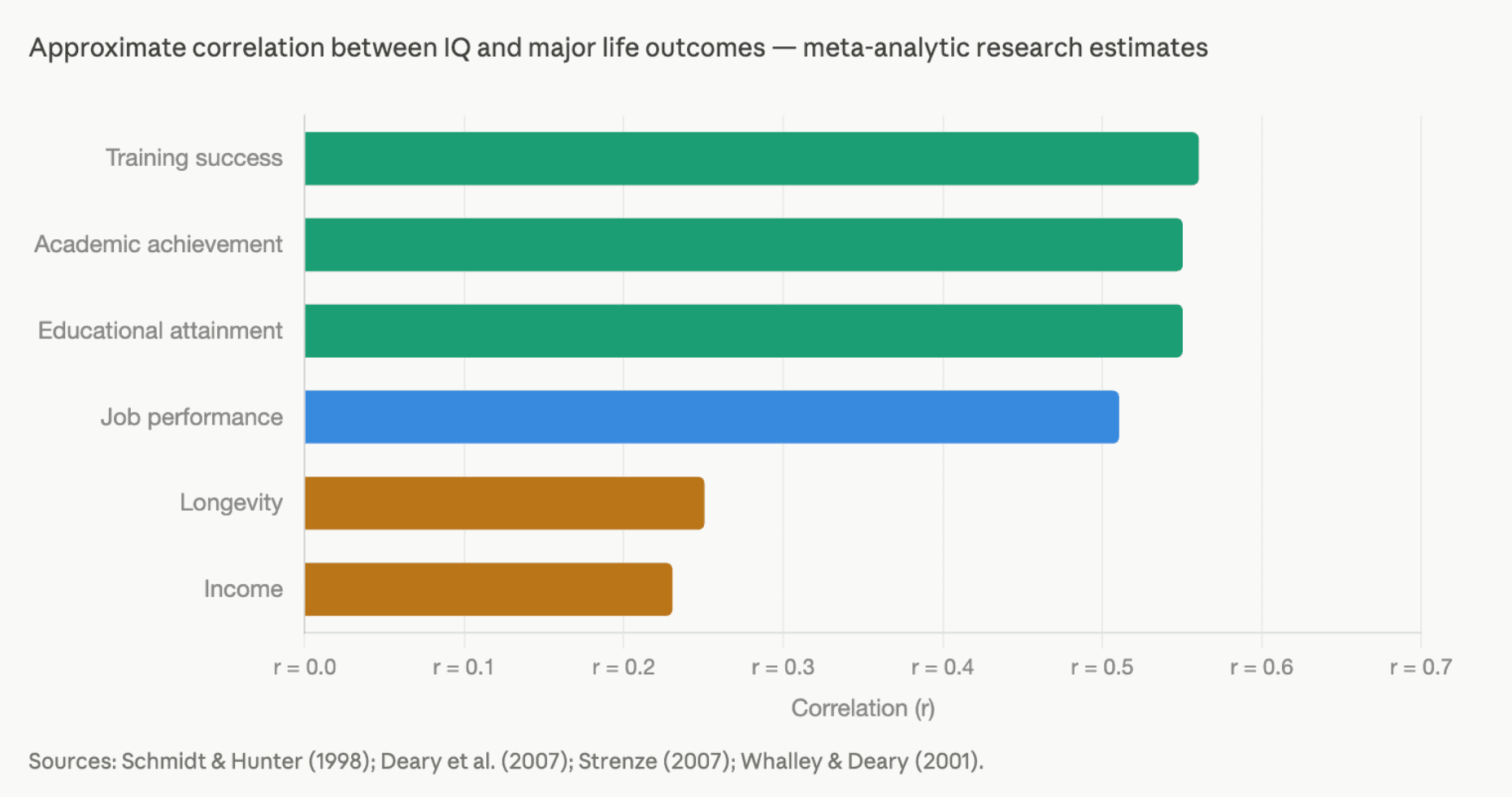 The correlations are meaningful but not deterministic. A correlation of .55 with academic achievement is strong for psychological research, but it leaves plenty of room for other characteristics to have an influence. Hard work, persistence, the quality of instruction, and other non-cognitive characteristics all matter. IQ is a probabilistic predictor, not a destiny.
What IQ scores do not tell us
IQ tests are designed to measure general cognitive ability, which is the capacity to reason, process information, and solve novel problems. They are not designed to measure everything that matters for life outcomes.
Personality characteristics (like conscientiousness, agreeableness, and neuroticism) and motivation are largely independent of IQ and matter enormously in many applied contexts. Research on the joint contributions of cognitive ability and non-cognitive traits has shown that personality characteristics, particularly conscientiousness, predict long-run outcomes in ways that genuinely add value beyond IQ. A person with a high IQ who does not show up, work hard, or cooperate effectively will be outperformed in many contexts by a person with somewhat lower IQ who does those things consistently. IQ also says nothing about accumulated expertise, domain-specific knowledge, social skills, or the practical experience that comes from years of work in a field. It does not measure a person's character or values.
An IQ score is one informative piece of evidence among many. It is one of the most predictive single measures available, but a comprehensive understanding of cognitive functioning always incorporates context and other information about a person.
It is important to recognize that there are genuine differences in what specific tests emphasize. Even though all professionally designed IQ tests are highly correlated (because they all measure g substantially), they differ in which broad abilities they weigh the most. A test that leans heavily on verbal tasks will produce different results for someone with strong verbal skills relative to their fluid reasoning, compared to a test that emphasizes nonverbal tasks.
A note on the RIOT
The Reasoning and Intelligence Online Test (RIOT) is the first professionally developed online IQ test built to meet the technical and ethical standards for psychological testing established by the American Educational Research Association, American Psychological Association, and National Council on Measurement in Education. It was developed by Dr. Russell T. Warne, who has spent more than 15 years researching human intelligence, and is built on the CHC model of cognitive abilities. The RIOT produces an overall IQ score alongside index scores for Verbal Reasoning, Fluid Reasoning, Spatial Ability, Working Memory, Processing Speed, and Reaction Time. The IQ scale ranges from 75 to 145, was normed on a representative U.S. sample, and was subject to independent expert review and screening for bias. The RIOT has received the same rigorous development as individually administered tests used.
Reading a RIOT score report follows the same interpretive logic described throughout this article. The overall IQ is the most reliable summary measure and the starting point. The index scores describe the profile of strengths within that overall score. The confidence interval provided with each score reflects inherent measurement uncertainty and prevents over-interpretation of small numerical differences.
What makes a professional test's score report valuable — compared to receiving a single number from an unvalidated quiz — is that it provides everything needed to interpret the number correctly: the score itself, the confidence interval, the percentile, and the subscores that give a more complete picture of cognitive functioning.
References
Carroll, J. B. (1993). Human Cognitive Abilities: A Survey of Factor-Analytic Studies. Cambridge University Press.
Schneider, W. J., & McGrew, K. S. (2018). The Cattell-Horn-Carroll theory of cognitive abilities. In D. P. Flanagan & E. M. McDonough (Eds.), Contemporary Intellectual Assessment (4th ed.). Guilford Press.
American Educational Research Association, APA, & NCME. (2014). Standards for Educational and Psychological Testing. Gottfredson, L. S. (1997). Why g matters: The complexity of everyday life. Intelligence, 24(1), 79–132. Gottfredson, L. S., & Deary, I. J. (2004). Intelligence predicts health and longevity, but why? Current Directions in Psychological Science, 13(1), 1–4. Breit, M., Scherrer, V., Tucker-Drob, E. M., & Preckel, F. (2024). The stability of cognitive abilities: A meta-analytic review of longitudinal studies. Psychological Bulletin. Schmidt, F. L., & Hunter, J. (1998). The validity and utility of selection methods in personnel psychology. Psychological Bulletin, 124(2), 262–274. Deary, I. J., Strand, S., Smith, P., & Fernandes, C. (2007). Intelligence and educational achievement. Intelligence, 35(1), 13–21. Murray, C. (2002). IQ and income inequality in a sample of sibling pairs. American Economic Review, 92(2), 339–343. Heckman, J. J., Stixrud, J., & Urzua, S. (2006). The effects of cognitive and noncognitive abilities on labor market outcomes. Journal of Political Economy, 114(3), 411–482. Lissitz, R. W., & Samuelsen, K. (2007). Applying and interpreting the standard error of measurement in intelligence testing. Journal of Psychoeducational Assessment.
McGrew, K. S., Schneider, W. J., Decker, S. L., & Bulut, O. (2023). A psychometric network analysis of CHC intelligence measures. Journal of Intelligence, 11(1), 19. Spearman, C. (1904). "General intelligence" objectively determined and measured. American Journal of Psychology, 15(2), 201–292. Horn, J. L., & Cattell, R. B. (1967). Age differences in fluid and crystallized intelligence. Acta Psychologica, 26, 107–129. Salthouse, T. A. (2010). Selective review of cognitive aging. Journal of the International Neuropsychological Society, 16(5), 754–760. Ritchie, S. J., & Tucker-Drob, E. M. (2018). How much does education improve intelligence? A meta-analysis. Psychological Science, 29(8), 1358–1369. Warne, R. T. (2025). Technical Manual for the Reasoning and Intelligence Online Test, Version 1.0. RIOT IQ. https://riotiq.com
Take our professional IQ test
Want to know your IQ? Try the first ever professional online IQ test.
AuthorDr. Russell T. WarneChief Scientist
