What Is Mental Age? What a Mental Age Test Really Measures
Mental age is the age level at which a person performs on cognitive tasks. It built the first IQ formula, and modern tests then dropped it. Here is why.
Dr. Russell T. WarneChief Scientist
Share
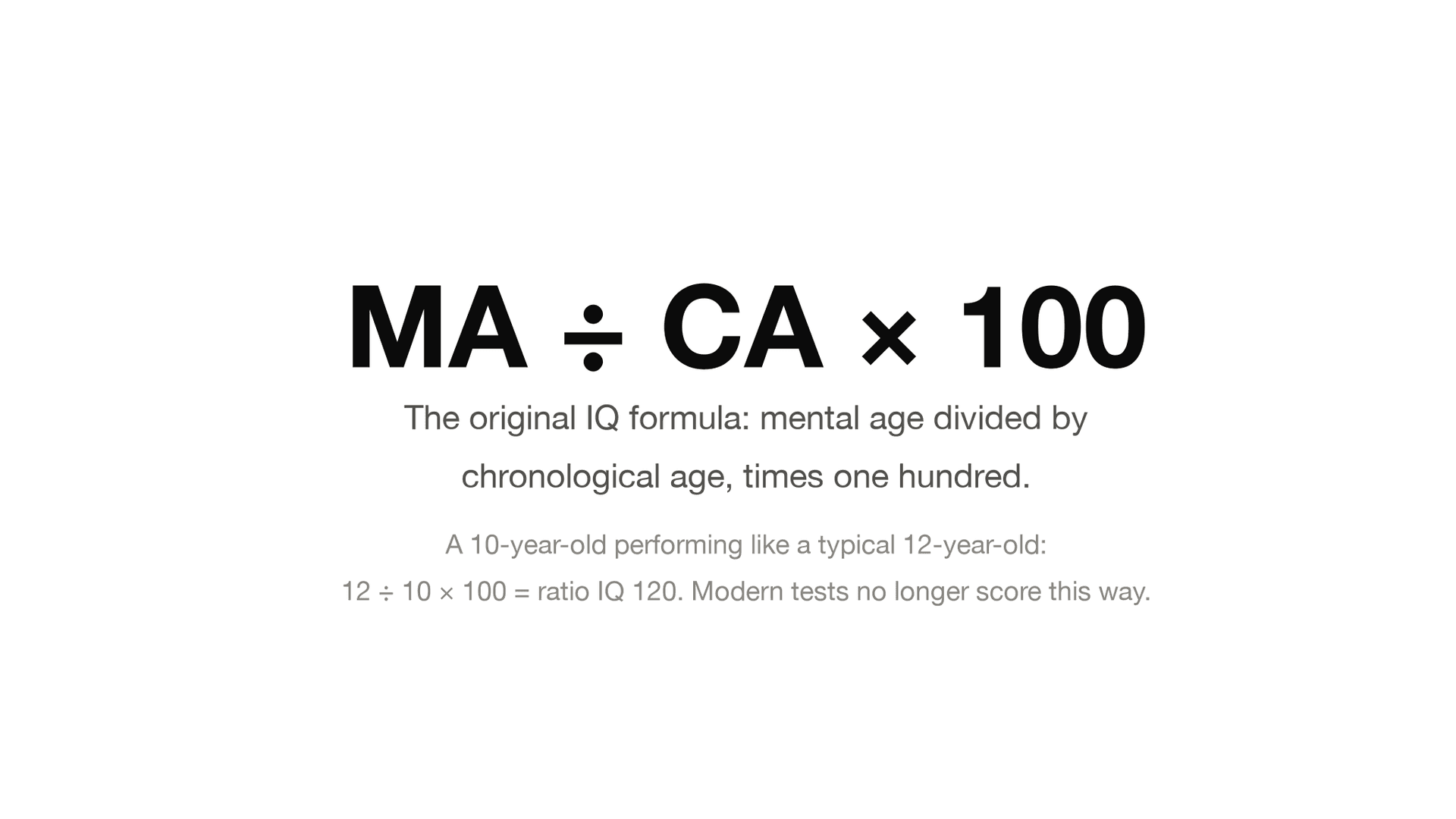
"Mental age" is the age level at which a person performs on cognitive tasks: a child who solves the problems a typical 12-year-old can solve has a mental age of 12, whatever their birth certificate says. The concept powered the first practical intelligence test in 1905 and gave IQ its original formula, mental age divided by chronological age, times 100. Modern tests abandoned that arithmetic decades ago, and the viral "mental age tests" that circulate online measure nothing at all. Here is what the idea really was, why it worked for children, and why psychology outgrew it.
Where mental age came from
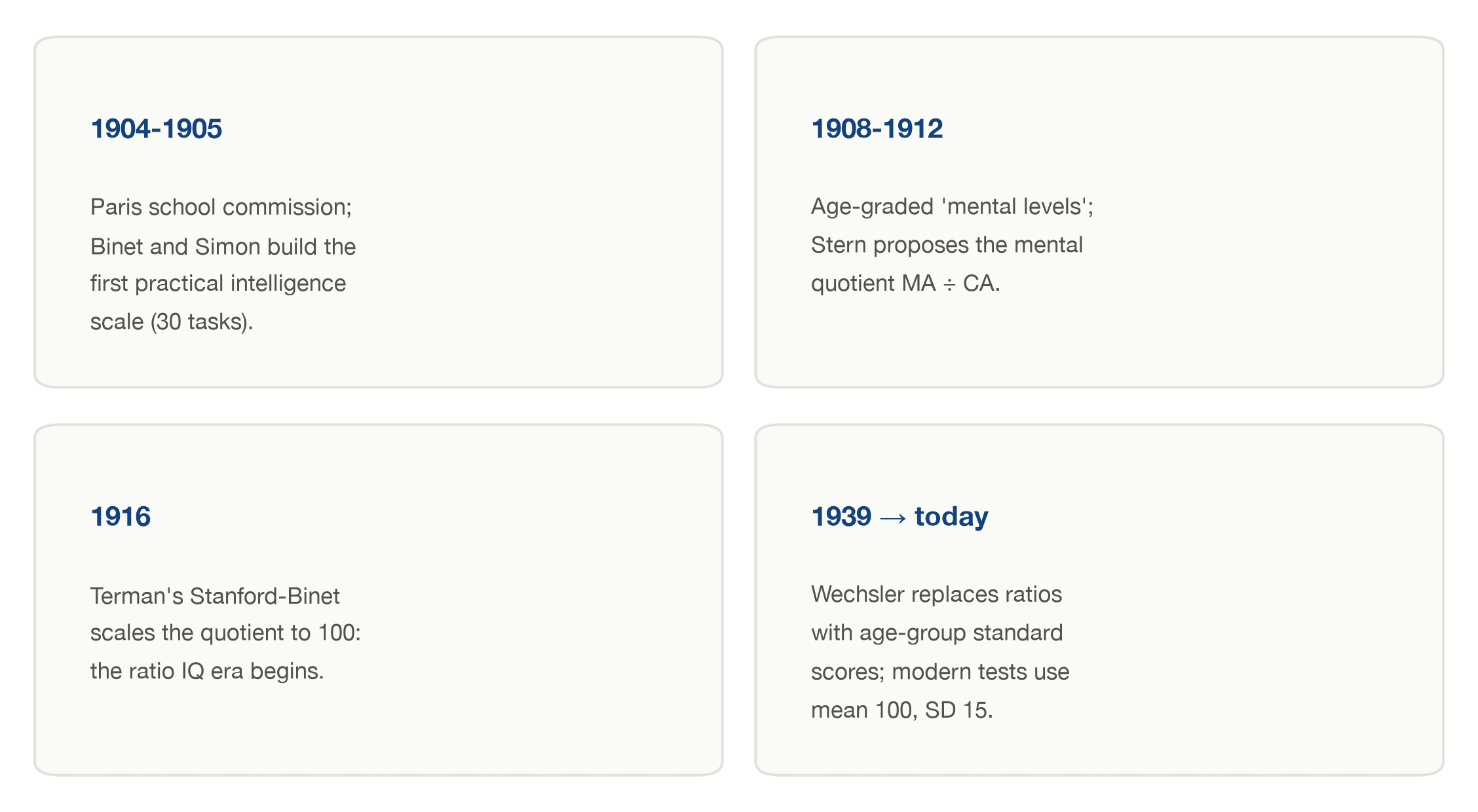
In 1904 the French ministry of public instruction appointed a commission on struggling schoolchildren in Paris, and asked how to identify pupils who needed special instruction. Alfred Binet and Théodore Simon answered in 1905 with the first practical "measuring scale of intelligence": thirty tasks arranged from easiest to hardest, anchored to what typical children at each age could do. Their 1908 revision made the age anchoring explicit, so a six-year-old who performed like a typical eight-year-old was said to be at the mental level of eight.
One nuance is worth keeping: Binet's own term was "mental level." The confident phrase "mental age," with its suggestion of a fixed developmental ladder, came from his American translators, and Binet himself resisted reading the scores that literally.
The original IQ formula
In 1912 the German psychologist William Stern proposed dividing mental age by chronological age, producing a "mental quotient" that let children of different ages be compared. Lewis Terman's 1916 Stanford-Binet scaled the quotient so the average sits at 100, and the "intelligence quotient" was born. In Terman's own words, to find it "we simply divide mental age by real age."
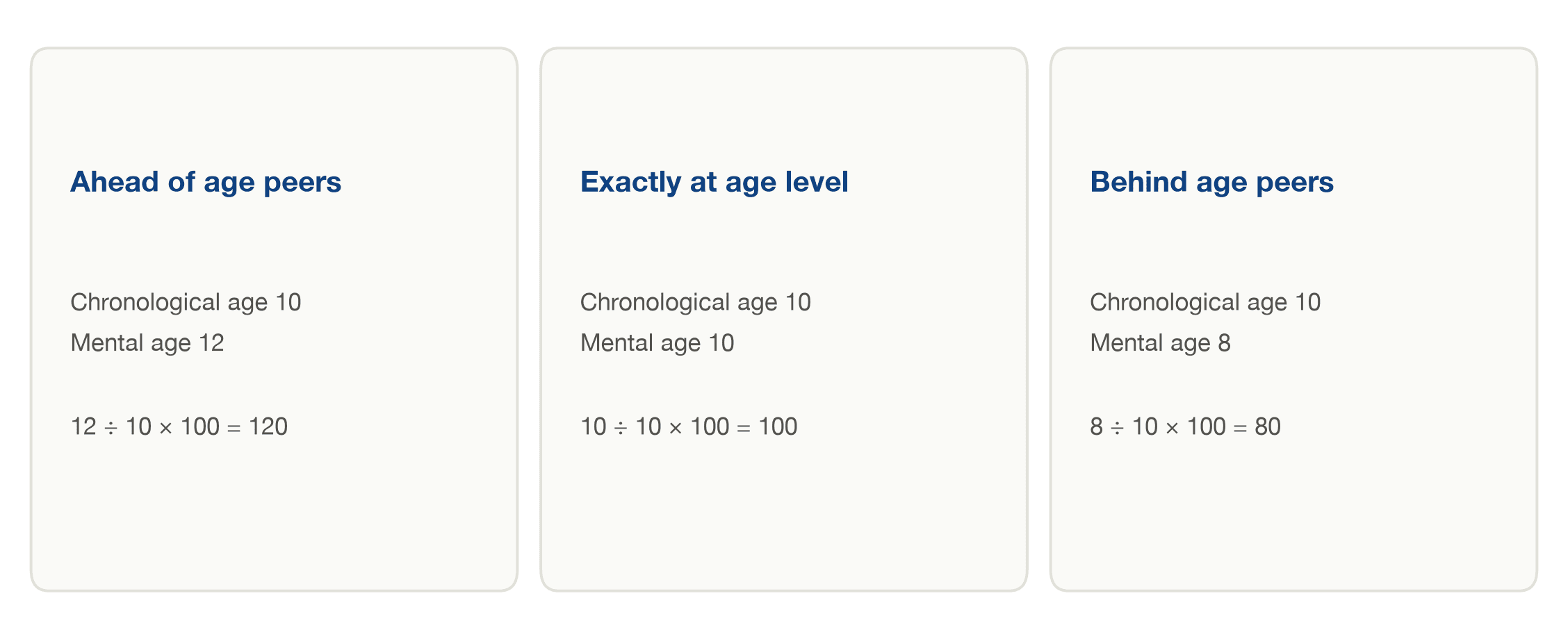
For schoolchildren the arithmetic worked well enough. A 10-year-old performing like a typical 12-year-old scored 120; one performing like a typical 8-year-old scored 80. Scores meant something concrete: distance ahead of or behind one's age group, in years.
Why mental age breaks down for adults
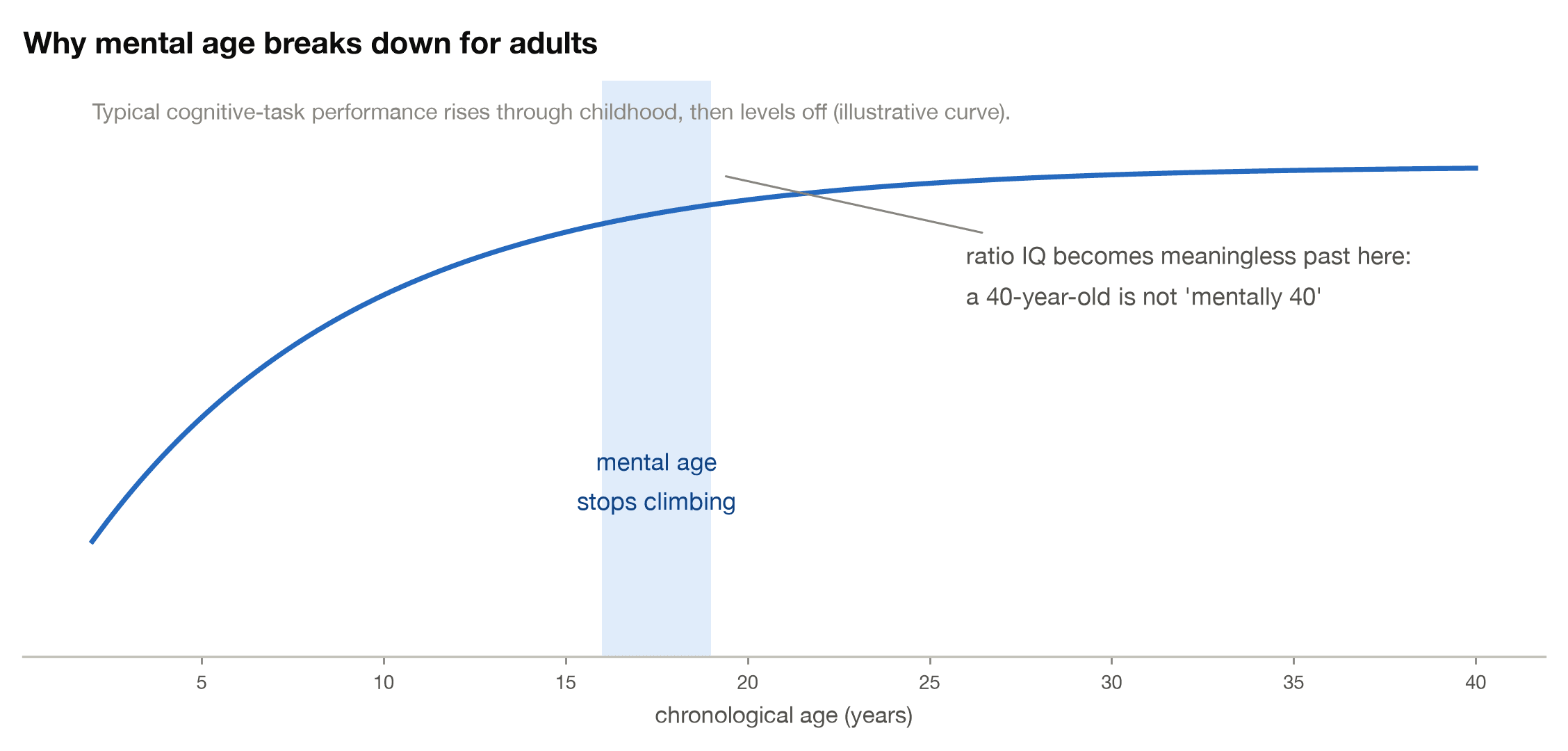
The formula has a fatal flaw, and Terman saw it in 1916: measurable intelligence "improves but little after the age of 15 or 16 years." Mental age stops climbing in mid-to-late adolescence while chronological age marches on, so the ratio turns to nonsense for adults. A perfectly average 40-year-old with the adult ceiling mental age of about 16 would compute to an IQ of 40, an absurd result for an ordinary person. Terman patched the problem by capping the denominator; the real fix came later.
What replaced it: the deviation IQ
David Wechsler's 1939 test dropped the quotient and scored people against the statistical distribution of their own age group. That "deviation IQ" is what every major test reports today: a mean of 100, a standard deviation of 15, and a score that means "here is where you stand among people your age." Even the modern Stanford-Binet, the direct descendant of Binet's scale, uses deviation scoring normed on thousands of census-matched cases. Our guides to how IQ is calculated and the IQ scale cover the modern system in detail.
Clinical practice moved on as well. The DSM-5 no longer diagnoses intellectual disability by IQ cutoff alone; severity is keyed to adaptive functioning, how a person actually manages daily life, with standard scores as one input.
Mental age today: clinics, courts, and viral quizzes
The phrase survives in three places. Clinicians sometimes use age-equivalent scores as a communication shorthand, with heavy caveats. Courts and journalists reach for "mental age of a seven-year-old" phrasing that professionals discourage, because a single age equivalent flattens a person's real profile of strengths and weaknesses. And the internet offers endless "what is your mental age?" quizzes, which publish no norms, no reliability data, and no standardization. Scores from such quizzes have no defined measurement meaning; they are entertainment, in the same way a fortune cookie is publishing.
Frequently asked questions
How was mental age calculated?
From performance on age-anchored tasks: a child who passed the items typical of 12-year-olds had a mental age of 12. Ratio IQ then divided mental age by chronological age and multiplied by 100.
What is the difference between mental age and IQ?
Mental age is a performance level expressed in years. IQ today is a deviation score: your standing relative to your own age group on a bell curve with mean 100 and standard deviation 15. The old ratio IQ connected the two; modern scoring does not use mental age at all.
Are online mental age tests accurate?
No. They are unnormed, unstandardized quizzes with no reliability evidence, so their scores have no measurement meaning. Real tests are normed on thousands of census-matched cases.
Do psychologists still use mental age?
Mostly no. Age-equivalent scores appear occasionally as clinical shorthand, but diagnosis and reporting rest on deviation scores plus adaptive functioning, per DSM-5 practice.
Why did tests stop using the ratio formula?
Because mental age plateaus in the mid-to-late teens, the ratio produces absurd results for adults. Wechsler's age-group standard scores fixed this in 1939 and became the universal method.
The takeaway
Mental age was a brilliant first draft: concrete, child-friendly, and good enough to launch a science. It was also a draft psychology revised a long time ago. If you want a number that means something today, you want a deviation score from a properly normed instrument, with stated precision. That is what the Reasoning and Intelligence Online Test from RIOT IQ provides, and it is the difference between measurement and a quiz. For what modern test items look like, see what kinds of questions are on an IQ test.
References
1. Binet, A., & Simon, T. (1905/1916). New methods for the diagnosis of the intellectual level of subnormals (E. S. Kite, Trans.). L'Année Psychologique, 12, 191-244. psychclassics.yorku.ca
2. Minton, H. L. (1998). Introduction to Binet and Simon (1905). Classics in the History of Psychology. psychclassics.yorku.ca
3. Terman, L. M. (1916). The measurement of intelligence. Houghton Mifflin. gutenberg.org
4. Kovacs, K., & Pléh, C. (2023). William Stern: The relevance of his program of "Differential Psychology" for contemporary intelligence measurement and research. Journal of Intelligence, 11(3), 41. doi.org
5. Boake, C. (2002). From the Binet-Simon to the Wechsler-Bellevue: Tracing the history of intelligence testing. Journal of Clinical and Experimental Neuropsychology, 24(3), 383-405. doi.org
6. Russo, N., et al. (2021). Choices, challenges, and constraints: A pragmatic examination of the limits of mental age matching in empirical research. Development and Psychopathology, 33(2), 727-738. doi.org
7. National Academies of Sciences, Engineering, and Medicine. (2015). Clinical characteristics of intellectual disabilities. National Academies Press. ncbi.nlm.nih.gov
Take our professional IQ test
Want to know your IQ? Try the first ever professional online IQ test.