The IQ Scale Explained: Ranges, Chart, and What Scores Mean
The IQ scale sets the average at 100 with a standard deviation of 15, so most people score 85–115. See the full chart of IQ ranges and what each score means.
Dr. Russell T. WarneChief Scientist
Share
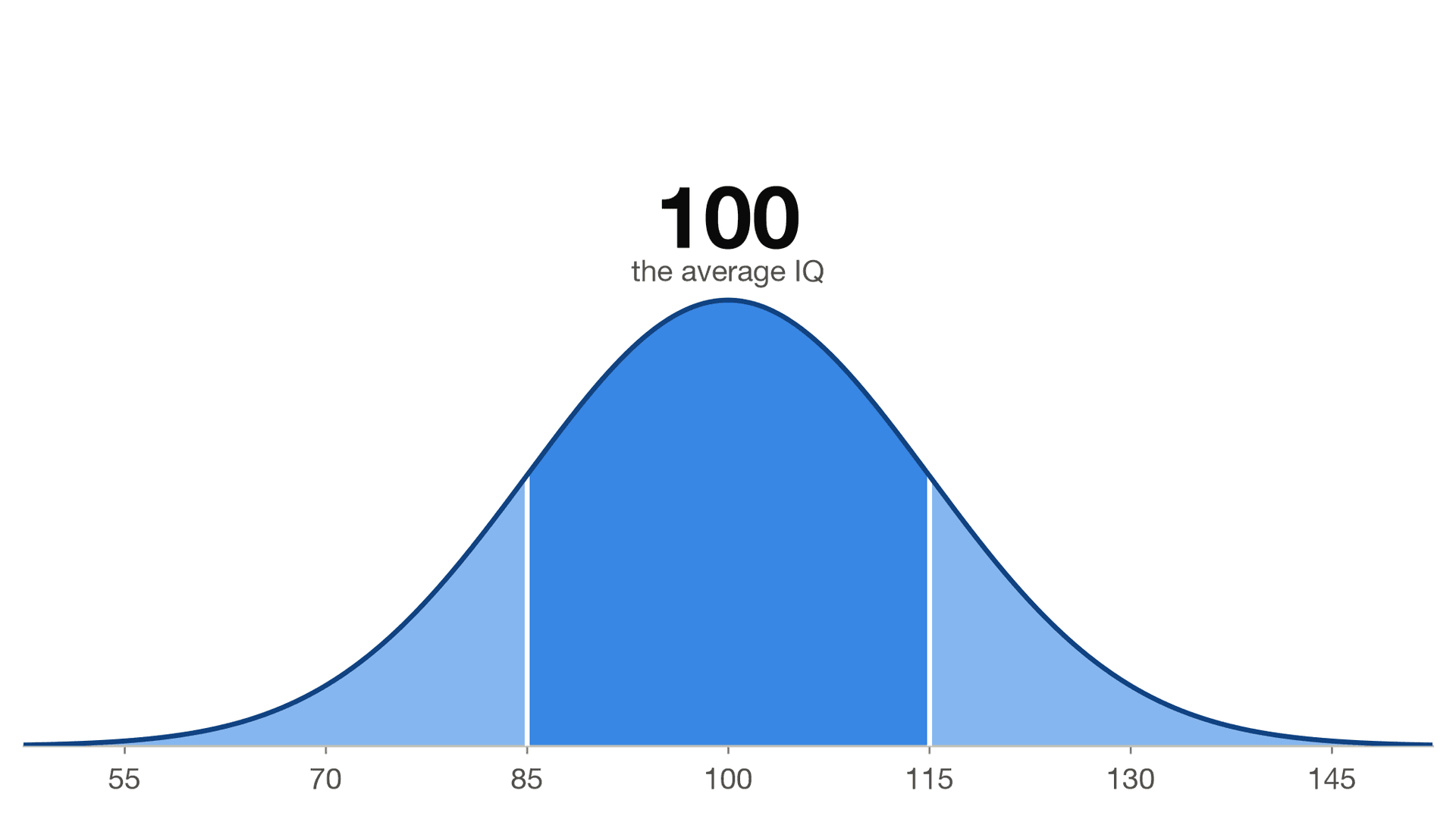
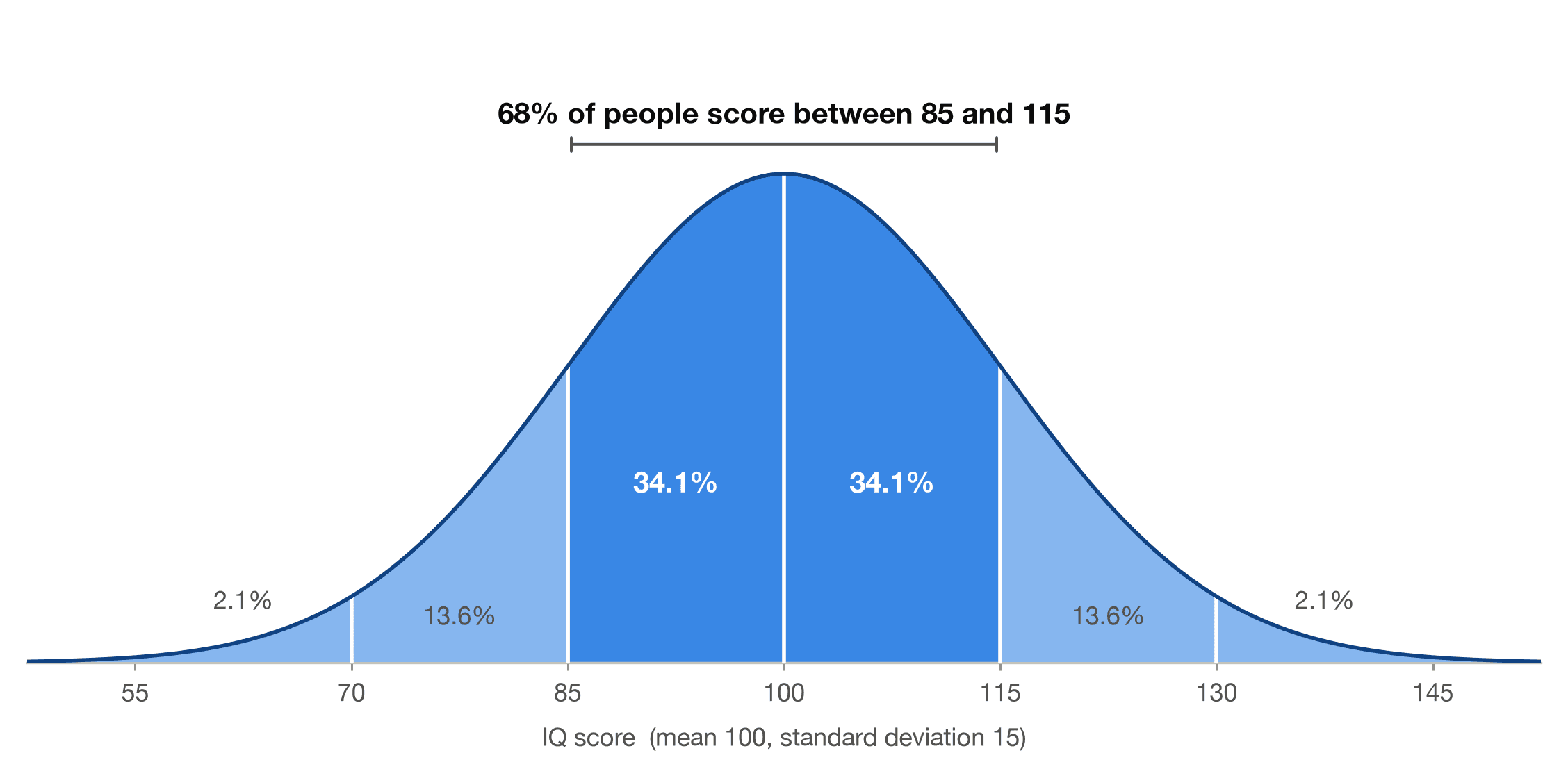
The IQ scale is a standardized scoring system in which the average score is set at 100 and the “standard deviation,” a measure of how spread out scores are, is 15 points. On this scale, about 68% of people score between 85 and 115, and about 95% score between 70 and 130. Scores follow a “normal distribution” (popularly called a “bell curve”), which makes very high and very low scores increasingly rare. This guide breaks down the full range of IQ classifications, shows how common each score is, and explains how to interpret IQ test results with appropriate caution.
What Is the IQ Scale?
An IQ scale is a standardized system for interpreting intelligence test results. The average score is set at 100, and most people score between 85 and 115. The further a score is from 100, the rarer it becomes.
Modern IQ tests use what psychometricians call "deviation IQ." Rather than calculating a ratio between mental age and chronological age (the original method from the early 1900s),deviation IQ compares your performance to others in your age group who took the same test. This approach gives scores consistent meaning across different ages and populations.
The Standard IQ Score Range and Classifications
When a test taker receives an IQ score, it is often labeled based on a classification system that describes how the person’s cognitive abilities compare to the general population. The labels vary slightly between tests, but the underlying statistical and interpretational framework stays the same.
Very High IQ
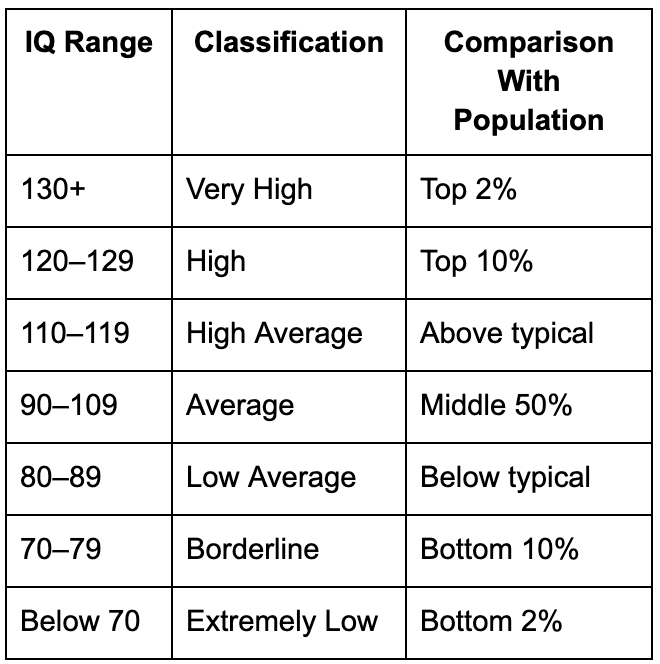
Scores of 130 and above place someone in the top 2% of the population. People in this range often qualify for gifted programs or high-IQ societies like Mensa. That said, avery high IQ does not guarantee success in any particular field. But it does say that the person has enough baseline ability to learn the skills and information needed to succeed in a wide variety of fields.
High IQ
The 120–129 range represents the next tier down, roughly the top 10% of test-takers. Many professionals in intellectually demanding careers score here, though plenty of successful people score lower, and plenty of high scorers work in all kinds of fields.
High Average IQ
Scores between 110 and 119 reflect above-typical cognitive functioning. This range often goes unnoticed because it doesn't qualify for special programs or labels, yet it represents meaningfully stronger reasoning and learning abilities than the population average. Many people who graduate from college and are successful in business and other endeavors have scores in this range.
Average IQ
The 90–109 range is where about half the population scores. "Average" is a statistical term here, not a value judgment. It means typical performance compared to same-age peers who took the same test under similar conditions. Many aspects of society are designed for people in the average range of IQ, and most semi-skilled jobs are obtainable by people with IQs between 90 and 109.
Low Average IQ
Scores of 80–89 are below average but still normal cognitive functioning. People in this range live independently, hold jobs, and manage daily responsibilities without difficulty. The "low" in "low average" refers only to position on the normal distribution.
Borderline IQ
The 70–79 range sometimes warrants further evaluation, particularly if someone is experiencing difficulties in school or daily life. However, a score in this range alone does not indicate disability or predict life outcomes with any certainty. That being said, many aspects of life are more challenging to people with IQs in this range, and these people are more likely to succeed when everyday tasks (e.g., caring for their health) are simplified.
Extremely Low IQ
Scores below 70 fall in the extremely low range and many people with scores this low have an intellectual disability. Clinical diagnosis of intellectual disability requires more than just an IQ score, though. Psychologists also assess adaptive functioning (which is the practical skills needed for daily life) before making any diagnosis.
IQ Scale Chart: How Common Is Each Score?
Two facts explain the whole chart: scores center on 100, and each step away from 100 is rarer than the last.
• 130 and above (Very High): about 2% of people
• 120–129 (High): about 7%
• 110–119 (High Average): about 16%
• 90–109 (Average): about 50%
• 80–89 (Low Average): about 16%
• 70–79 (Borderline): about 7%
• Below 70 (Extremely Low): about 2%
Percentages are derived from the normal distribution with a mean of 100 and a standard deviation of 15; label conventions vary somewhat between tests.
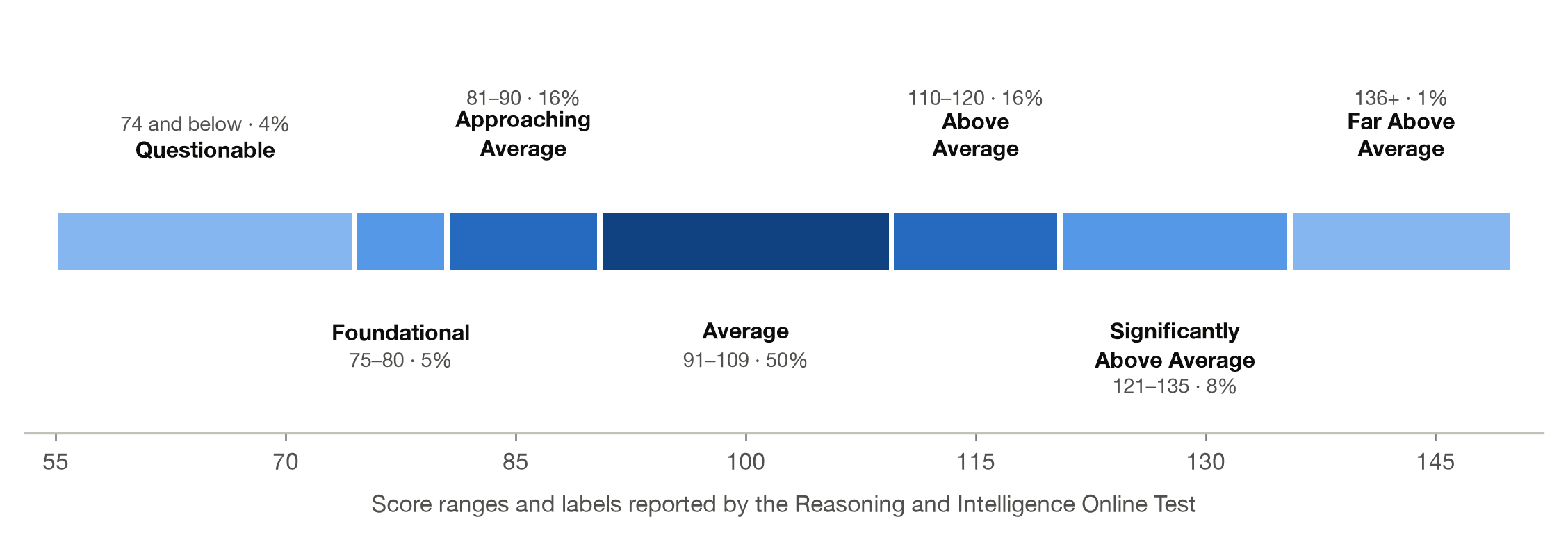
The Reasoning and Intelligence Online Test uses its own reporting labels: scores from 91 to 109 are “Average” (about half the population), 110 to 120 is “Above Average,” 121 to 135 is “Significantly Above Average,” and 136 and above is “Far Above Average.” Below the average range, 81 to 90 is “Approaching Average,” 75 to 80 is “Foundational,” and scores of 74 and below are labeled “Questionable.”
What Is the Average IQ Score
The average IQ is 100 by design, not by coincidence. When professional test creators, called psychometricians, develop a new IQ test, they administer it to a large sample of people (called the norm sample) and then set the scale so that the norm sample’s average equals exactly 100.
For a deeper look at how the average is set and how it compares by age and country, see our guide to the average IQ.
What Is a Good IQ Score?
"Good" depends entirely on context. A score of 110 might be considered good for general purposes, while certain graduate programs or competitive positions might expect higher. There's no universal threshold that separates "good" from "not good."
The most meaningful way to think about any IQ score is whether it accurately reflects your cognitive abilities. A "good" score is one you can trust, which means it is one that came from a properly normed test with established reliability and validity.
What Is Considered a High IQ Score
Scores of 120 and above are typically labeled "high," placing someone in roughly the top 10% of the population. At 130 and above, scores enter the "very superior" range, representing the top 2%.
High scores suggest strong reasoning, problem-solving, and learning abilities. Yet IQ tests capture only certain aspects of cognition. Creativity, social skills, personality traits and many other important aspects are not measured by standard IQ tests.
What IQ Is Considered Genius?
The term "genius" appears constantly in popular discussions of IQ, but it is not a formal clinical classification. In the early 20th century, the threshold for “genius” was about an IQ of 140, but today the term has no scientific meaning. Some popular sources place the "genius" threshold anywhere from 140 to 160 or higher, but there is no official standard.
Mensa Qualification Requirements
Mensa accepts members who score at or above the 98th percentile on approved intelligence tests. Because different tests have different score distributions, the qualifying number varies. On the Wechsler scales, the cutoff is 130.
Gifted Program Classifications
Educational giftedness thresholds vary considerably by program and location. Some states and school districts use IQ cutoffs of 120 or 130 as a minimum for program admission. Others purposely avoid using IQ tests and instead base admission decisions on criteria like achievement tests, teacher recommendations, or creativity assessments.
The meaning of "gifted" matters here. “Gifted” is an educational classification that states that the typical educational program is not challenging enough for the child. It does not refer to an innate, unchanging ability in the child.
How High Does the IQ Scale Go?
The IQ scale does not extend upward without limit. Every test has a “test ceiling,” which is the highest score it can report. On the most widely used modern tests, the ceiling is about 160. Scores above the ceiling cannot be measured reliably because too few people in any norm sample score that high.
This is why claims of IQs of 180, 200, or higher should be treated with skepticism: no properly normed modern test produces them. For more, see what is the highest possible IQ.
What Is a Full Scale IQ?
A “full scale IQ” (FSIQ) is not a different scale. It is the overall composite score a test reports after combining performance across all of its subtests. Subtest and domain scores (such as verbal ability or working memory) describe specific abilities; the full scale IQ summarizes general performance in a single number on the standard scale described above. Read our full explainer on what a full scale IQ is.
How IQ Scales Differ Across Tests
Most IQ scores from different IQ tests are comparable, but in some circumstances this comparability can break down. Be cautious with comparing scores across tests in these situations:
• Standard deviation: The standard deviation (SD) is a measure of how spread out scores are. Most tests’ IQ scales have a SD of 15. But some use 16 as the SD, which affects how scores are spread out. For scores near the average (100), the differences are trivial. But for scores further from the average, discrepancies between the different IQ scales can be noticeable
• Norming sample: Tests that collect their norm samples at about the same time and from similar populations will produce comparable scores. However, if two tests are normed more than about 15 years apart, or if the norm samples are not similar (e.g., from different countries, different age groups, or speaking different languages), then the scores will not be comparable.
• Test ceiling and floor: The “test ceiling” is the maximum score for a test, and the “test floor” is the minimum score for a test. People who score extremely high or who struggle with the most basic questions are often given a score at or near the test’s ceiling or floor, even if that number is not a good reflection of their abilities. Additionally, most test scores are less precise in the 5 points or so near the ceiling or floor.
Understanding IQ Percentiles and Standard Deviation
Percentiles and standard deviations provide additional context for interpreting IQ scores beyond simple classification labels.
• Percentile rank: The percentage of people who scored lower than the test taker. An IQ of 115 corresponds to roughly the 84th percentile, meaning the person scored higher than 84% of the norming sample.
• Standard deviation: About 68% of people score within one standard deviation of the mean (between 85 and 115).
• Confidence interval: There is always some inexactness when measuring intelligence (or any other psychological trait). To make test users aware of this, test creators often report a range of scores (called a “confidence interval”) that represent the range of scores where the person’s actual ability is likely to be within. It is helpful to think of this range as a margin of error around the score that the test taker obtained.
What IQ Scores Measure
Most IQ tests measure general intelligence and also a collection of more specific cognitive abilities. The most common abilities that are measured on tests include:
• Verbal ability: The ability to understand, master, and use the nuances of language
• Fluid reasoning: The ability to solve novel problems without relying on prior knowledge
• Crystallized knowledge: Accumulated information and skills learned through education and experience
• Processing speed: How quickly you can perform simple cognitive tasks
• Working memory: The ability to hold and manipulate information in mind temporarily
• Visual-spatial processing: Understanding and manipulating visual information
Knowing which abilities a particular test measures helps clarify what an IQ score actually reflects.
Classification of Low IQ Scores
Clinical diagnosis of intellectual disability requires more than an IQ score below 70. Current diagnostic criteria also require significant limitations in adaptive functioning: the practical skills needed for daily life.
A low IQ score alone does not determine whether someone has an intellectual disability. There needs to be a combination of low IQ and adaptive limitations. Additionally, these limitations and low IQ need to begin during childhood or adolescence.
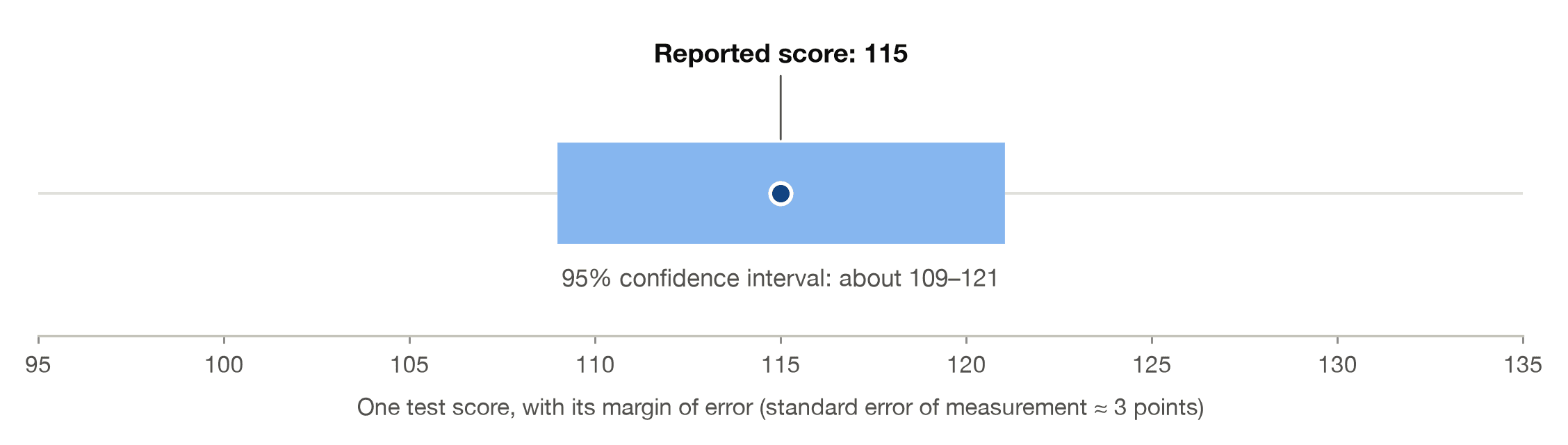
Every test score includes some inexactness, called “measurement error”. On most professionally developed tests, the “standard error of measurement” is around three points, so a reported IQ of 115 most likely reflects a true score between about 109 and 121. Reputable tests provide confidence intervals that show this range of uncertainty. Treating a score as a precise, fixed number overstates what any single test administration can reveal.
Understand Your Subscale Scores
A composite IQ score can mask meaningful variation in specific abilities. Someone might have exceptional verbal reasoning but average processing speed, or strong fluid reasoning but weaker crystallized knowledge. Looking at the full profile often reveals useful information that is overlooked when focusing on the overall number alone.
Consider Context
Scores should never be interpreted in isolation. Testing occurs within the context of the norm sample, the test taker’s life, and the purpose of testing. A given score may be “good” for a particular examinee taking the test for one purpose and “disappointing” for a different examinee or purpose. Often, the examiner who administered the IQ test will provide information that is helpful in interpreting the score.
Why Your IQ Test Choice Matters
The quality of an IQ test determines how meaningful your score will be. Tests that follow professional psychometric standards, such as proper norming, reliability testing, and validity evidence, produce scores you can trust for important decisions.
Many online IQ tests lack scientific rigor, offering entertainment rather than accurate measurement. However, online testing can meet professional standards when created by testing professionals who have built their test on established theoretical frameworks and scored using data from representative norm samples. Before taking an online IQ test, it is important to do some research into the test to make sure that its creator(s) are professionals and that the test has been reviewed by independent experts. Tests created by amateurs or anonymous parties should always be avoided.
The Reasoning and Intelligence Online Test was developed by a team led by intelligence researcher Dr. Russell T. Warne and reports scores on the standard scale, with a mean of 100 and a standard deviation of 15, and provides a full cognitive profile rather than a single number. Take the RIOT IQ test.
Frequently Asked Questions
What is the IQ scale?
The IQ scale is the standard scoring system for intelligence tests: the average is set at 100 with a standard deviation of 15, so about 68% of people score between 85 and 115.
What is the range of the IQ scale?
About 95% of people score between 70 and 130, and 99.7% score between 55 and 145. Most professionally developed tests can report scores only up to a ceiling of roughly 160.
What is a normal IQ on the scale?
Scores from 85 to 115 cover the middle 68% of the population. On the Reasoning and Intelligence Online Test, the “Average” range is defined as 91 to 109, which contains about half of the population.
Is 120 a high IQ?
Yes. A score of 120 is higher than approximately 91% of the population and marks the start of the high range in most classification systems.
What is a full scale IQ?
A full scale IQ is the overall composite score an IQ test reports after combining performance across all of its subtests. It is a summary of general cognitive performance, not a separate scale.
What IQ is considered genius?
There is no scientific definition of “genius.” Scores of 130 and above (roughly the top 2%) are commonly described as very high. More on genius IQ scores.
References
1. American Educational Research Association, American Psychological Association, & National Council on Measurement in Education. (2014). Standards for educational and psychological testing. American Educational Research Association. testingstandards.net
2. American Mensa. (n.d.). Qualifying test scores.us.mensa.org
3. American Psychological Association. (n.d.). Deviation IQ. In APA dictionary of psychology.dictionary.apa.org
4. Warne, R. T. (2020). In the know: Debunking 35 myths about human intelligence. Cambridge University Press. doi.org/10.1017/9781108593298
5. Watkins, M. W., Canivez, G. L., Dombrowski, S. C., McGill, R. J., Pritchard, A. E., Holingue, C. B., & Jacobson, L. A. (2022). Long-term stability of Wechsler Intelligence Scale for Children–Fifth Edition scores in a clinical sample. Applied Neuropsychology: Child, 11.doi.org/10.1080/21622965.2021.1875827
Take our professional IQ test
Want to know your IQ? Try the first ever professional online IQ test.