Does IQ matter? Yes—in school, jobs, income, and health, higher IQ strongly predicts success. But it’s not destiny. Discover why IQ matters and where it doesn’t.
Dr. Russell T. WarneChief Scientist
Share
Since the early 20th century, psychologists have studied how IQ relates to various life outcomes. The research is clear: intelligence, as measured by IQ tests, predicts many important outcomes in life. But IQ is not destiny, and understanding the limits of what it can reveal is just as important as understanding its predictive power.
Where IQ matters most
IQ is an especially strong predictor in settings that demand complex problem-solving, abstract thinking, and quick learning. These contexts include:
Education: IQ isone of the best predictors of academic performance across all grade levels. Students with higher IQ scores tend to earn better grades, score higher on standardized tests, and complete more years of schooling. This makes sense; school is fundamentally about learning new information and solving problems, which are core components of intelligence.
The workplace: In professional settings, IQ predicts job performance, especially in cognitively demanding occupations. Higher IQ is associated withfaster training times and better job performance across many industries. The relationship is strongest for complex jobs like engineering, medicine, and scientific research, where problem-solving and abstract thinking are central to daily work.
Income: People with higher IQ scores tend to earn more money over their lifetimes. Some of this relationship is causal; cognitive ability helps people access well-paying careers that have explicit or implicit intelligence requirements for entry or advancement.
Health and longevity: Higher IQ is associated with better physical health and longer life expectancy, even after controlling for socioeconomic status. One reason may be that people with higher cognitive ability are better at understanding health information, following medical advice, and avoiding risky behaviors.
Where IQ matters less
While IQ predicts many outcomes, its predictive power is limited in several areas:
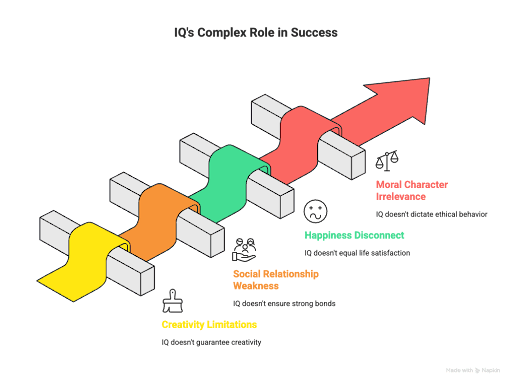
Creativity: IQ and creativity overlap to some degree, but they are not the same thing. An above-average level of intelligence is necessary for high-level creative work, but factors like openness to experience, motivation, and domain-specific knowledge are also important.
Social relationships: IQ does not predict the quality of friendships, romantic relationships, or family bonds. Emotional regulation, empathy, communication skills, and personality traits are far more influential in these domains.
Happiness and life satisfaction: The correlation between IQ and happiness is weak at best. People across the entire IQ spectrum report similar levels of well-being. Social connections, a sense of purpose, and stable mental health matter much more for life satisfaction.
Moral character: Intelligence has no relationship with ethical behavior. High-IQ individuals are not more virtuous, honest, or compassionate than others. Character is shaped by values, upbringing, and personal choices, not cognitive ability.
IQ describes probabilities, not certainties
One of the most important things to understand about IQ is that it operates probabilistically. A person with an IQ of 115 is more likely to succeed in college than someone with an IQ of 95, but individual outcomes vary tremendously based on other factors.
Hard work, conscientiousness, emotional stability, and supportive environments can help people achieve more than their IQ alone would predict. In the workplace, for example, non-cognitive traits can compensate for about 7-10 IQ points, depending on the job and circumstances. However, there are limits to this compensation. It would be unrealistic to expect someone with an IQ of 85 to become a physician, no matter their dedication.
Conversely, a high IQ does not guarantee anything. Intelligence opens doors, but doesn't force people to walk through them. Plenty of high-IQ individuals underachieve due to a lack of motivation, poor work habits, or personal challenges. Think of IQ as a tailwind; it makes many things easier, but it's not a substitute for effort, persistence, or good decision-making.
Notable exceptions
While higher IQ generally correlates with positive outcomes, some conditions are actually more common in people with higher scores. High-functioning autism and anorexia nervosa both showelevated rates in higher-IQ populations. This demonstrates that intelligence is not a universal advantage in every aspect of human functioning.
IQ is a useful predictor of outcomes in education, work, and health-related domains. It captures a real and important aspect of human cognitive ability. At the same time, IQ is just one piece of a much larger puzzle. Personality, motivation, social skills, emotional regulation, and environmental factors all play crucial roles in shaping life trajectories.
This probabilistic perspective is both accurate and helpful. It acknowledges the real influence of intelligence while avoiding two extremes: dismissing IQ entirely or treating it as an all-determining fate. Intelligence matters, but so do many other things. That's actually encouraging news, because it means people at all levels of cognitive ability can find meaningful paths to success and fulfillment.
Watch “Hidden Talents Behind Bars: How Harsh Environments Reshape Intelligence” on the Riot IQ YouTube channel for a surprising look at what really defines ability beyond IQ scores.
Take our professional IQ test
Want to know your IQ? Try the first ever professional online IQ test.