What IQ is considered genius? Discover what IQ level is considered genius, historical 140 threshold, rarity of genius level IQ scores, and more.
Dr. Russell T. WarneChief Scientist
Share
A good IQ test can tell you where a score falls on a scale, but labels like "genius" are less precise than they sound. The question "what IQ is considered genius?" is one of the most frequently asked questions in IQ and intelligence research, and the answer is more complicated than most people expect.
Different organizations use different thresholds for labeling scores, and these cutoffs are arbitrary. To understand what constitutes a genius-level IQ, it is necessary to look at how IQ scores are distributed and the historical context behind these classifications.
Understanding IQ Score Distribution
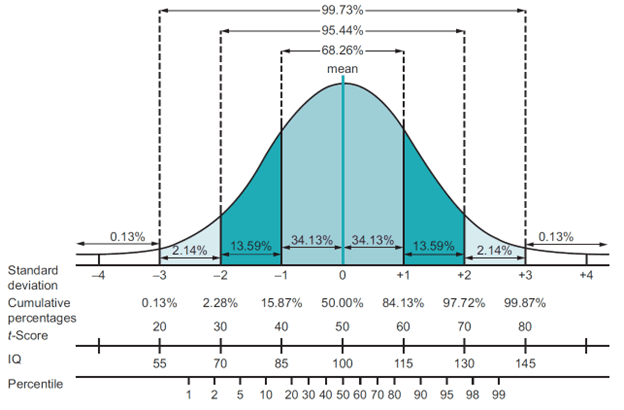
Professionally developed IQ scores that form a bell-shaped curve, called a “normal distribution,” when graphed (pictured below). Most IQ tests, including professionally developed tests like theReasoning and Intelligence Online Test (RIOT), use a scale where 100 is the average IQ, and the standard deviation (a measure of how spread out scores are) is 15 points. On this metric, about 68% of people in a normal distribution of IQ scores have a score between 85 and 115. About 95% of people score between 70 and 130. The further a score is from 100, the fewer people obtain that score.
This statistical reality is important for understanding the rarity of high IQ scores. Only about 2.37% of the population scores above 130, and less than 0.13% score above 145.
It is important to notice that there is a gradual transition from average scores (in the middle at the highest point in the curve) to the extremes where there are few people scoring high -- or low. This means that there is no natural break point that serves as a dividing line between “genius” and “non-genius” scores. Any cutoff point will be arbitrary.
IQ Score Classifications
Even though there is no natural dividing line between different categories of scores, many intelligence test creators still create ranges of scores and label them. This helps with interpretation because most non-experts are not accustomed to dealing with IQ scores.
There is no set of ranges and labels that all IQ test creators agree on, but the ranges and labels are broadly similar because most tests have the same average (100) and same standard deviation (15). The score ranges and labels for the RIOT are:
● 64 and below: Questionable score (4% of population)
● 75-80: Foundational score (5% of population)
● 81-90: Approaching Average Score (16% of population)
● 91-109: Average Score (50% of population)
● 110-120: Above Average Score (16% of population)
● 121-135: Significantly Above Average Score (8% of population)
● 136 or higher: Far Above Average Score (1% of population)
These cutoffs are not based on any natural boundaries in human cognition. Asresearch on the structure of intelligence shows, cognitive abilities exist on a continuum. There is no magical point where someone suddenly becomes a "genius." Also, notice that on the RIOT, it is the score that is classified as “average,” “above average,” etc. The RIOT is not designed to label people.
What IQ Score is “Genius”? The Historical Perspective
The term “genius” is not used among psychologists today, but historically the label was applied to people (often children) with very high IQ scores. The most famous cutoff for genius was an IQ of 140, set by Lewis Terman in the 1910s. He later applied this cutoff into a famous study of over 1,500 high-scoring children in a long-running study called the “Genetic Studies of Genius.” Because of Terman’s prominence as creator of the Stanford-Binet, president of the American Psychological Association, and instigator of a famous study of high-IQ kids, the cutoff of an IQ of 140 became a common threshold for “genius.”
Terman followed the high-IQ children in his Genetic Studies of Genius for over 70 years. Contrary to popular stereotypes about troubled geniuses, they generally became well-adjusted, successful adults with better mental health, higher education levels, and greater career success than average. This research challenged the "mad scientist" stereotype and showed that high intelligence typically leads to positive life outcomes. These results have since been replicated in other studies of bright young people.
Today, researchers are more cautious about using the term "genius" to describe high IQ scores. Professional test creators, including those who developed the RIOT, typically avoid the word "genius" in their technical documentation. Instead, they use more precise terms like "extremely high" or "very superior" for scores in the 130+ range.
What IQ Makes You a Genius? A Practical Answer
Although most experts do not consider “genius” to be a scientific term any more, many would argue that IQs above 130 or 140 represent an exceptional level of intelligence. Some key points to remember:
● 1 in 100 people obtain a score of 135 or higher on a properly administered IQ test.
● 1 in 200 people obtain a score of 139 or higher
● 1 in 500 people obtain a score of 143 or higher
● 1 in 1000 people obtain a score of 146 or higher
● The smartest person in the United States is expected to have an IQ of 187 (1 in 330 million), although it is extremely difficult to create a test that accurately measures scores this high.
● Only professionally developed tests that meet established psychometric standards can provide accurate IQ scores
● Even among people with very high IQ scores, there are enormous individual differences in interests, personality, and life outcomes
Take The First Ever Online Professional IQ Assessment
If you're curious about your own cognitive abilities, you can explore free IQ tests like theSample RIOT. It's the only free IQ test created by a professional that demonstrates what a legitimate assessment looks like without the inflated scores or unreliable results common to most free online tests.
Want to see how a professional online IQ test actually works? This video walks you through the RIOT and explains what makes it different from other online tests:
Take our professional IQ test
Want to know your IQ? Try the first ever professional online IQ test.