An IQ of 135 puts you at the 99th percentile, about 1 in 100 people. See what an IQ of 135 means for gifted identification and what top 1% ability predicts.
Dr. Russell T. WarneChief Scientist
Share
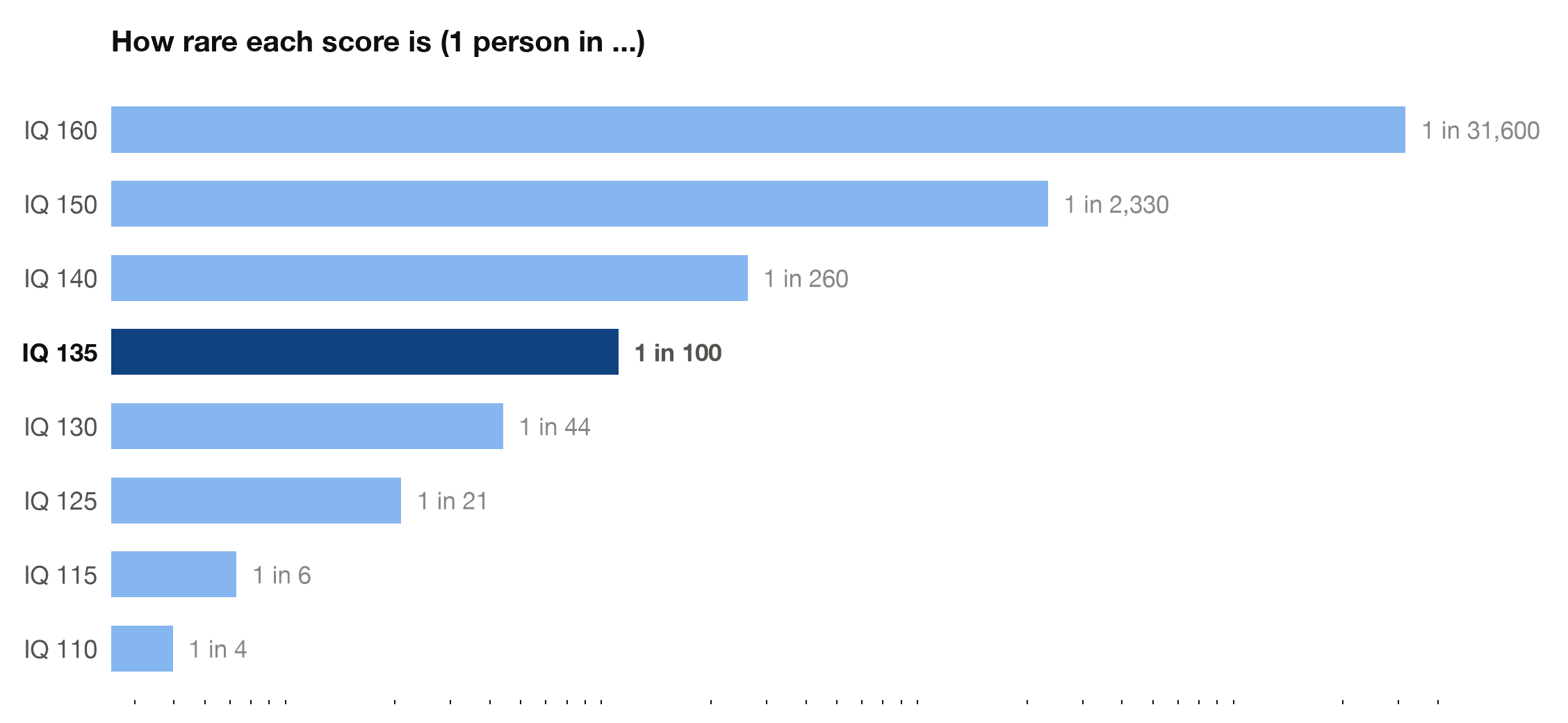
An IQ of 135 places you at the 99th percentile: computed from the normal distribution with a mean of 100 and a "standard deviation" (a measure of score spread) of 15, about 1 person in 102 scores 135 or higher. It is the closest round score to "top 1%," since the exact 99th percentile falls at an IQ of 134.9. A 135 clears the usual gifted threshold of 130 with room to spare, and it happens to be the cutoff behind the most famous study of gifted children ever run. This article covers the math, what a 135 means for gifted identification, and what research says top 1% ability predicts.
The math: why 135 is the top 1% score
On the mean-100, SD-15 scale, a 135 is a "z score" of +2.33. Running that through the standard normal distribution gives the 99.02nd percentile, leaving the top 0.98% of scorers, about 1 in 102 people. Running the calculation in reverse shows why 135 owns the top-1% label: the score that exactly marks the 99th percentile is 134.9. In a large lecture hall of 200 people, the expectation is 2 people at this level; in a 1,000-student school, about 10.
135 and gifted identification
Formal gifted rules are rarely written as bare numbers. They are written in standard-deviation and percentile terms, which then resolve to scores on whichever test a district uses. Ohio's statute, for example, identifies "superior cognitive ability" by a score two standard deviations above the mean, minus the "standard error of measurement" (the expected wobble in an obtained score), on an approved individual test, with a 95th-percentile group-test performance as one alternative pathway. A 135 clears bars like these even after allowing for measurement error, a point our guide to IQ confidence intervals makes concrete.
Clearing the statistical bar is not the same as being identified, however. In many districts, testing only happens after a teacher nomination or a behavioral rating scale flags a child, and those filters can miss high-ability students who are quiet, bored, or unconventional. Direct, well-normed testing is the more reliable route. Our article on child giftedness covers how identification works in practice.
The score that launched gifted education
135 has a special place in the field's history. Beginning in 1922, teachers across California nominated their youngest and brightest students for Lewis Terman's Life Cycle Study, and children were enrolled if they scored an IQ of 135 or more on the early Stanford-Binet. With additions through 1928, the sample reached 1,528 participants (856 boys, 672 girls) who were then followed for the rest of their lives. It was the first large longitudinal study of gifted children, and it made 135 the original entry ticket to "gifted" as a studied category.
One caution when reading the old cutoff: Terman's early scores were "ratio IQs" (mental age over chronological age, times 100), which behave differently at the high end than the "deviation IQs" modern tests report. The historical 135 and a modern 135 are close cousins rather than identical twins.
What top 1% ability predicts
The sharpest modern evidence on the top 1% comes from the Study of Mathematically Precocious Youth (SMPY), which identified two cohorts of 13-year-olds in the 1970s as being in the top 1% of mathematical reasoning ability, 1,650 people in all. Four decades later, their accomplishments far exceeded base-rate expectations: 4.1% had earned tenure at a major research university, 2.3% were top executives at Fortune 500 or name-brand companies, and 2.4% were attorneys at major firms. Collectively the cohorts had published 85 books and 7,572 refereed articles, secured 681 patents, and amassed $358 million in grants.
Two footnotes keep the finding honest. SMPY selected on a mathematical reasoning test taken young rather than an IQ test, so the group represents the top 1% of tested reasoning ability, the band a 135 corresponds to. And outcomes within the group still varied enormously: most members did not become professors or executives. The SMPY team's 35-year review adds a practical lesson, finding that special educational opportunities "can markedly enhance the development of talent." Identification at this level matters because of what it unlocks. For the next band up the scale, see what an IQ of 140 means.
Frequently asked questions
Is an IQ of 135 in the top 1 percent?
Essentially yes. Computed from the normal distribution (mean 100, SD 15), 135 is the 99.02nd percentile, and the exact 99th-percentile score is 134.9. About 1 person in 102 scores 135 or higher.
Is 135 IQ gifted?
Yes, comfortably. The common gifted threshold is 130 (two standard deviations above the mean), and statutory definitions are usually written as two standard deviations or a percentile rank, bars that a 135 clears even after allowing for measurement error.
What did Terman's famous study have to do with 135?
Terman's Life Cycle Study, the first large longitudinal study of gifted children, enrolled California schoolchildren who scored 135 or higher on the early Stanford-Binet, ultimately 1,528 participants who were followed for the rest of their lives.
What do people with top 1% ability go on to do?
In the SMPY study, people identified at 13 in the top 1% of reasoning ability produced far more than base rates predict: about 4% earned tenure at major research universities, and the cohorts collectively produced thousands of papers and hundreds of patents. Outcomes still varied widely within the group.
Can a child with a 135 IQ be missed by gifted programs?
Yes. Identification often relies on teacher nominations and rating scales before any testing happens, and those filters can miss high-ability children. Direct, well-normed testing is the more reliable route to identification.
The takeaway
An IQ of 135 marks the 99th percentile, about 1 in 100 people, a level with a documented record of unusual accomplishment when it is identified and given opportunity. If you suspect you or your child sits near this line, a well-normed measurement beats a guess. The Reasoning and Intelligence Online Test from RIOT IQ reports modern deviation scores with confidence intervals; you can take the free RIOT IQ test and see your percentile directly.
References
1. Kern, M. L., Friedman, H. S., Martin, L. R., Reynolds, C. A., & Luong, G. (2009). Conscientiousness, career success, and longevity: A lifespan analysis. Annals of Behavioral Medicine, 37(2), 154-163. pmc.ncbi.nlm.nih.gov
2. Lubinski, D., Benbow, C. P., & Kell, H. J. (2014). Life paths and accomplishments of mathematically precocious males and females four decades later. Psychological Science, 25(12), 2217-2232. pubmed.ncbi.nlm.nih.gov
3. Lubinski, D., & Benbow, C. P. (2006). Study of Mathematically Precocious Youth after 35 years. Perspectives on Psychological Science, 1(4), 316-345. pubmed.ncbi.nlm.nih.gov
4. Ohio Revised Code § 3324.03. Identification of gifted students.codes.ohio.gov
5. Guilmette, T. J., et al. (2020). American Academy of Clinical Neuropsychology consensus conference statement on uniform labeling of performance test scores. The Clinical Neuropsychologist, 34(3), 437-453. pubmed.ncbi.nlm.nih.gov
6. Warne, R. T. (2019). An evaluation (and vindication?) of Lewis Terman. Gifted Child Quarterly, 63(1), 3-21. eric.ed.gov
Take our professional IQ test
Want to know your IQ? Try the first ever professional online IQ test.