Why is 100 the average IQ? It’s just a convenient choice—exactly 50% of people score below 100 and 50% above. Discover why 100 means “average,” if it’s good, and how the bell curve works.
Dr. Russell T. WarneChief Scientist
Share
The choice of 100 as the average IQ is completely arbitrary. There's nothing magical or inherent about the number 100; it was simply chosen because it is convenient and easy to interpret. Test creators could have set the average at any number they wanted.
This is similar to how temperature scales work. Water freezes at 0°C or 32°F. Those are different numbers, but measuring the same physical phenomenon. The numbers themselves are arbitrary conventions, but they're useful because everyone agrees on what they mean.
Origins Of The 100 Average
The tradition of using 100 as the average goes back to the early 20th century and the "quotient IQ" formula. German psychologist Wilhelm Stern proposed that IQ could be calculated using the formula: (mental age ÷ chronological age) × 100.
In this system, if a child's mental age (the typical age of children who performed as well as they did) matched their actual age, the result would be 100. For example, if an 8-year-old performed as well as the average 8-year-old, their IQ would be (8 ÷ 8) × 100 = 100. A 10-year-old who performed like a typical 12-year-old would have an IQ of (12 ÷ 10) × 100 = 120.
The multiplication by 100 served a practical purpose: it eliminated decimals. Without it, the average person would have an IQ of 1.0, and a gifted child might score 1.3, numbers that don't feel very different.
The Shift To Deviation IQ
The quotient formula had serious problems, particularly for adults. It doesn't make sense to say a 40-year-old has the "mental age" of a 50-year-old, since cognitive development plateaus in adulthood. Additionally,quotient IQs couldn't be compared across different ages, which created confusion.
To solve these problems, psychologists developed the "deviation IQ" in the mid-20th century. This system still uses 100 as the average, but compares people to others in their own age group using standard deviations rather than mental ages.
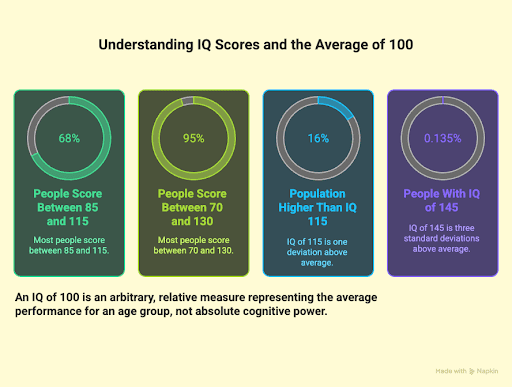
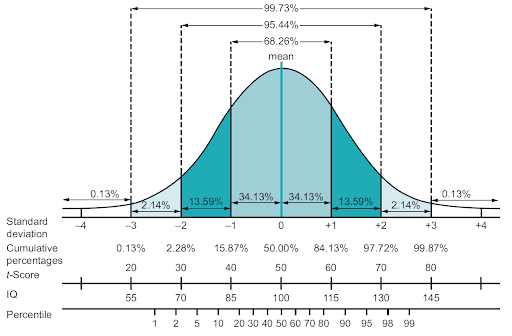
Today, the creators of most IQ tests set the average score at 100 and the standard deviation (a measure of how spread out scores are) at 15 points. This means that approximately 68% of people score between 85 and 115, and about 95% score between 70 and 130. The normal distribution allows psychologists to express how far above or below average someone performed.
Every modern IQ test uses deviation IQs, though the term "IQ" (which originally stood for "intelligence quotient") has stuck around, even though scores are no longer calculated as quotients.
Why Not Change The Average To Something Else?
Decades of research have used the 100-point scale, and professionals worldwide understand what different IQ scores mean. A score of 130 signals "very high" intelligence, 70 indicates the threshold for intellectual disability, and 85-115 represents the typical range. Changing it now would invalidate this accumulated knowledge and make historical comparisons more difficult. Indeed, some tests measure intelligence (like college admissions tests) and use different scores for their average. Comparing their scores to IQs is more difficult because of the different scales they use.
The Normal Distribution And 100
IQ scores follow a normal distribution (also called a normal distribution), where most people cluster near the average, and scores become increasingly rare as they get further from 100 in either direction. This pattern occurs naturally in many human traits.
By centering the scale at 100 with a standard deviation of 15, psychologists can quickly determine not just whether someone is above or below average, but by how much. Someone with an IQ of 115 is one standard deviation above average, placing them higher than about 84% of the population. An IQ of 145 is three standard deviations above average, found in less than 0.2% of people.
Watch “Are IQ Tests Accurate?” on the Riot IQ YouTube channel for a deeper look into how these tests define and measure the average.
Take our professional IQ test
Want to know your IQ? Try the first ever professional online IQ test.