With a population average of 100, scores above 115 are generally considered above average. We explain standard deviations and thresholds for gifted status.
Dr. Russell T. WarneChief Scientist
Share
The definition of a "good" intelligence quotient (IQ) score relies on statistical positioning relative to the general population rather than subjective opinion. Modern intelligence tests are standardized so that the population average is set at 100, which serves as the reference point for interpretation. The further a score is from 100, the further from average it is. Scores meaningfully above 115 are noticeably above average.
That said, the significance of any score depends on the quality of the test itself. Results from unstandardized or informal quizzes do not carry the statistical reliability needed for accurate interpretation.
How Is the Normal Distribution Applied to Intelligence?
Intelligence scores are interpreted using a Gaussian distribution, often informally called the “bell curve.” In a normal distribution, most scores concentrated near the average. Because the normal distribution has known characteristics, we can apply “the 68–95–99.7 rule.” This states that:
• about 68 percent of individuals score between 85 and 115
• roughly 95 percent of the population has a score between 70 and 130
• 99.7% of people have an IQ between 55 and 145.
The 68–95–99.7 allows an IQ score to be understood not as a standalone number, but as a position within a large, representative population.
How Are IQ Scores Classified?
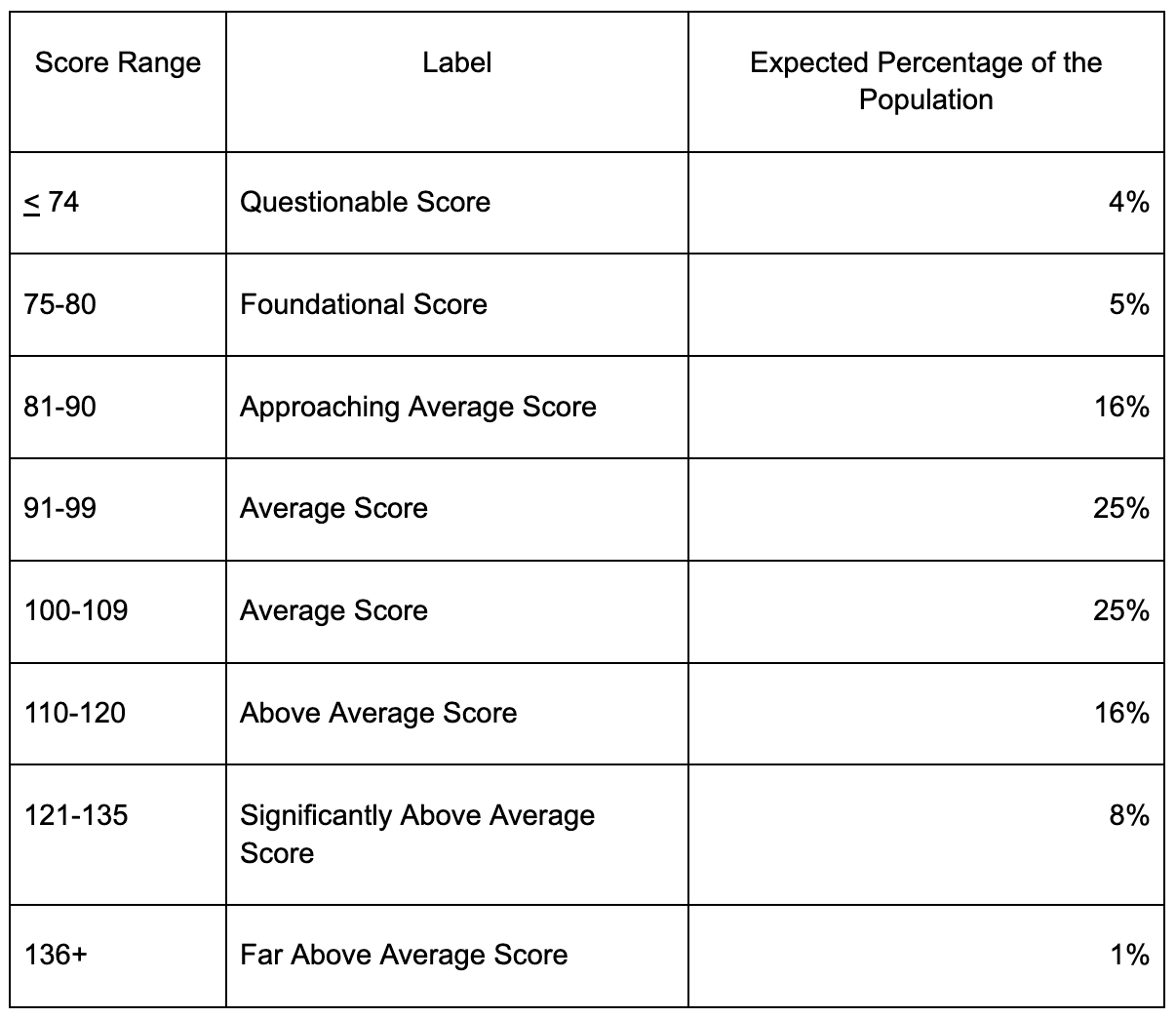
Different test creators use different labels for IQ score ranges. On the Reasoning and Intelligence Online Test (RIOT), the following labels are used to interpret scores:
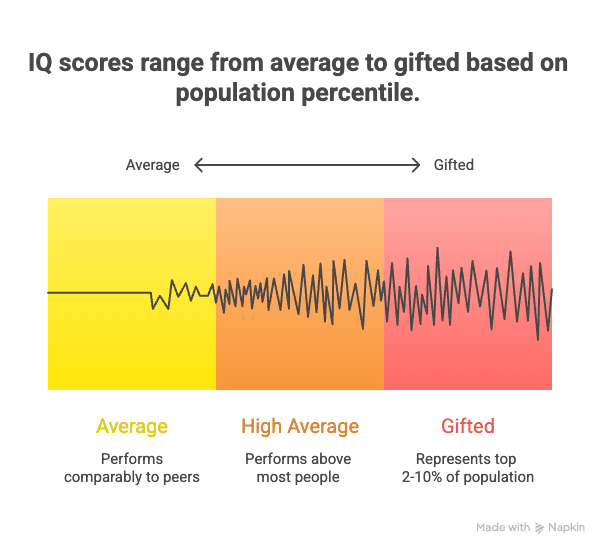
Sometimes the phrase “gifted” is used to label scores. There is universal threshold for when a score is in the “gifted range.” For many experts, the top 2% to 10% of the population can be labeled gifted (which corresponds to IQ minimums of 120 to 130), but others believe a larger percentage of the population can justifiably be called “gifted.” And some experts do not use IQ at all when labeling people as gifted.
What Does a High IQ Score Predict?
Higher IQ scores are associated with faster learning, stronger abstract reasoning, and more efficient problem-solving. These abilities support quicker mastery of complex information and greater adaptability when facing unfamiliar challenges, which matters most in cognitively demanding work.
Many studies link higher intelligence with educational attainment, job performance, and occupational level, particularly in roles that require sustained reasoning and complex decision-making. At the same time, testing experts stress that an IQ score reflects probability, not certainty. A higher score increases the likelihood of success but does not guarantee it, just as a lower score does not rule it out. Intelligence functions as a meaningful advantage, but its impact depends on how it interacts with factors such as persistence, motivation, and access to opportunity.
How Is the Quality of a Test Evaluated?
The value of an IQ score rests on the psychometric quality of the test used to obtain it. A result has meaning only when the assessment demonstrates both reliability and validity. Reliability concerns whether the test yields consistent results over time, while validity addresses whether it measures the cognitive abilities it claims to assess. Many free online quizzes do not meet these criteria and are intended for casual exploration rather than careful interpretation.
Meaningful cognitive measurement also depends on proper norming. This process requires administering the assessment to a large, representative sample so that individual scores can be interpreted in relation to the broader population. Without this reference, a score has no meaningful context for interpretation. Professionally developed tests are carefully calibrated to align score distributions with population norms, which is why results from unnormed quizzes lack scientific credibility when compared with standardized assessments.
How Does RIOT IQ Meet Professional Standards?
Professional test developers follow established ethical and technical standards designed to preserve accuracy and interpretability. The RIOT is structured around these principles. Its items are reviewed by specialists in cognitive, educational, and developmental psychology to confirm that they assess general reasoning ability without cultural or linguistic bias. Through adherence to recognized psychometric practices, the assessment produces results that reflect a defensible statistical position rather than an exaggerated or impressionistic score.
Watch “IQ Explained in 8 Minutes: The Truth About IQ (And Why It Matters)” on the Riot IQ YouTube channel for clear context on how IQ scores are interpreted and why the idea of a “good” score depends on how IQ works.
Take our professional IQ test
Want to know your IQ? Try the first ever professional online IQ test.