Learn to interpret free online IQ test results accurately in 2026. Discover why most are invalid, what legitimate scores include, limitations of abbreviated tests, and next steps for deeper insights.
Dr. Russell T. WarneChief Scientist
Share
Free IQ test results flood the internet, but understanding what those numbers actually mean or whether they mean anything at all requires careful consideration. Most free online IQ tests produce scores with no scientific validity, leaving test takers deceived or confused about their actual cognitive abilities. However, a small number of free assessments provide results grounded in legitimate methodology, though with important limitations compared to comprehensive professional testing.
The key to understanding free IQ test results lies in knowing what to look for, what the numbers represent, and most importantly, what those results can and cannot tell about cognitive abilities.
Why Do Most Free IQ Test Results Mean Nothing?
The vast majority of free online IQ tests generate meaningless numbers dressed up to look authoritative. These tests lack the foundational elements necessary for a valid psychological assessment. Without a representative norm sample, proper statistical procedures, or any validation research, the scores they produce are little more than guesses.
Understanding why requires recognizing what makes IQ scores meaningful in the first place. An IQ score derives its meaning from comparison to a carefully selected norm sample that represents the population. For example, when someone scores 115, that number indicates performance better than approximately 84% of the comparison group. But if that comparison group consists of self-selected visitors to that particular website's free test, the score says nothing about how the test taker compares to the general population. Additionally, many tests deliberately inflate results to make test takers feel good and share their impressive-looking scores on social media, creating viral marketing at the expense of accuracy.
What Should Test Results Actually Include?
Legitimate IQ test results, even from abbreviated free assessments, should provide several key pieces of information beyond just a single number. An overall IQ score serves as the primary measure, typically with a mean of 100 and a standard deviation of 15. This score should always be accompanied by a margin of error or confidence interval, acknowledging the inexactness inherent in any psychological measurement.
Score interpretation should explain what the numbers mean in practical terms rather than leaving test takers to guess whether their results are good, average, or concerning. For example, percentiles translate IQ scores into more intuitive terms because they state the percentage of people that the examinee outscores. Abbreviated free tests should also provide a clear acknowledgment of limitations. There must be honest communication about what the shortened assessment can and cannot measure.
Professional tests go much further by providing subscores across multiple cognitive domains, detailed cognitive profiles showing patterns of strengths and weaknesses, and indicators that flag potential issues with the testing session. Free abbreviated versions naturally cannot provide this level of detail, but they should at least acknowledge the lack of subscores that a more comprehensive assessment would provide.
How Can I Interpret a Sample RIOT IQ Test Result?
The Sample RIOT IQ test represents what a legitimate free assessment looks like when developed according to scientific standards. This abbreviated version takes approximately 8 minutes and includes shortened versions of three subtests from the full RIOT.
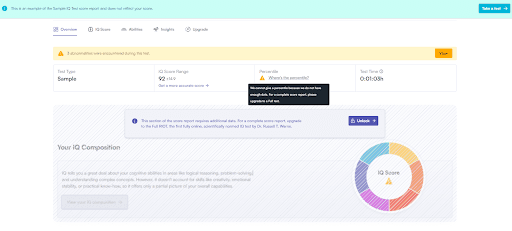
Example report from the Sample RIOT IQ Test
The score report begins with the IQ score itself, displayed prominently with a margin of error of ±14.9 points. This margin is notably wider than the full RIOT's ±3.7 point range because the abbreviated format provides less detailed information about the examinee. Someone scoring 115 on the Sample test likely has a true IQ somewhere between 100 and 130, which is a substantial range that reflects the limitations of brief assessment.
Below the IQ score, the report provides percentile information showing how the score compares to other RIOT test takers. If the percentile indicates "higher than 75% of test takers," that communicates the score's meaning more clearly than the number alone. The score interpretation section explains what the IQ range means in practical terms, providing context about what different score ranges typically indicate about cognitive abilities and functioning.
What Are the Limitations of Free Sample Test Results?
Even the best free IQ test results come with significant limitations that must be understood to avoid misinterpretation. The Sample RIOT, despite being developed by professionals using scientific methods, provides only a snapshot of general cognitive ability, rather than a comprehensive assessment. The abbreviated format means fewer items sampling each cognitive domain, which increases measurement error and reduces precision.
The wider margin of error reflects this reduced precision and represents an honest acknowledgment of what a brief assessment can and cannot achieve. The Sample test also lacks the detailed cognitive profile information available in a comprehensive assessment. The full RIOT provides index scores across six cognitive domains (verbal reasoning, fluid reasoning, spatial ability, working memory, processing speed, and reaction time) and identifies cognitive profiles showing patterns of relative strengths. The Sample version, with only three abbreviated subtests, cannot provide this level of nuanced detail.
What Should Someone Do After Getting My Free IQ Test Results?
After receiving your IQ test results, several paths forward exist depending on individual needs and goals. For those whose curiosity is satisfied by knowing their approximate cognitive ability level, the initial results from a legitimate free IQ test are sufficient and no further action is needed.
Those seeking more detailed information should pursue comprehensive testing. This may be appropriate for people wanting to know about cognitive strengths and weaknesses, who are considering educational or career decisions that depend on understanding specific abilities, those who are needing assessment for any official purpose. The fullRIOT assessment provides the detailed cognitive profile and precise measurement that the Sample version cannot offer. For situations requiring clinical documentation or legal recognition, traditional assessment by a licensed psychologist remains necessary.
The Sample RIOT IQ test can also serve as preparation for a more comprehensive assessment by reducing anxiety about unfamiliar testing situations. Test anxiety can depress scores on any assessment, so familiarity with the process helps ensure that comprehensive testing captures true ability rather than nervousness about the unknown.
Watch “Top 16 Most Asked Questions on IQ, Intelligence, and the RIOT Answered by Dr. Russell Warne” on the Riot IQ YouTube channel for clear context on how to interpret free IQ test results accurately.
Take our professional IQ test
Want to know your IQ? Try the first ever professional online IQ test.