What is the highest IQ score? Learn what IQ goes up to (around 160), the highest score on an IQ test, and practical limits of testing.
Dr. Russell T. WarneChief Scientist
Share
An IQ test does not have a meaningful hard upper limit in theory. But in practice, professionally developed IQ tests rarely measure scores above 160. The reason has nothing to do with human potential and everything to do with how IQ tests work and what makes them useful scientific instruments.
Why IQ Tests Have Practical Limits
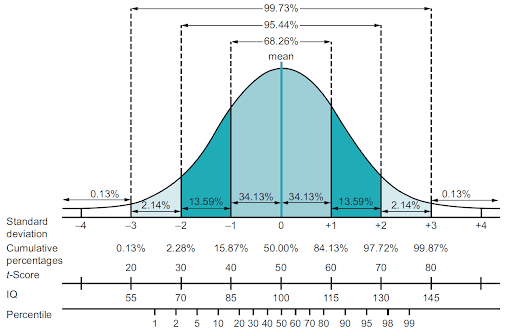
When graphed, IQ scores create a normal distribution (pictured below). The average of these scores is 100 and the standard deviation (a measure of how spread out scores are) is 15. In this distribution, most people’s scores cluster near the average. About 68% of people score between 85 and 115, and 95% score between 70 and 130. The further a score is from the average in either direction, the fewer people there are who obtain those scores.
Here's the problem: an IQ of 145 is three standard deviations above the mean, occurring in only about 0.13% of the population. An IQ of 160 is four standard deviations above the mean and occurs in roughly 0.00317% of people; that's 1 in every 31,700. To be “1 in a million,” a person needs an IQ of 171. In theory, the smartest person in the United States (who is 1 in 330 million) has an IQ of 187.
Gathering sufficient data becomes nearly impossible when measuring extremely rare scores. A test creator would need to test several hundred thousand people to find enough examinees scoring at 160+ to validate that the test functions correctly at that level. This is why most professionally developed IQ tests, including the Wechsler tests and the Reasoning and Intelligence Online Test (RIOT), cap their scores around 145.
The Problem with Extreme IQ Claims
You may have heard claims about historical figures or scientists with IQs of 200, 250, or even 400. These numbers are not credible.
First, there's the statistical problem already mentioned: scores that extreme would be so rare that validating them would be impossible. Second, many of these astronomical IQ estimates come from amateur "tests" found online or from retrospective estimates of historical figures' IQs based on their accomplishments or childhood achievements. These estimates rely on unsystematic data, and the interpretation is often distorted by the person’s later reputation.
Can IQ Tests Measure “Genius”?
Despite these limitations, professional IQ tests can absolutely identify people with exceptional intelligence. An IQ of 130 places someone in the top 2.3% of the population. An IQ of 145 is in the top 0.13%. These scores reliably identify people who will excel in cognitively demanding fields and who process information faster and more effectively than the vast majority of people. Even if these people’s general intelligence doesn’t make them “1 in a million,” someone with an IQ of 130 or 145 is still a very bright person whose intelligence makes them more likely to make worthwhile contributions to their career field or society. The IQ level needed to make a person a “genius” is a question of how that term is defined. (“Genius” is not a scientific term.) But most IQ tests are capable of measuring relatively rare levels of intellect.
Still, the maximum score that an IQ test produces is rarely the most important characteristic of a test. Because most people’s scores are within 3 standard deviations of the average (i.e., 55 to 145), professional test creators focus on creating tests that work well across that range of intelligence. Making finer distinctions at the extreme high end is not as important because these distinctions matter for only a tiny percentage of examinees.
Red Flags for Extreme IQ Claims
If you encounter IQ scores above 160-170, you should be skeptical. Here are some warning signs:
• Anonymous test creators: Legitimate test creators attach their names and credentials to their work. Anonymity prevents accountability.
• Low-quality norm samples or missing norm sample information: A norm sample is the sample of people who have previously taken the test who are used as a comparison group for later examinees. Professional tests have documented norm samples that are representative of their target population. If the norm sample is not representative of the general population, then IQ scores on the test are distorted. Even worse is when there is no information about the norm sample.
• Claims that "anyone" can take the test: There is no intelligence test that is suitable for everyone in the world. Age, language, culture, familiarity with technology, disabilities, and other characteristics can make a test inappropriate for some examinees. Professional test creators are very clear about stating who their test is designed for (a group called the “target population”). A test designed for American adults won't necessarily work well for children, non-English speakers, or people from vastly different cultures. If the target population for a test is not clear, then it is not a good test.
• Impossibly high scores: Any test claiming to measure IQs above 160 is probably not following professional standards. Even scores in the 150s are suspicious if the test was not proctored by a professional.
Curious about what could make an IQ test biased, which could yield inaccurate IQ scores? Check out this video:
Ultimately, the highest possible IQ is limited by the limitations of test development and the statistical rarity of extreme scores. Professional IQ tests typically measure up to about 160 because that's where meaningful, validated measurement remains feasible. Claims of scores beyond this range should be met with skepticism, as they almost always come from amateur tests that don't follow proper psychometric standards.
If you're curious about your own intelligence, seek out professionally developed tests like the Reasoning and Intelligence Online Test that meet established scientific standards and provide validated, meaningful results across multiple cognitive dimensions. The Sample RIOT Free IQ Test is an 8-minute assessment that can give you a general measure of your intelligence.
Take our professional IQ test
Want to know your IQ? Try the first ever professional online IQ test.