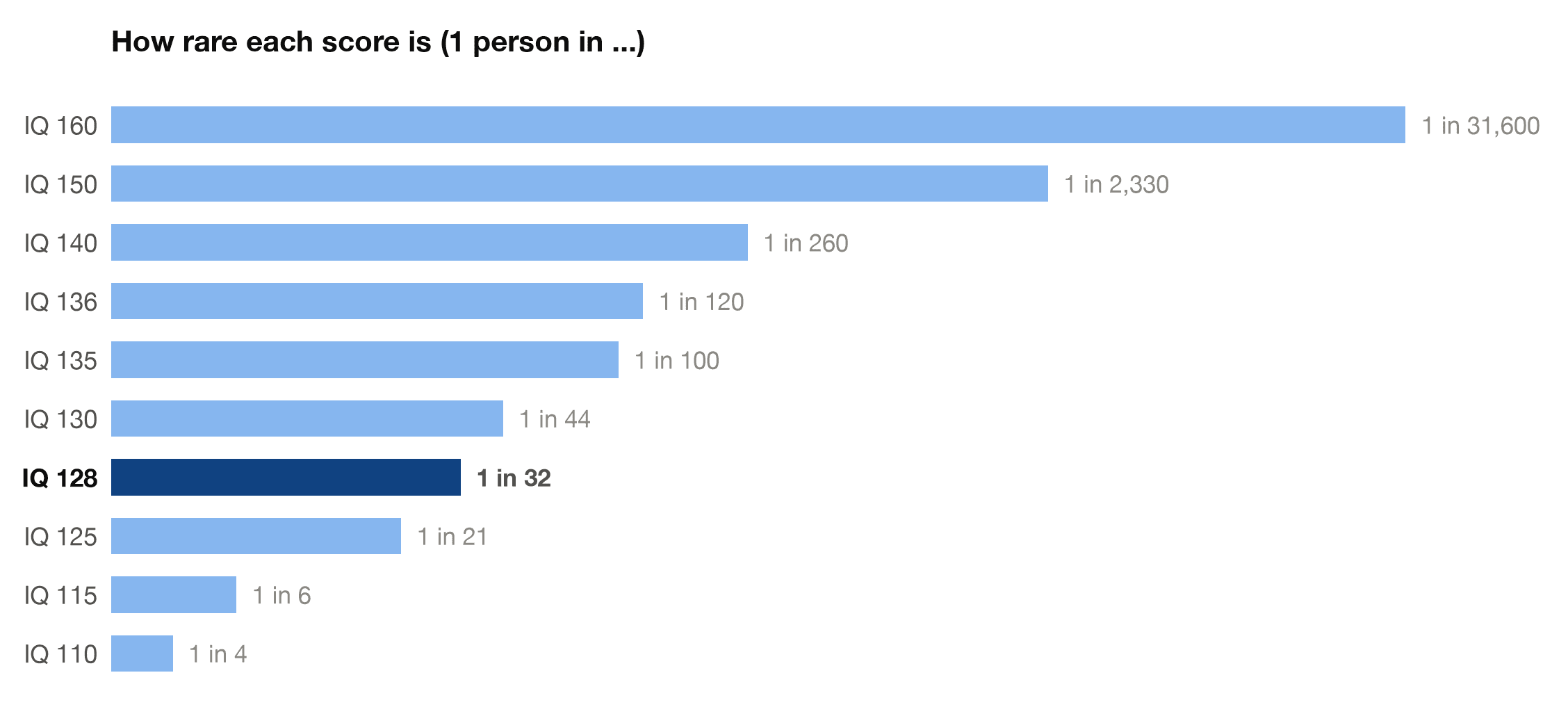
An IQ of 128 sits at the 97th percentile, about 1 in 32 people. Learn what an IQ of 128 means and why Wechsler drew his Very Superior line at 128 in 1944.
Dr. Russell T. WarneChief Scientist
Share
An IQ of 128 is 1.87 "standard deviations" (a measure of how spread out scores are) above the average of 100, which places it at the 96.9th percentile: about 1 person in 32 scores as high or higher. On today's tests that is the band just below the conventional gifted line of 130. It was not always the runner-up number. On David Wechsler's original adult scale, published in the 1940s, 128 was where the top classification began: "Very Superior, 128 and over." This article covers the math behind 128, the story of how that 1944 line was drawn, and what a 128 means now.
The math: 128 on the bell curve
Modern tests report "deviation IQs": scores that describe how far you stand from the average of your own age group on a normal curve with a mean of 100 and a standard deviation of 15. A 128 is a "z score" of 28 divided by 15, or +1.87. Feeding that into the cumulative normal curve gives the 96.9th percentile, the top 3.1% of scorers. In concrete terms, about 3 students in a class of 100 would score 128 or higher, and a few points lower sits the 125 band, at about 1 person in 21.
1944: when 128 was the top of the scale
In The Measurement of Adult Intelligence, Wechsler published the classification table for his adult test, covering ages 10 to 60. The top three rows read: "Bright Normal, 111-119, 16.1%"; "Superior, 120-127, 6.7%"; and "Very Superior, 128 and over, 2.2%." On that scale, a 128 carried the highest label the test could assign, and the label covered the top 2.2% of adults.
Why the line fell at 128
Wechsler did not choose 128 because it looked memorable. He built his bands from the "probable error" (P.E.), an older statistical unit equal to 0.6745 standard deviations, writing that "we decided to use the intervening integral multiples of the probable error" as boundaries and that the scheme "is symmetrical, comprising as many classes above the mean as there are below it." Average ran from -1 to +1 P.E., Bright Normal from +1 to +2, Superior from +2 to +3, and Very Superior was everything beyond +3 P.E. Of that final slice he noted: "This distance is equivalent to about 2.2 per cent of the total area of the normal curve." On the Wechsler-Bellevue's actual adult norms, the +3 P.E. line landed at 128.
From 128 to 130: same idea, new norms
Three probable errors is 3 times 0.6745, or 2.02 standard deviations, and two standard deviations above the mean on a modern mean-100, SD-15 scale is almost exactly 130. That is why older literature says "Very Superior, 128 and over" while modern convention draws the gifted line at 130: they express the same statistical idea, roughly the top 2%, on different norms. The two figures are close cousins rather than the same computation; Wechsler's 2.2% came from probable-error bands on his 1930s and 1940s norm samples, while today's convention counts the share above 130 on current deviation IQs. Today's cutoff has its own history and mechanics, which we cover on our page about an IQ of 130.
What 128 means today
On current tests, 128 sits in the band just under the conventional gifted line. What the band is called depends on the publisher; the American Academy of Clinical Neuropsychology's consensus statement notes that "no universally accepted system exists for assigning qualitative descriptors to scores in specific ranges." The labels have shifted for 80 years while the underlying statistic, distance from the mean in standard deviations, is what actually carries meaning. How the scale and its percentiles work is covered in our explainer on the IQ bell curve.
A measured 128 is really about 123 to 133
Every obtained score carries "measurement error." With Full Scale IQ reliability of .97 to .98 on the flagship adult test, the "standard error of measurement" works out to about 2.1 to 2.6 points, and a 95% confidence interval to roughly plus or minus 4 to 5 points. An obtained 128 is therefore best read as a band from about 123 (roughly 1 person in 16) to 133 (roughly 1 in 72). That band straddles 130, so a 128 is statistically indistinguishable from the classic gifted threshold. Some rules acknowledge this directly: Ohio's gifted statute sets its bar at two standard deviations above the mean "minus the standard error of measurement," and 130 minus 2.6 is 127.4, a bar a 128 clears. American Mensa instead requires the 98th percentile, about 130.8 on an SD-15 scale, which a 128 at the 96.9th percentile falls just short of, though within measurement error.
Frequently asked questions
Is an IQ of 128 good?
Yes. It is the 96.9th percentile: higher than about 97% of people, or roughly 1 in 32. On Wechsler's original 1944 adult classification it was the entry point of the very top band, "Very Superior."
Is 128 IQ gifted?
It is just below the conventional gifted line of 130, and within measurement error of it. Many rules acknowledge this: Ohio's statute, for example, sets the bar at two standard deviations above the mean minus the standard error of measurement, which a 128 can meet.
Why was 128 the "Very Superior" cutoff?
Wechsler drew his bands at whole multiples of the probable error of the IQ distribution, and the +3 P.E. line, covering the top 2.2% of adults, landed at 128 on his test's norms. The modern top-2% convention at 130 is the same statistical idea on today's mean-100, SD-15 scale.
Could someone with a 128 score 130 on a retest?
Easily. With a standard error of measurement of about 2 to 3 points, a measured 128 corresponds to a 95% confidence range of roughly 123 to 133, which straddles 130. Two sittings of the same test can plausibly land on either side of the line.
What percentile is an IQ of 128?
The 96.9th percentile on a mean-100, SD-15 scale: about the top 3.1%, or 1 person in 32.
The takeaway
A 128 reflects strong general cognitive ability with real predictive validity, whatever label a given decade attaches to it. The classification lines have moved since 1944; the statistics underneath them have not. If you want to know where you stand on the modern scale, a properly normed assessment such as the Reasoning and Intelligence Online Test from RIOT IQ reports a deviation score with its measurement error stated; you can take the free IQ test and read the result as the range it really is.
References
1. Wechsler, D. (1944). The measurement of adult intelligence (3rd ed.). Williams & Wilkins. archive.org
2. Guilmette, T. J., Sweet, J. J., Hebben, N., et al. (2020). American Academy of Clinical Neuropsychology consensus conference statement on uniform labeling of performance test scores. The Clinical Neuropsychologist, 34(3), 437-453. pubmed.ncbi.nlm.nih.gov
3. Canivez, G. L. (2010). Review of the Wechsler Adult Intelligence Scale-Fourth Edition. In The eighteenth mental measurements yearbook. Buros Institute. ux1.eiu.edu
4. Ohio Revised Code § 3324.03. Identification of gifted students.codes.ohio.gov
5. American Mensa. (n.d.). Qualifying test scores.us.mensa.org
Take our professional IQ test
Want to know your IQ? Try the first ever professional online IQ test.