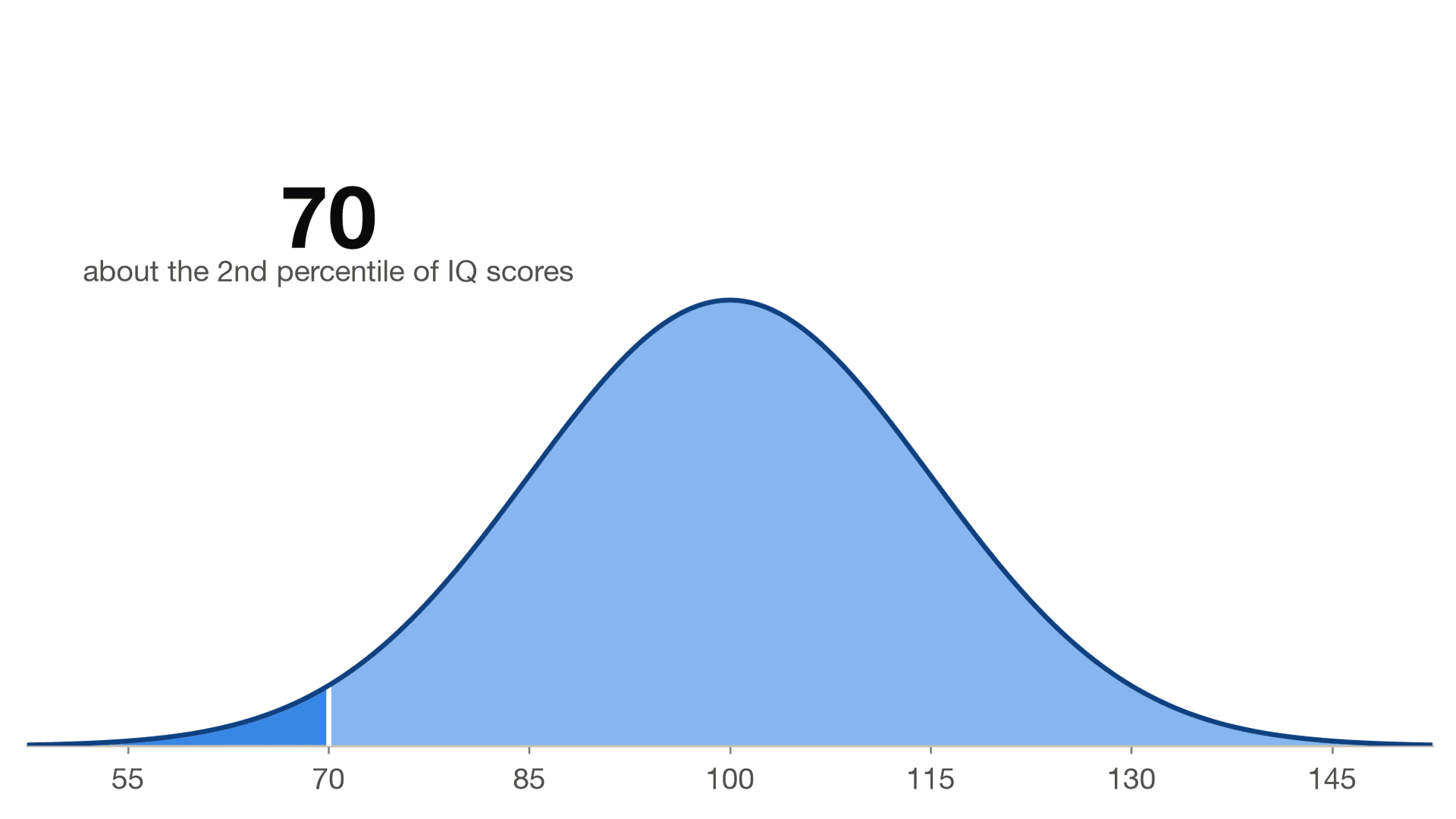
An IQ of 70 sits two standard deviations below the average of 100, near the 2nd percentile. Here is what an IQ of 70 means, and what it does not mean.
Dr. Russell T. WarneChief Scientist
Share
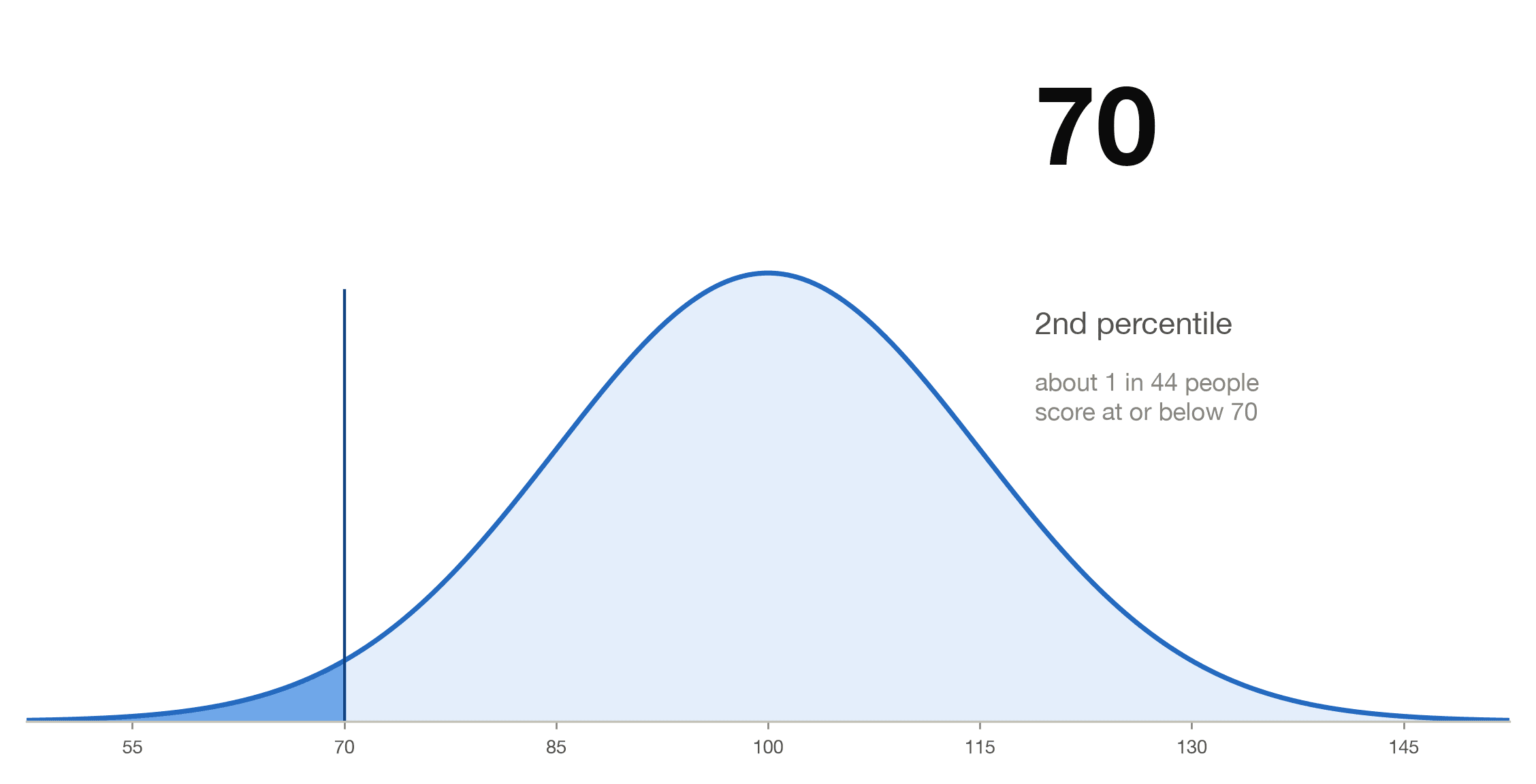
An IQ of 70 is exactly two "standard deviations" (the statistic that describes how spread out scores are) below the average of 100. Computed from the normal curve with a mean of 100 and a standard deviation of 15, that places 70 at about the 2nd percentile: roughly 1 person in 44 scores at or below 70, and about 98% of people score higher. On the descriptive system used with Wechsler tests, 70 sits at the bottom edge of the "Borderline" band. Two facts matter as much as the number itself. A single tested score is really a range of about five points either side, and no IQ score by itself diagnoses anything. This article covers where 70 falls on the bell curve, what clinicians actually require before diagnosing an intellectual disability, and what to do after a score near this level.
Where 70 Falls on the Bell Curve
Percentile and rarity
IQ scores follow a roughly bell-shaped distribution centered on 100. A 70 corresponds to a z-score of -2.0, and the normal curve puts that at the 2.3rd percentile. These percentiles are calculated from the curve itself rather than counted from any test publisher's tables, and real score distributions deviate slightly from perfect normality in the tails, so treat them as close estimates rather than exact counts.
Descriptive labels on modern tests
The WAIS-IV descriptive categories label scores below 70 "Extremely Low," 70-79 "Borderline," 80-89 "Low Average," and 90-109 "Average." A 70 therefore sits on the boundary between the two lowest bands. These labels describe score ranges, not people, and nothing about a person changes between a 69 and a 71. For a sense of the next step up the scale, see our article on what an IQ of 85 means.
An IQ Score Is Not a Diagnosis
What DSM-5 and AAIDD actually require
The American Association on Intellectual and Developmental Disabilities defines intellectual disability as "a condition characterized by significant limitations in both intellectual functioning and adaptive behavior that originates before the age of 22." The DSM-5 requires three criteria: deficits in intellectual functioning confirmed by clinical evaluation and individualized testing, deficits in "adaptive functioning" (the daily living, social, and practical skills a person actually uses), and onset of both during childhood. The DSM-5 abandoned specific IQ cutoffs as a diagnostic criterion, although 70 remains the historical screening anchor because it marks two standard deviations below the mean. A person who scores 70 with solid adaptive skills does not meet the criteria. Our guide to low IQ and intellectual disability covers the full diagnostic picture.
Measurement error: why 70 really means about 65 to 75
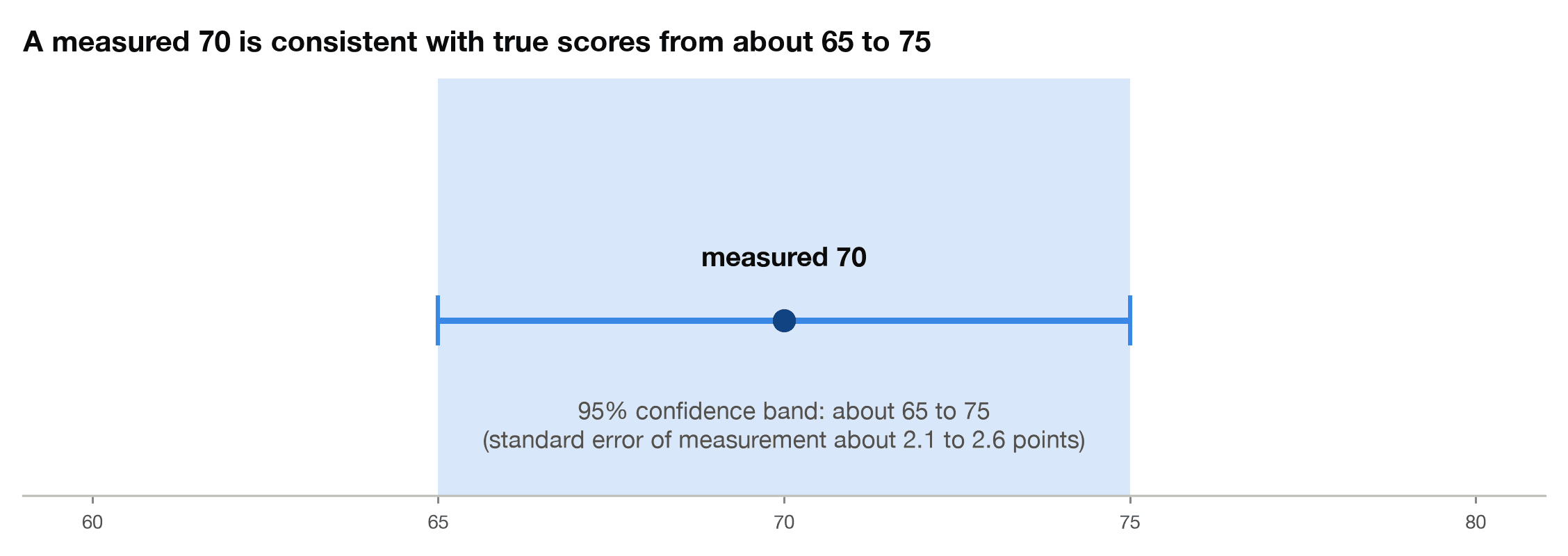
Every test carries a "standard error of measurement," the statistical wobble between a tested score and the underlying true score. In Hall v. Florida (2014), the U.S. Supreme Court described an IQ score as "best understood as a range, e.g., five points on either side of the recorded score," and struck down Florida's rigid rule treating 70 as a hard cutoff in capital cases because it created an unacceptable risk of error. A tested 70 could plausibly reflect a true score anywhere from about 65 to 75, which is exactly why clinicians never rest a decision on one number.
Everyday Life Around a Score of 70
Research on work and training is honest about the challenges without being fatalistic. Gottfredson (1997) found that employment options narrow sharply below IQ 80 and that, for scores below about 70 to 75, competitive employment options in her analysis were largely limited to supported or sheltered settings. Her paper used the clinical vocabulary of the 1990s; the accepted term today is intellectual disability. The practical reading is about how jobs are structured rather than about human worth: people near this range succeed best with concrete tasks, hands-on training, consistent routines, and good supervision, and vocational programs are built to supply exactly those supports. Adaptive strengths, health, and opportunity shape outcomes at least as much as the score. Our article on what counts as a low IQ puts this range in wider context.
From "Feeble-Mindedness" to Modern Language
Terminology has moved a long way. Terman's 1916 classification for the original Stanford-Binet labeled everything below 70 "definite feeble-mindedness," a phrase quoted here only as history. Modern practice replaced that vocabulary with neutral band labels and, far more consequentially, stopped treating any score as a verdict: today a diagnosis requires evidence about adaptive behavior and developmental history, gathered by a qualified professional, before it means anything clinically.
What to Do After a Score Near 70
A single score, especially from an unproctored online quiz, is not a clinical finding. Poor sleep, illness, low motivation, test anxiety, hearing or vision problems, and taking a test in a second language can all pull a score well below a person's true level. A borderline result is the strongest case for careful retesting and, where concerns persist, a full evaluation: an individually administered IQ battery plus a standardized adaptive-behavior assessment, interpreted together by a qualified professional. For a trustworthy starting estimate, the Reasoning and Intelligence Online Test from RIOT IQ is a professionally built, normed measure, and the free IQ test is a sensible screening step. It is a screening tool, and no online test can substitute for a clinical evaluation.
Frequently asked questions
Is an IQ of 70 considered an intellectual disability?
Not by itself. Both the DSM-5 and AAIDD require significant limitations in adaptive behavior that began during the developmental period, in addition to low measured intellectual functioning. Many people who score near 70 do not meet those criteria.
What percentile is an IQ of 70?
Calculated from the normal curve with a mean of 100 and a standard deviation of 15, a 70 is at about the 2nd percentile. Roughly 1 person in 44 scores at or below 70, and about 98% score higher.
Can a person with an IQ of 70 live a normal life?
Yes, many do. Outcomes depend far more on adaptive skills, support, health, and opportunity than on the score alone. People near this range hold jobs, maintain relationships, and live independently, sometimes with help for complex tasks like finances and paperwork.
Can an IQ of 70 change or improve?
Scores can move on retesting because of measurement error of roughly five points either side, motivation, health, or testing conditions, so one low score should never be treated as final. No program has been shown to produce large, lasting gains in underlying general ability.
Why does the number 70 matter legally?
Historically, 70 marked two standard deviations below the mean and served as a screening threshold for intellectual disability. In Hall v. Florida (2014), the U.S. Supreme Court ruled that a rigid 70 cutoff is unconstitutional in capital cases because a score is really a range of about five points either side.
References
1. American Association on Intellectual and Developmental Disabilities. (n.d.). Defining criteria for intellectual disability.aaidd.org
2. Boat, T. F., & Wu, J. T. (Eds.). (2015). Clinical characteristics of intellectual disabilities. In Mental disorders and disabilities among low-income children. National Academies Press. ncbi.nlm.nih.gov
3. Gottfredson, L. S. (1997). Why g matters: The complexity of everyday life. Intelligence, 24(1), 79-132. udel.edu
4. Grieve, R. (2020). WAIS interpretation [Course document reproducing WAIS-IV Table 6.3 descriptive categories]. Western Kentucky University. people.wku.edu
5. Hall v. Florida, 572 U.S. 701 (2014). Legal Information Institute, Cornell Law School. law.cornell.edu
6. Terman, L. M. (1916). The measurement of intelligence. Houghton Mifflin. archive.org
7. Warne, R. T. (2020). In the know: Debunking 35 myths about human intelligence. Cambridge University Press. doi.org/10.1017/9781108593298
Take our professional IQ test
Want to know your IQ? Try the first ever professional online IQ test.