An IQ of 155 is 3.7 standard deviations above average, about 1 in 8,000 rarity. What an IQ of 155 means, and why scores this high are hard to measure.
Dr. Russell T. WarneChief Scientist
Share
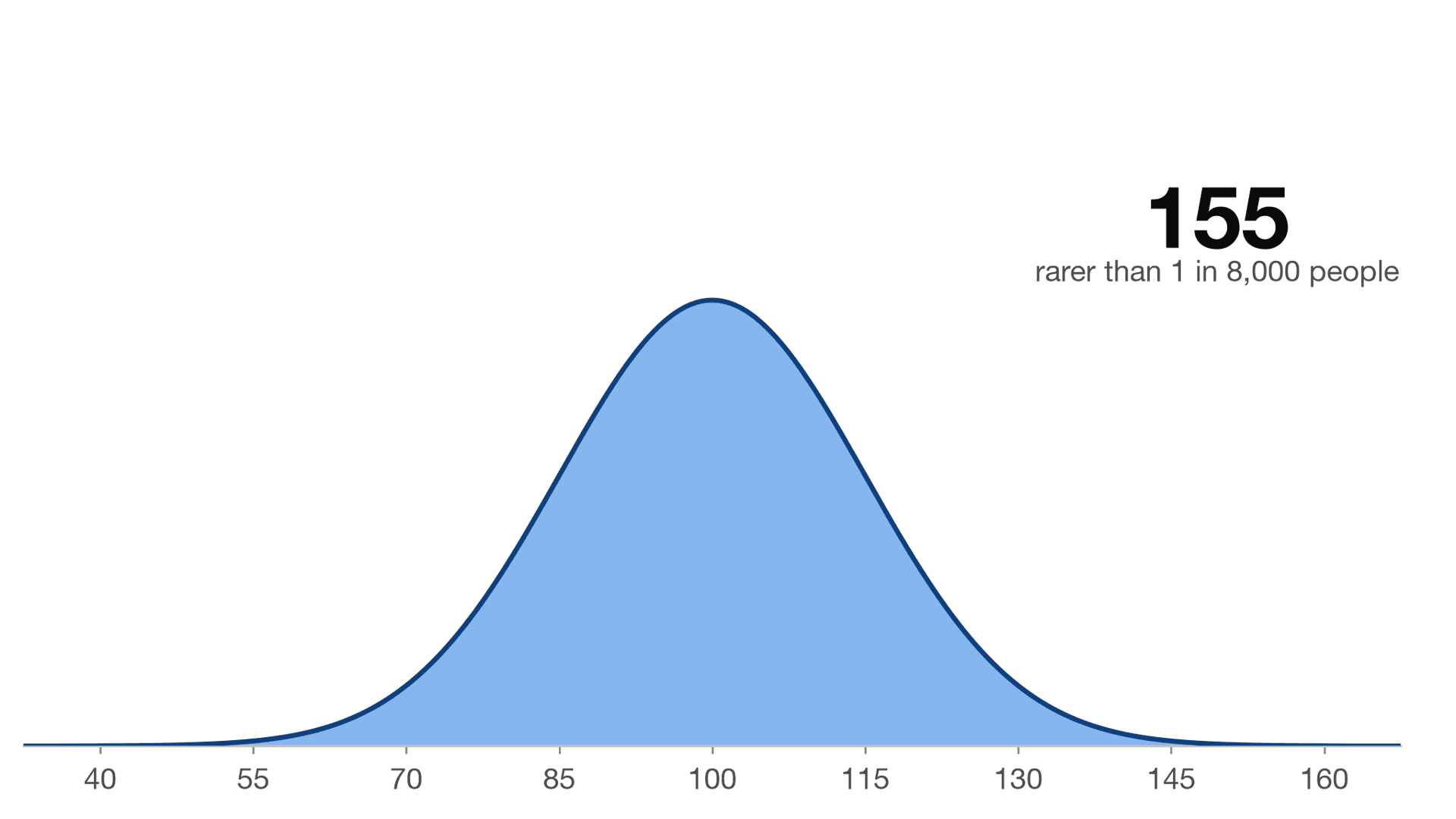
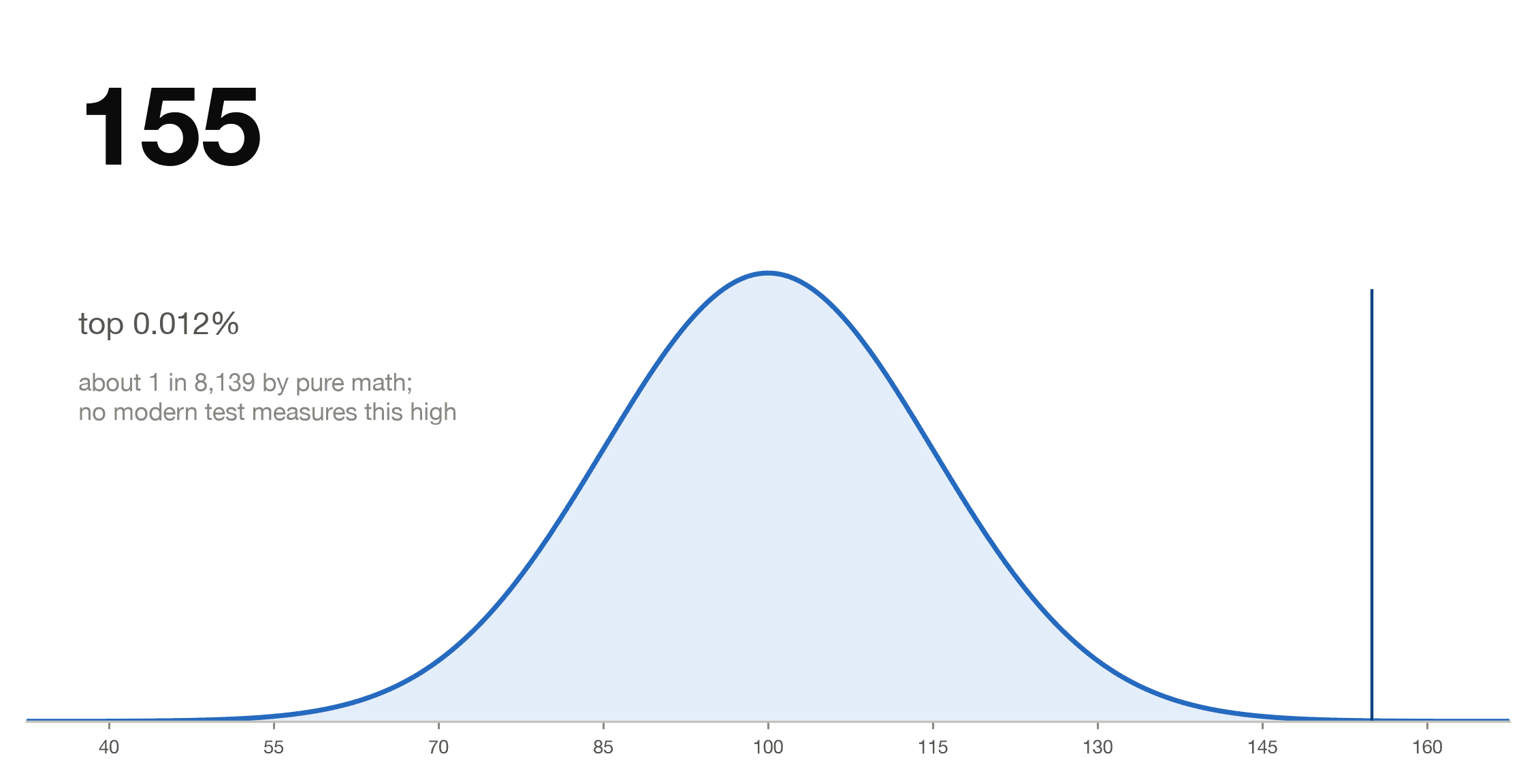
An IQ of 155 is 3.67 "standard deviations" (the statistic that describes how spread out scores are) above the average of 100. Computed from the normal curve with a mean of 100 and a standard deviation of 15, that is roughly the 99.99th percentile: about 1 person in 8,100 would score at or above 155. The figure is a theoretical extrapolation of the curve, because real norm samples contain very few people anywhere near this level. A 155 sits beyond every named band on standard tests, clears the strictest high-IQ society cutoffs with room to spare, and lives near the practical edge of what standard test norms can distinguish. This article covers the rarity math, the labels, and why scores this high carry extra uncertainty.
How Rare Is a 155?
The z-score arithmetic is simple: 155 is 55 points, or 3.67 standard deviations, above the mean, and the normal curve assigns that a rarity of about 1 in 8,100. The caveat matters more here than anywhere lower on the scale: the extreme tail is a mathematical projection, not an empirical count. Pearson's WISC-V technical documentation reports that among the 2,200 children in the test's norming sample, only 16 obtained any composite score of 150 or higher. Norms built from a handful of extreme cases simply cannot carve fine distinctions at this altitude, which is why scores near 155 sit at the practical edge of standard measurement.
Beyond the Labels
Descriptive category systems run out well before 155. The reproduced WAIS-IV table tops out with scores of 120 and above labeled "Superior," so a 155 is simply off the chart. Terman's 1916 classification put everything above 140 at "'near' genius or genius," a label modern psychometrics dropped: today "genius" describes extraordinary achievement rather than any test number. Where the scale starts to thin out just below this level is covered in our articles on what an IQ of 150 means and what an IQ of 160 means.
High-IQ Societies and a 155
A 155 clears every major society threshold. Mensa admits at the 98th percentile, which its qualifying-score tables put at about 130 to 132 on major tests, so a 155 exceeds the bar by more than 20 points. The far stricter Triple Nine Society admits at the 99.9th percentile, listing cutoffs such as 146 on the WAIS-III or Stanford-Binet 5, and a 155 is comfortably above that too. Membership signifies a documented score above a cutoff, nothing more; our overview of high-IQ societies explains the landscape.
Why Scores This High Are Fuzzy
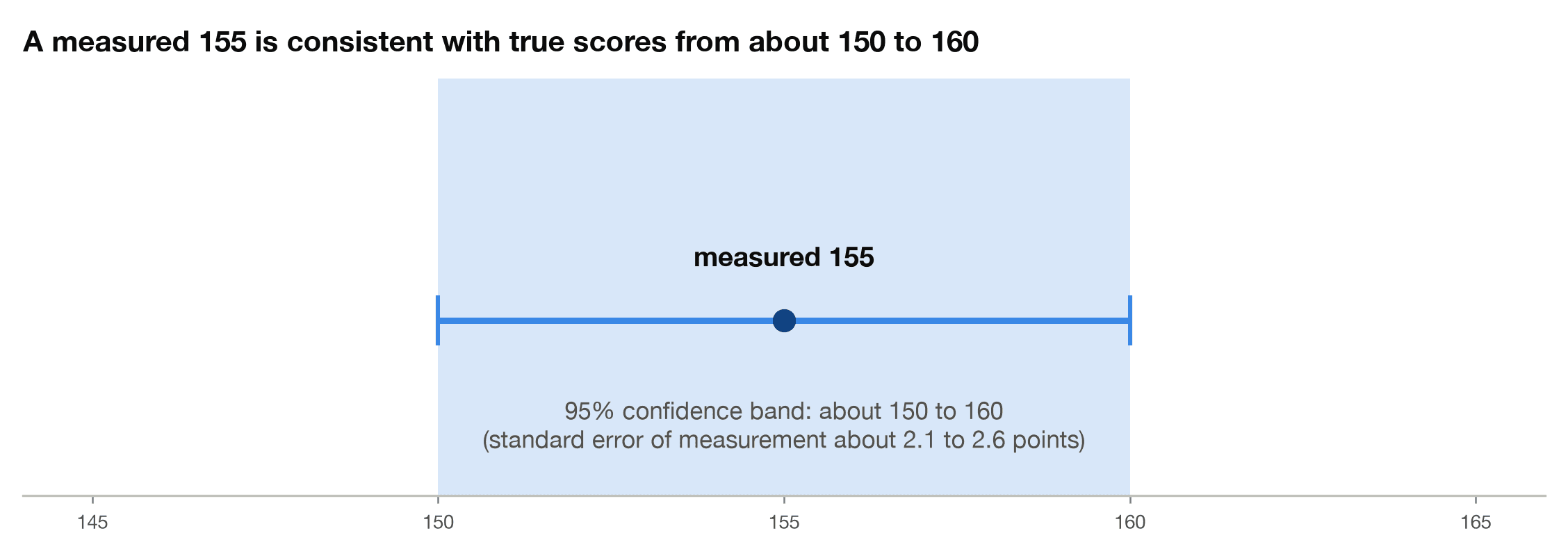
Three separate problems compound at the extreme. First, norming: with almost nobody this high in the reference samples, small raw-score differences translate into large IQ differences. Second, the ordinary "standard error of measurement" still applies; the U.S. Supreme Court in Hall v. Florida (2014) described a score as "best understood as a range, e.g., five points on either side of the recorded score," so a tested 155 is best read as roughly 150 to 160. Third, scales differ: on an older SD-16 Stanford-Binet metric a 155 corresponds to about 151 to 152 on the SD-15 scale, and on the SD-24 Cattell scale used by some older societies a "155" works out to only about 134 in SD-15 terms (both conversions computed via z-scores). A claim that someone "has an IQ of 155" is uninterpretable without knowing the test and the scale.
Living With an Exceptional Score
Scores this high are overrepresented in cognitively demanding fields such as research, medicine, law, and engineering, but no career is assigned by a number, and within every field the ordinary virtues (diligence, curiosity, reliability, collaboration) decide outcomes. A 155 is a strong tailwind, and it is only that. The sensible response to an exceptional score is the same as to any score: use it as information about how you learn, and get on with the work.
How to Get a Score You Can Cite
A number worth quoting needs a real test behind it: professional construction, real norms, and documented administration. The Reasoning and Intelligence Online Test from RIOT IQ is a validated, normed assessment built by psychometric professionals, and the free IQ test is the fastest way to see where you stand on the measurable part of the scale.
Frequently asked questions
How rare is an IQ of 155?
Computed from the normal curve with mean 100 and standard deviation 15, about 1 person in 8,000 scores at or above 155, near the 99.99th percentile. The estimate is theoretical: even large norming samples contain only a handful of people anywhere near this level.
Is an IQ of 155 a genius IQ?
Terman's 1916 chart labeled everything above 140 "near genius or genius," but modern tests use no genius label at all. Psychologists today reserve the word for extraordinary real-world achievement rather than any test score, though 155 is exceptionally high by any standard.
Does an IQ of 155 qualify for Mensa?
Easily. Mensa admits at the 98th percentile, about 130 to 132 on major tests, so a 155 clears the bar by more than 20 points. It also clears the far stricter Triple Nine Society, which requires the 99.9th percentile, about 146 on the WAIS or Stanford-Binet 5.
Can IQ tests even measure 155 accurately?
Only roughly. Norming samples contain very few people this high (16 of 2,200 children in the WISC-V sample scored 150 or above on any composite), so precision drops and the usual five-point error band matters more. A tested 155 is best read as roughly 150 to 160.
What jobs do people with an IQ of 155 have?
There is no assigned career for any score. Scores this high are overrepresented in cognitively demanding fields such as research, medicine, law, and engineering, but personality, interests, opportunity, and work habits decide outcomes within every field.
References
1. American Mensa. (n.d.). Qualifying test scores.us.mensa.org
2. Grieve, R. (2020). WAIS interpretation [Course document reproducing WAIS-IV Table 6.3 descriptive categories]. Western Kentucky University. people.wku.edu
3. Hall v. Florida, 572 U.S. 701 (2014). Legal Information Institute, Cornell Law School. law.cornell.edu