Jun 24, 2026·IQ Scores & InterpretationIQ vs. EQ: Which One Matters More for Career Success?
Does emotional intelligence really beat cognitive ability? Uncover the science behind workplace success. Read the article and try the RIOT IQ test!
Dr. Russell T. WarneChief Scientist
Few debates in modern psychology have generated as much public interest as the question of whether IQ or "EQ" (a popular shorthand for emotional intelligence) matters more for career success. Since Daniel Goleman published his 1995 bestseller Emotional Intelligence: Why It Can Matter More Than IQ, millions of people have believed that emotional abilities are as powerful as — or even more powerful than — cognitive ability for determining workplace outcomes. The claim was appealing. It suggested that success was not fixed by the cognitive abilities a person was born with but could be developed by learning to manage emotions.
As someone who has spent over 15 years researching intelligence, I find this to be a question that deserves a careful, evidence-based answer. The short version: cognitive ability (measured by IQ) remains one of the strongest predictors of career outcomes that psychologists have ever identified. Emotional intelligence, while an intriguing concept, has a much weaker and more contested evidence base. The popular framing of "IQ vs. EQ" creates a false competition that does not reflect what the research actually shows.
This article examines the data behind both constructs, including recent updates to decades-old meta-analyses, and explains what the science says about which traits genuinely matter for workplace performance.
What Does "EQ" Actually Measure?
Before comparing IQ and EQ, it is important to understand that "EQ" is not a single, agreed-upon construct the way IQ is. There is no universal EQ test, and the term means different things depending on who is using it. In the scientific literature, emotional intelligence generally refers to the ability to perceive, understand, and manage emotions. The most rigorous definition comes from John Mayer, Peter Salovey, and David Caruso [1], who described emotional intelligence as "the capacity to reason, understand, and manage emotions" and proposed that it also reflects "the emotion system's capacity to use emotion to enhance thought." The problem is that what Goleman popularized under the "EQ" banner was a much broader collection of traits — including persistence, motivation, self-awareness, social skills, and impulse control. Many of these traits are already well-studied personality characteristics. This is not a minor detail; it has major implications for whether EQ is measuring something genuinely new or simply repackaging traits that psychologists already knew about.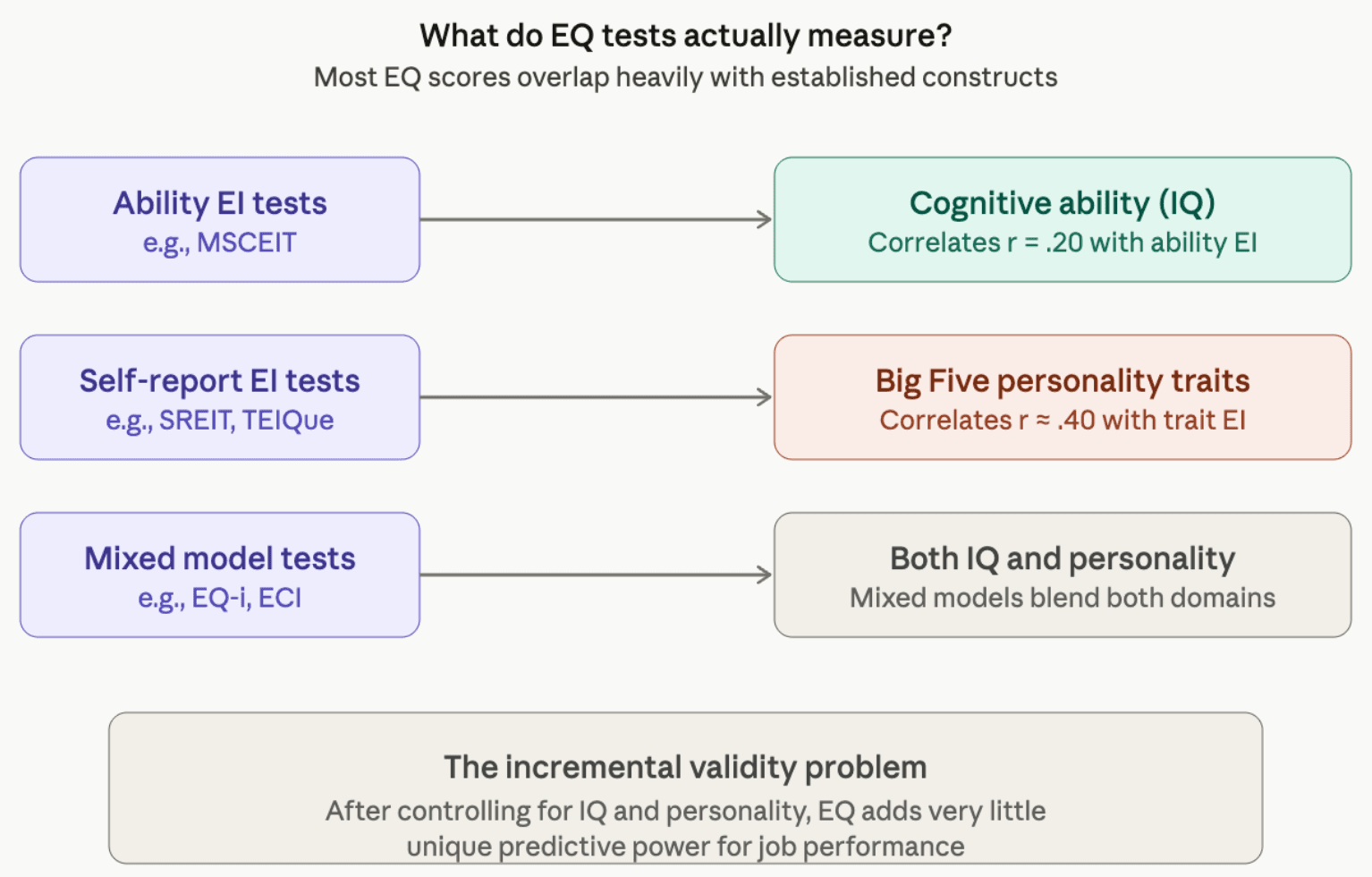 This overlap is not a trivial issue. A 2017 study [2] found that the general factor of personality and trait EI share such extensive genetic and phenotypic overlap that they may be measuring essentially the same underlying construct. And a 2010 meta-analysis by Joseph and Newman [3] in the Journal of Applied Psychology found that performance-based EI measures (the MSCEIT) were redundant with personality and cognitive ability when predicting job performance. Only in jobs with high emotional labor demands — such as customer service or nursing — did ability-based EI measures contribute any unique prediction.
 In other words, for most of the workforce, what EQ tests measure is a blend of traits that psychologists could already assess with established IQ and personality instruments.
What Does the Research Say About IQ and Career Success?
The evidence that cognitive ability predicts career outcomes is among the most robust findings in all of psychology. The landmark meta-analysis by Frank Schmidt and John Hunter, published in Psychological Bulletin in 1998, synthesized 85 years of personnel selection research [4] and found that general mental ability predicted job performance with a corrected correlation of r = .51 — stronger than education (r = .10), work experience (r = .18), or reference checks (r = .26). More recent work has refined those numbers. Sackett, Zhang, Berry, and Lievens (2022) [5], published in the Journal of Applied Psychology, reexamined the meta-analytic methods used in earlier studies and found that some validity estimates had been inflated by overcorrection for range restriction. Their updated estimate placed the corrected validity of cognitive ability for job performance at r = .31. That is lower than the original estimate, but it still makes cognitive ability one of the strongest single predictors in the research literature. Beyond direct job performance, cognitive ability is also a robust predictor of other career outcomes. A comprehensive meta-analysis by Tarmo Strenze (2007) [6], published in Intelligence, examined longitudinal studies and found that IQ correlates with occupational attainment at r = .43, educational attainment at r = .56, and income at r = .20. Schmidt (2002) [7] further showed that the validity of cognitive ability scales with job complexity: the corrected correlation with supervisor ratings of performance was .57 for high-complexity jobs (about 17% of the workforce), .51 for medium-complexity jobs (63% of the workforce), and .38 for low-complexity jobs (20% of the workforce). These numbers matter because they show that IQ is not just predictive in academic settings. It predicts real-world outcomes including training speed, promotions, and income — and the more cognitively demanding the work, the stronger the prediction becomes.
What Does the Research Say About EQ and Career Success?
The most comprehensive meta-analysis of EQ and job performance was conducted by O'Boyle, Humphrey, Pollack, Hawver, and Story (2011) [8], published in the Journal of Organizational Behavior. They classified EQ measures into three "streams": ability-based tests (like the MSCEIT), self-report ability measures, and "mixed model" measures that blend emotional abilities with personality traits. Their findings showed corrected correlations with job performance ranging from .24 to .30 across the three streams. Those are meaningful numbers — EQ measures are picking up on something relevant to workplace functioning. The critical question is whether that "something" is a new, distinct ability or a repackaged combination of cognitive ability and personality.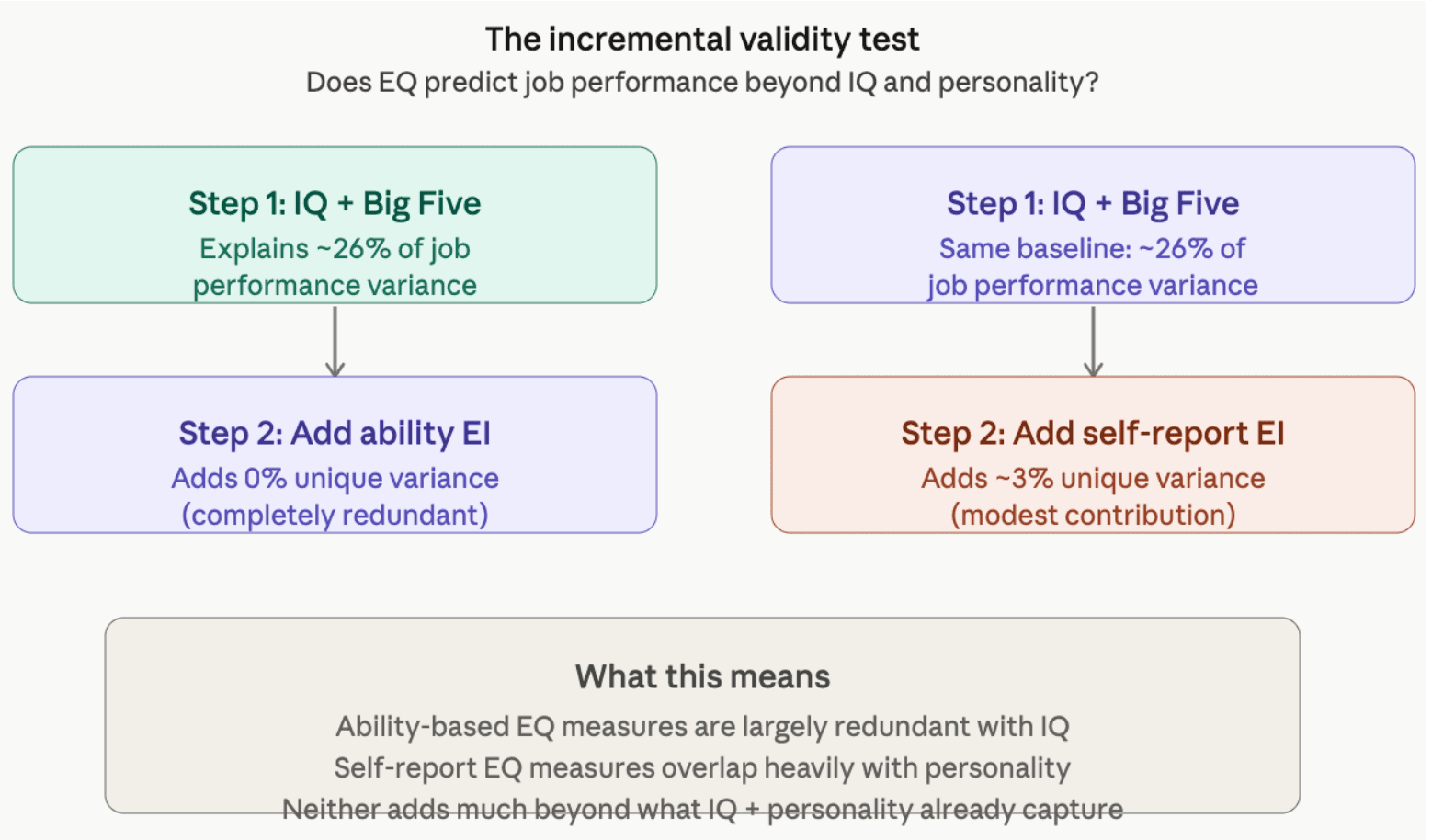 A 2017 meta-analysis by Miao, Humphrey, and Qian [9], published in the Journal of Occupational and Organizational Psychology, tested this directly by examining whether EQ has "incremental validity" — meaning whether it predicts outcomes beyond what IQ and the Big Five personality traits already predict. They found that ability-based EI contributed no incremental validity when cognitive ability and the Big Five were already in the model. Self-report and mixed EI measures contributed a modest increment (ΔR² = .03 to .06), but this small addition is likely because those scales are partially measuring personality traits that the standard Big Five framework captures incompletely.
 In the words of Edwin Locke (2005) [10], who called EI "an invalid concept" in the Journal of Organizational Behavior, the construct suffers from a fundamental definitional problem: it bundles too many unrelated traits under one umbrella, making it impossible to determine what EQ measures are capturing that is unique.
Why the "80% of Success" Claim Is Wrong
One of the most persistent myths about EQ is the claim — often attributed to Goleman — that emotional intelligence accounts for 80% of success in life and work, while IQ accounts for only 20%. In the tenth anniversary edition of his book, Goleman himself clarified that this was a misreading of his original argument. He never intended to claim that EQ outperforms IQ by a four-to-one margin.
The actual data could not be further from this claim. Based on the meta-analytic evidence reviewed here, cognitive ability explains roughly 10% to 26% of the variance in job performance (depending on the validity estimate and job complexity), while EQ measures explain approximately 6% to 9% — most of which overlaps with cognitive ability and personality. The notion that EQ dwarfs IQ in predicting career success is not supported by any peer-reviewed evidence.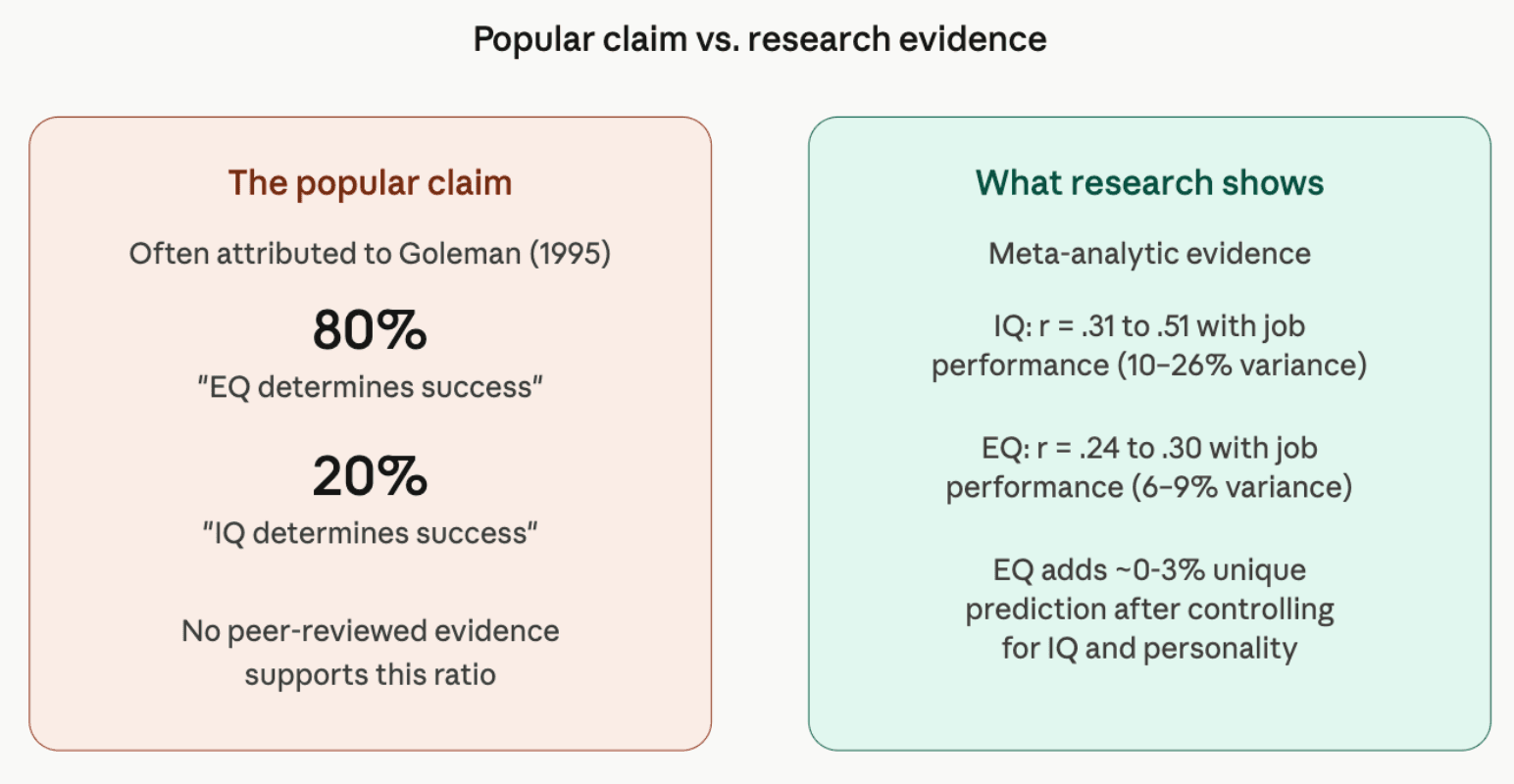 The personality trait that does consistently predict job performance beyond cognitive ability is conscientiousness. The landmark 1991 meta-analysis by Barrick and Mount [11] in Personnel Psychology, which examined 117 studies across five occupational groups, found that conscientiousness was the only Big Five trait that predicted performance across all job types, with a corrected correlation of about .20. Emotional stability (low neuroticism) is also a consistent predictor, especially in high-stress occupations.
What Actually Predicts Career Success?
Given all of this evidence, a clear hierarchy emerges. Cognitive ability and structured interviews sit at the top of the evidence pyramid. Personality traits — particularly conscientiousness and emotional stability — occupy the next tier. EQ measures fall in the modest range, alongside work experience and job knowledge, and their unique contribution after accounting for IQ and personality is minimal.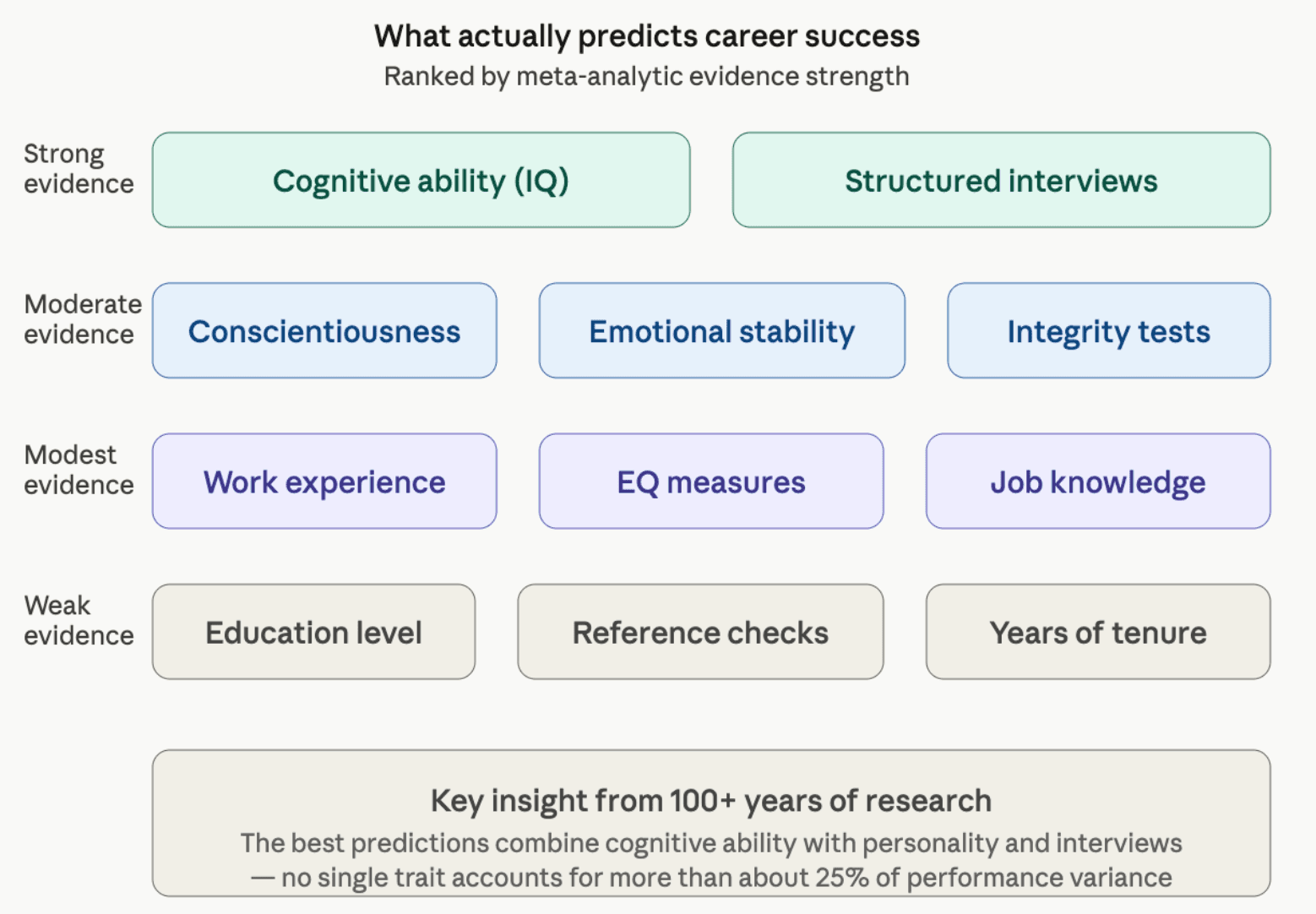 It is also worth noting that cognitive ability is especially valuable because of how broadly it predicts. IQ forecasts training speed, occupational attainment, promotions, and income across virtually all industries and job types. That breadth of prediction is rare for any psychological variable. By contrast, the predictive power of EQ measures appears to be concentrated in specific contexts — particularly jobs with high emotional labor demands like healthcare, customer service, and sales.
Why This Matters
The IQ-vs.-EQ framing has real consequences beyond academic debate. If organizations overweight EQ in their hiring and promotion decisions based on popular claims rather than evidence, they may be selecting employees on the basis of traits that add little predictive value — while underweighting cognitive ability, which consistently predicts performance. This can lead to less effective hiring, reduced workforce productivity, and unfair selection processes.
Similarly, the EQ narrative can create unrealistic expectations among individuals. The idea that "EQ matters more than IQ" may lead people to underinvest in developing their knowledge base, reasoning ability, and problem-solving capacity — in favor of vaguely defined "emotional skills" that are difficult to measure and even harder to train.
Interpersonal skills, self-regulation, and emotional awareness clearly matter in the workplace and in life. But the scientific evidence suggests that these traits are best understood through established personality frameworks. When a hiring manager says they want someone with "high EQ," they are usually describing a person who is conscientious, emotionally stable, agreeable, and socially skilled — all traits that personality science already measures well.
Putting It All Together
The IQ-vs.-EQ debate is, in many ways, a manufactured controversy. It was born from a bestselling book that made ambitious claims ahead of the evidence, and it persists because the idea of a learnable "emotional intelligence" is more appealing than the reality that cognitive ability — which is substantially heritable and difficult to change — is a powerful predictor of career outcomes.
The honest answer to "IQ vs. EQ: Which one matters more?" is that IQ has much stronger and more consistent evidence behind it. The non-cognitive traits that contribute to career success are better captured by personality science than by the construct of emotional intelligence. And the best predictions of workplace performance come not from choosing between IQ and EQ, but from combining cognitive ability measures with well-validated personality assessments and structured interviews.
Take the First Ever Professional Online IQ Test
The Reasoning and Intelligence Online Test is the first online IQ test that actually meets professional standards for psychological assessment. It was created by Dr. Russell Warne, who has over 15 years of experience in intelligence research.
What makes the RIOT different from the countless online IQ tests found with a quick internet search? Most of those tests are created by amateurs without proper training in psychometrics. The RIOT clearly stands out as the first-ever professional online IQ test. The RIOT underwent the same rigorous development process as traditional in-person IQ tests used by psychologists, including expert review, the first-ever proper U.S.-based online norm sample, and compliance with educational and psychological testing standards from APA, AERA, and NCME. The RIOT reports not just an overall IQ score but six index scores — Verbal Reasoning, Fluid Reasoning, Spatial Ability, Working Memory, Processing Speed, and Reaction Time — providing a comprehensive picture of cognitive strengths and areas for growth.
References
[1] Mayer, J. D., Salovey, P., & Caruso, D. (2000). Models of emotional intelligence. In R. J. Sternberg (Ed.), Handbook of intelligence (pp. 396–420). Cambridge University Press.
[2] Van der Linden, D., Schermer, J. A., de Zeeuw, E., Dunkel, C. S., Pekaar, K. A., Bakker, A. B., Vernon, P. A., & Petrides, K. V. (2018). Overlap between the general factor of personality and trait emotional intelligence: A genetic correlation study. Behavior Genetics, 48, 147–154. https://doi.org/10.1007/s10519-017-9885-8 [3] Joseph, D. L., & Newman, D. A. (2010). Emotional intelligence: An integrative meta-analysis and cascading model. Journal of Applied Psychology, 95(1), 54–78. https://doi.org/10.1037/a0017286 [4] Schmidt, F. L., & Hunter, J. E. (1998). The validity and utility of selection methods in personnel psychology: Practical and theoretical implications of 85 years of research findings. Psychological Bulletin, 124(2), 262–274. https://doi.org/10.1037/0033-2909.124.2.262 [5] Sackett, P. R., Zhang, C., Berry, C. M., & Lievens, F. (2022). Revisiting meta-analytic estimates of validity in personnel selection: Addressing systematic overcorrection for restriction of range. Journal of Applied Psychology, 107(11), 2040–2068. https://doi.org/10.1037/apl0001040 [6] Strenze, T. (2007). Intelligence and socioeconomic success: A meta-analytic review of longitudinal research. Intelligence, 35(5), 401–426. https://doi.org/10.1016/j.intell.2006.09.004 [7] Schmidt, F. L. (2002). The role of general cognitive ability and job performance: Why there cannot be a debate. Human Performance, 15(1–2), 187–210. https://doi.org/10.1080/08959285.2002.9668091 [8] O'Boyle, E. H., Humphrey, R. H., Pollack, J. M., Hawver, T. H., & Story, P. A. (2011). The relation between emotional intelligence and job performance: A meta-analysis. Journal of Organizational Behavior, 32(5), 788–818. https://doi.org/10.1002/job.714 [9] Miao, C., Humphrey, R. H., & Qian, S. (2017). A meta-analysis of emotional intelligence and work attitudes. Journal of Occupational and Organizational Psychology, 90(2), 177–202. https://doi.org/10.1111/joop.12167 [10] Locke, E. A. (2005). Why emotional intelligence is an invalid concept. Journal of Organizational Behavior, 26(4), 425–431. https://doi.org/10.1002/job.318 [11] Barrick, M. R., & Mount, M. K. (1991). The Big Five personality dimensions and job performance: A meta-analysis. Personnel Psychology, 44(1), 1–26. https://doi.org/10.1111/j.1744-6570.1991.tb00688.x [12] Goleman, D. (1995). Emotional intelligence: Why it can matter more than IQ. Bantam Books.
[13] Warne, R. T. (2020). In the know: Debunking 35 myths about human intelligence. Cambridge University Press. https://doi.org/10.1017/9781108593298 Take our professional IQ test
Want to know your IQ? Try the first ever professional online IQ test.
AuthorDr. Russell T. WarneChief Scientist
