An IQ of 110 beats about 3 in 4 people, the start of the high average range. See what a 110 IQ means for school and work, backed by validity research.
Dr. Russell T. WarneChief Scientist
Share
An IQ of 110 places you at about the 75th percentile of the population: higher than roughly 3 in 4 people. It is also the first score in the Wechsler "high average" classification band, which runs from 110 to 119, so it is the smallest score that changes your label from average to above average. The more useful question is what a score in this range actually predicts, and that evidence, from decades of education and employment research, is the focus of this article.
110 on the bell curve
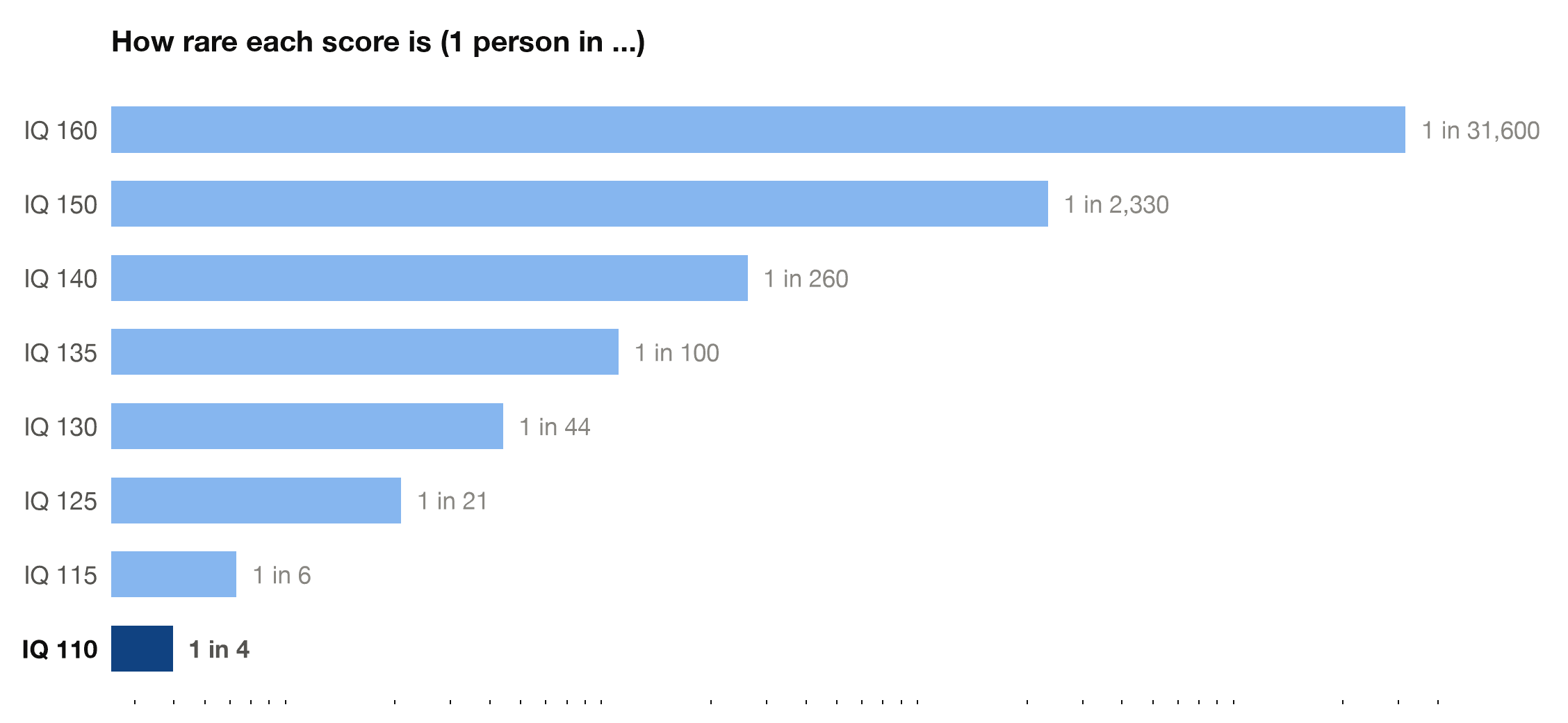
IQ tests report "deviation IQs" on a normal distribution with a mean of 100 and a standard deviation of 15, so 110 is two-thirds of a standard deviation above the mean. About 25.2 percent of people score 110 or higher. Because the middle of the curve is crowded, points near the mean buy rank quickly: the ten points from 100 to 110 move you about 25 percentile ranks, from the 50th to the 75th. The same ten points far out in the tail, from 140 to 150, barely move percentile rank and instead change rarity from about 1 in 261 to about 1 in 2,331. Our guide to the IQ bell curve explains why the same distance means different things at different places on the scale.
What a 110 IQ predicts for education
Learning research gives a concrete picture of this range. Gottfredson (1997), reviewing employment-testing data, notes that workers scoring up to about IQ 95 "tend to need explicit teaching of most of what they need to know," while people above that range increasingly pick up material on their own. At 110, standard instructional formats, college coursework included, pose no ability barrier. People at this level routinely complete degrees, and within this range study habits, interest, and persistence do most of the work of separating outcomes.
What a 110 IQ predicts at work
The validity evidence
General mental ability is the single best-studied predictor of job performance. Schmidt and Hunter (1998), summarizing 85 years of validity research, report a "predictive validity" of .51 for general mental ability for jobs of medium complexity, a tier covering 62 percent of jobs in the US economy, and describe it as the best available predictor of job-related learning and the acquisition of job knowledge. That is why cognitive tests keep appearing in hiring research; our article on IQ tests in hiring covers the practical debate.
Where 110 sits among job applicants
Gottfredson's Wonderlic data locate 110 on the occupational map. Median applicant scores run around IQ 112 (the 81st percentile of the general adult population) for accountant and teacher, and around IQ 100 (the 50th percentile) for cashier, meter reader, and teller. A 110 is above the typical applicant for most jobs and just below the applicant median for the most cognitively demanding professions. These figures describe typical ranges among applicants, and they are not entry requirements: no mainstream career is closed at 110.
What validity does and does not mean for one person
A validity coefficient of .51 describes prediction across many people, and it leaves individual outcomes wide open. Scores forecast group averages well and single lives loosely; motivation, conscientiousness, opportunity, and plain chance carry enormous weight for any one person. For the broader evidence base, see what IQ predicts.
How precise is a 110?
With Full Scale reliability of .97 to .98 on a flagship test, the "standard error of measurement" is about 2.1 to 2.6 points, which gives a 95 percent "confidence interval" of roughly 106 to 114 around a measured 110. That interval spans the top of the average band (109 and below) and solidly high average territory (114). Classification labels flip on single points, so hold the label loosely and treat the score as a region of the scale rather than a fixed rank.
The bottom line
A 110 IQ is an above-average score with no practical ceilings attached: standard education poses no barrier, and the occupational data show people at this level across every field. From here, the differentiators are effort, interest, and opportunity rather than additional points. If you want a score you can actually rely on, the Reasoning and Intelligence Online Test from RIOT IQ is a properly normed assessment that reports your result with its confidence interval, not just a single number.
Frequently asked questions
Is an IQ of 110 good?
Yes, it is above average. 110 places you at about the 75th percentile, higher than roughly 3 out of 4 people, and it is the first score in the "high average" classification band (110 to 119).
What percentile is a 110 IQ?
About the 75th percentile on the standard scale (mean 100, SD 15). Roughly 1 in 4 people scores 110 or higher.
What jobs match an IQ of 110?
Employment-testing data show 110 is above the median applicant for most occupations and near the median for professional fields like teaching and accounting (median around IQ 112). No mainstream career is closed at 110; interest and persistence matter more from there.
Can someone with a 110 IQ succeed in college?
Yes. People at this level routinely complete degrees, and cognitive-ability research shows learning from standard instruction poses no barrier in this range. Study habits and motivation are usually the deciding factors.
Is 110 IQ high average or average?
110 is the bottom of the high average band (110 to 119) on Wechsler-style classifications. But because tests have a measurement error of 2 to 3 points, a measured 110 could reflect a true score anywhere from about 106 to 114.
References
1. Schmidt, F. L., & Hunter, J. E. (1998). The validity and utility of selection methods in personnel psychology: Practical and theoretical implications of 85 years of research findings. Psychological Bulletin, 124(2), 262-274. se.edu
2. Gottfredson, L. S. (1997). Why g matters: The complexity of everyday life. Intelligence, 24(1), 79-132. udel.edu
3. Karande, S., Sawant, S., Kulkarni, M., Kanchan, S., & Sholapurwala, R. (2005). Comparison of cognition abilities between groups of children with specific learning disability having average, bright normal and superior nonverbal intelligence. Indian Journal of Medical Sciences, 59(3), 95-103. pubmed.ncbi.nlm.nih.gov
4. Canivez, G. L. (2010). Review of the Wechsler Adult Intelligence Scale-Fourth Edition. The eighteenth mental measurements yearbook. Buros Institute. ux1.eiu.edu
Take our professional IQ test
Want to know your IQ? Try the first ever professional online IQ test.