An IQ of 95 is a solidly average score, about the 37th percentile and within a whisker of 100. What an IQ of 95 means and how to interpret it fairly.
Dr. Russell T. WarneChief Scientist
Share
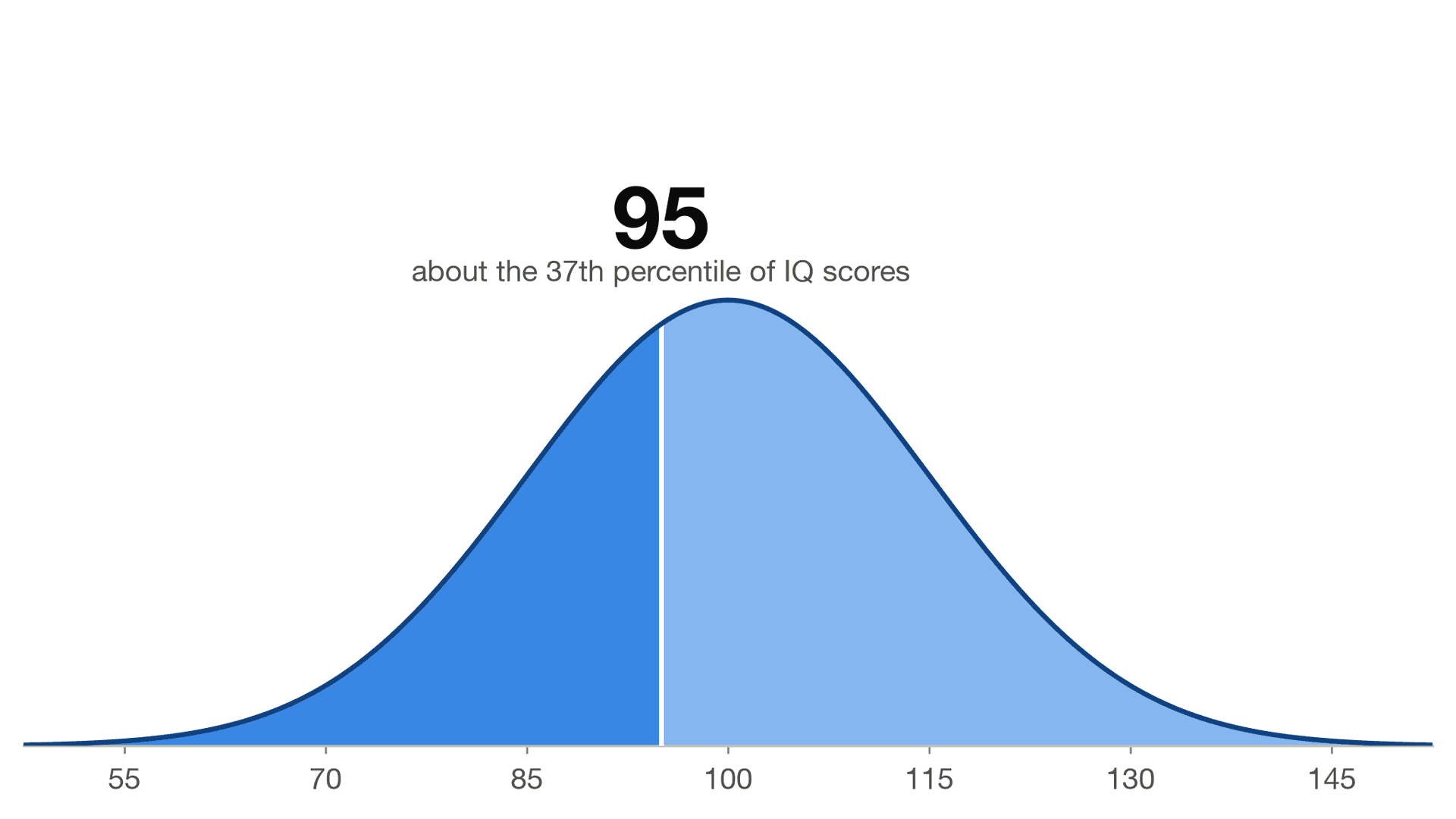
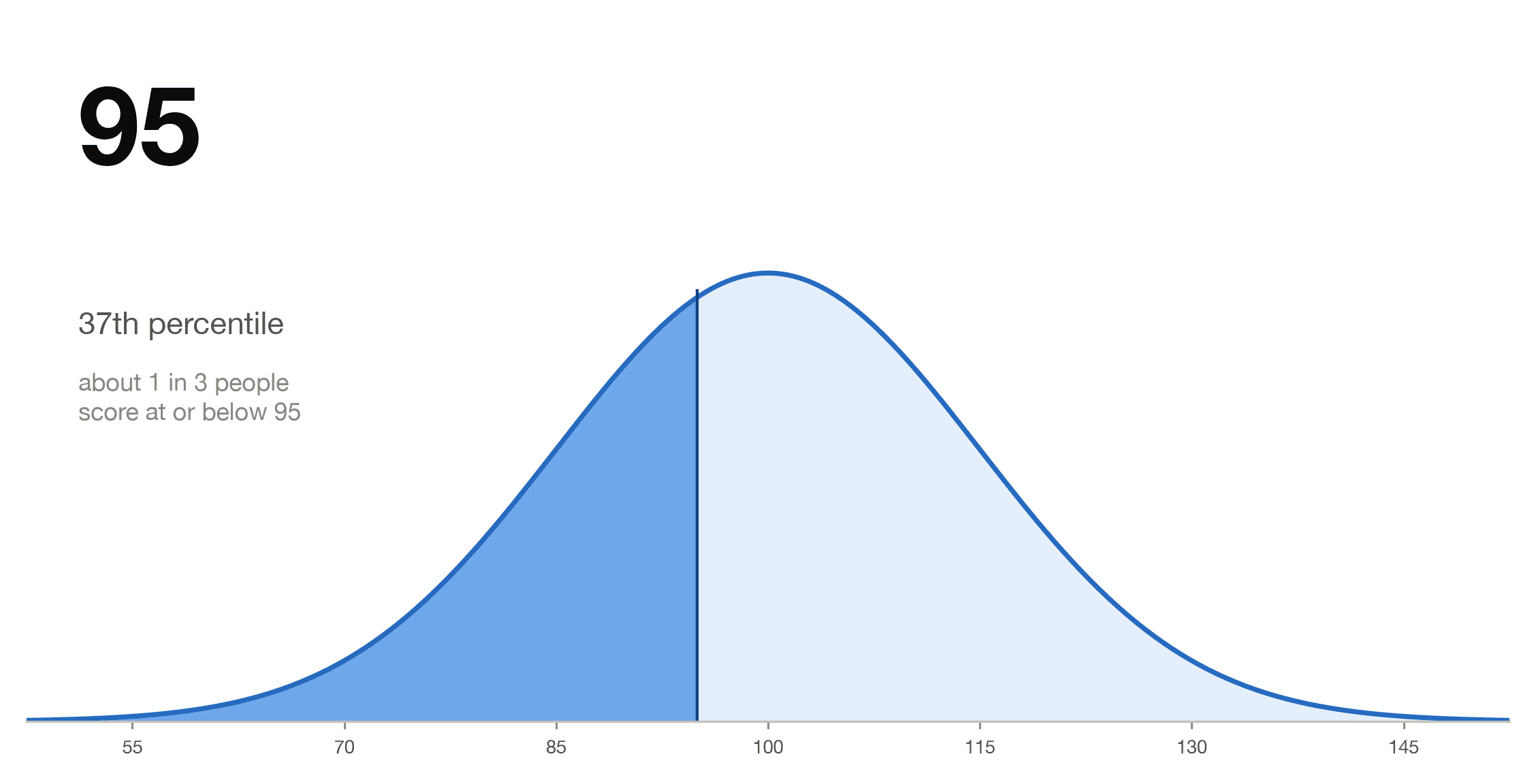
An IQ of 95 is a solidly average score. It sits one third of a "standard deviation" (the statistic that describes how spread out scores are) below the mean of 100, comfortably inside the 90-109 "Average" band that Wechsler-style tests use, a band shared by roughly half the population. Computed from the normal curve with a mean of 100 and a standard deviation of 15, a 95 lands at about the 37th percentile: around 37% of people score at or below it and about 63% score higher. Given normal measurement error, a 95 is statistically indistinguishable from 100 in a single sitting. This article explains the numbers and the most common ways people misread a score like this.
Where 95 Falls on the Bell Curve
Percentile and rarity
A 95 corresponds to a z-score of -0.33, which the normal curve places at about the 37th percentile, a few points below the exact center of the distribution. The same arithmetic shows the 90-109 Average band covering roughly half of all people. Both figures are calculated from the normal curve with a mean of 100 and a standard deviation of 15 rather than from any publisher's tables. For the full picture of how scores spread out, see the IQ bell curve explained.
A century of "average"
The average band is old and stable. Terman classified 90-110 as "normal, or average, intelligence" in 1916, and the modern WAIS-IV descriptive system draws essentially the same box at 90-109. A 95 has been squarely average for over a century of testing.
Why 95 and 100 Are Practically the Same Score
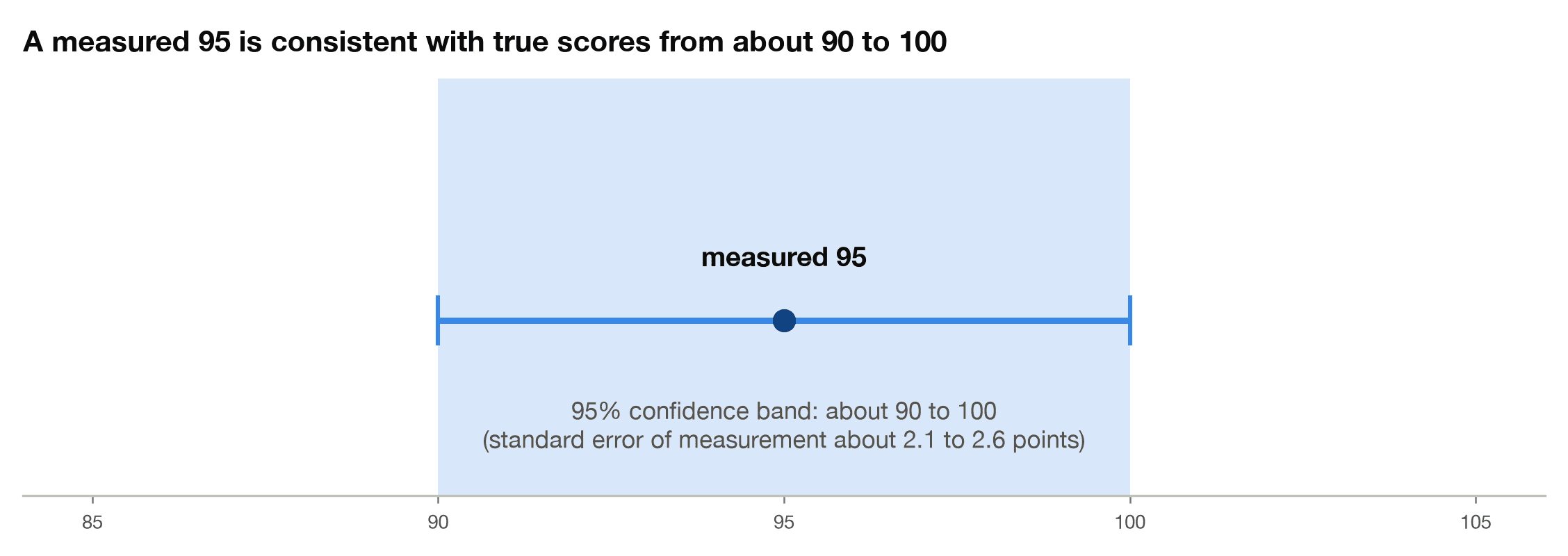
Every test carries a "standard error of measurement," the expected wobble between tested and true scores. In Hall v. Florida (2014), the U.S. Supreme Court described an individual score as "best understood as a range, e.g., five points on either side of the recorded score." A tested 95 is therefore best read as "somewhere around 90 to 100," and a person who scores 95 today could easily score 100 on another good test next month, and vice versa. Five points is within the noise of even excellent instruments, so it is a mistake to build an identity on a gap that small. Our article on what an IQ of 105 means makes the same point from the other side of 100.
Life at 95: School, Work, and Learning Style
A 95 is compatible with the full mainstream of school and career outcomes. Many people at this level complete college and work across the breadth of ordinary occupations; the most cognitively abstract fields are statistically harder to enter, and interests, conscientiousness, and training style shape outcomes alongside ability. Gottfredson's (1997) employment review describes the band just below the middle as learning best through explicit teaching, demonstration, and practice, and the middle itself as mastering routines through hands-on experience; a 95 sits across those descriptions. Her 1990s military figures, mapped to roughly IQ 85 to 91 across services (via the AFQT, an aptitude composite rather than an IQ test), were all comfortably below a 95.
Common Misreadings of a 95
• "Below 100 means below average": wrong. The Average band runs from 90 to 109, and roughly half the population is inside it. A 95 is an average score, full stop.
• "My online quiz said something different": unnormed quiz sites are entertainment. Without a real norming sample, a number has nothing to be a percentile of.
• "Brain training will move it": retest wobble aside, no program has been shown to produce large, lasting gains in underlying general ability. Skepticism is the evidence-based position.
What typical adult scores look like, and why small differences among them rarely matter, is covered in our guide to the normal IQ score for adults.
Getting a Number You Can Trust
If you want a score worth interpreting, take a professionally developed, normed test under good conditions: rested, undistracted, and in your strongest language. The Reasoning and Intelligence Online Test from RIOT IQ reports how you compare against a real norming sample, and the free IQ test is the easiest place to start.
Frequently asked questions
Is an IQ of 95 average?
Yes, fully average. Modern tests label 90-109 as the Average band, and roughly half the population lands in it. A 95 is about the 37th percentile computed from the bell curve, a few points below the exact center at 100.
What percentile is an IQ of 95?
Computed from the normal curve with mean 100 and standard deviation 15, a 95 sits at about the 37th percentile: around 37% of people score at or below it and about 63% score above it.
Is 95 basically the same as 100?
For one test sitting, effectively yes. The standard error of measurement is about five points either side, so a tested 95 is best read as "somewhere around 90 to 100." Small gaps like this are within the noise of even excellent tests.
Is an IQ of 95 good enough for college or a professional job?
Many people at this level complete college and work across the full mainstream of occupations. More cognitively abstract fields are statistically harder to enter, and interests, conscientiousness, and training style all shape outcomes alongside ability.
How can I find out my real IQ?
Take a professionally developed, normed test under good conditions: rested, undistracted, in your strongest language. Free quiz-style sites are usually unnormed entertainment; a serious instrument reports how you compare with a real norming sample.
References
1. Gottfredson, L. S. (1997). Why g matters: The complexity of everyday life. Intelligence, 24(1), 79-132. udel.edu
2. Grieve, R. (2020). WAIS interpretation [Course document reproducing WAIS-IV Table 6.3 descriptive categories]. Western Kentucky University. people.wku.edu
3. Hall v. Florida, 572 U.S. 701 (2014). Legal Information Institute, Cornell Law School. law.cornell.edu
4. Terman, L. M. (1916). The measurement of intelligence. Houghton Mifflin. archive.org
5. Warne, R. T. (2020). In the know: Debunking 35 myths about human intelligence. Cambridge University Press. doi.org/10.1017/9781108593298
Take our professional IQ test
Want to know your IQ? Try the first ever professional online IQ test.