How do IQ percentiles work? See the full IQ percentile conversion table, the rarity math behind every score, and how to read your own percentile rank.
Dr. Russell T. WarneChief Scientist
Share
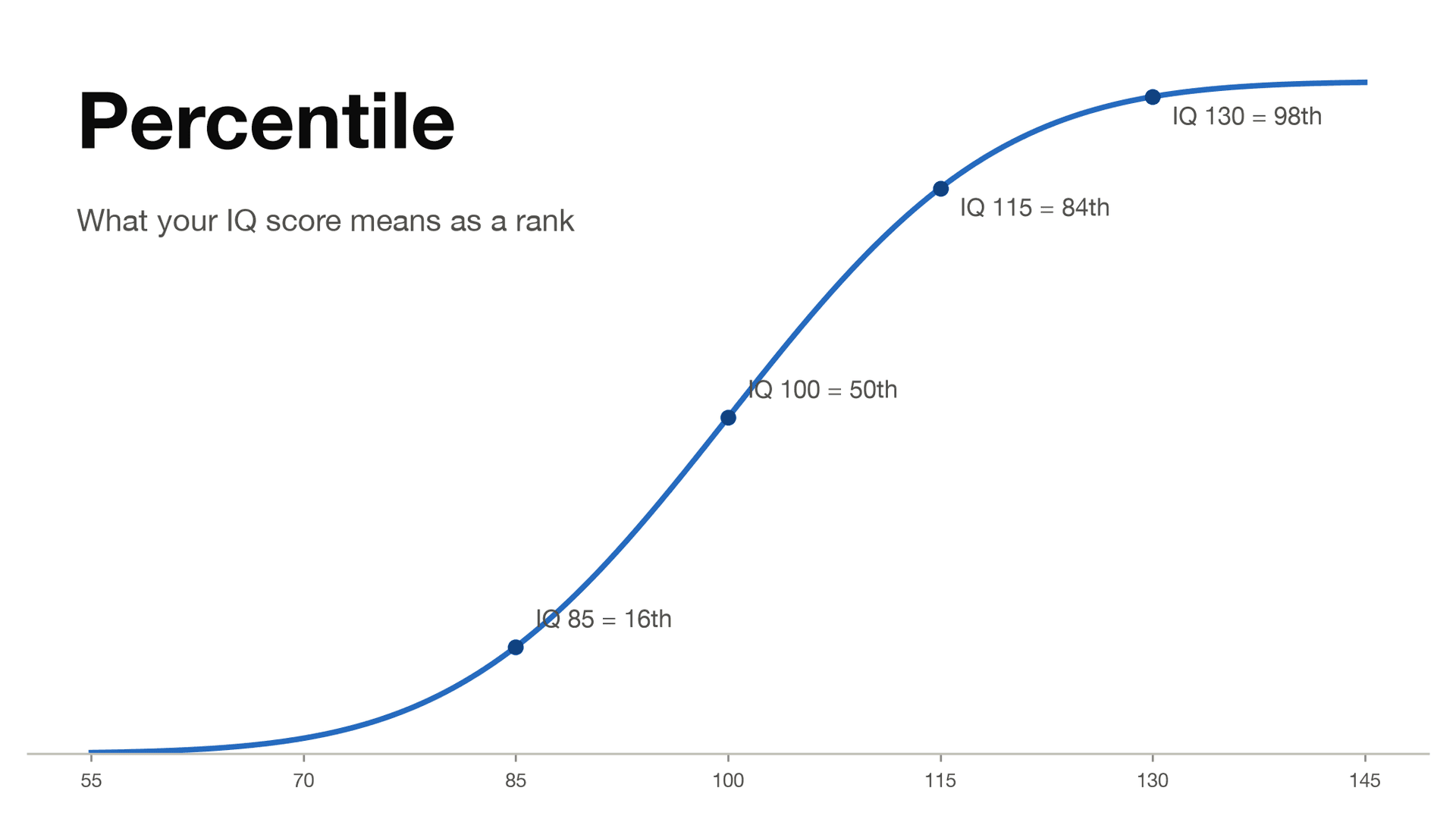
An IQ "percentile" is the percentage of people in a test's norming population who score below you. Because modern IQ scores are standardized to a mean of 100 with a "standard deviation" (a measure of score spread) of 15, every IQ converts to a percentile through the normal distribution: an IQ of 100 is the 50th percentile, 115 is the 84th, and 130 is the 98th. This article gives the full conversion table, the rarity math behind it, the percentile landmarks that drive real decisions, and how to read a percentile from your own score report.
The IQ percentile conversion table
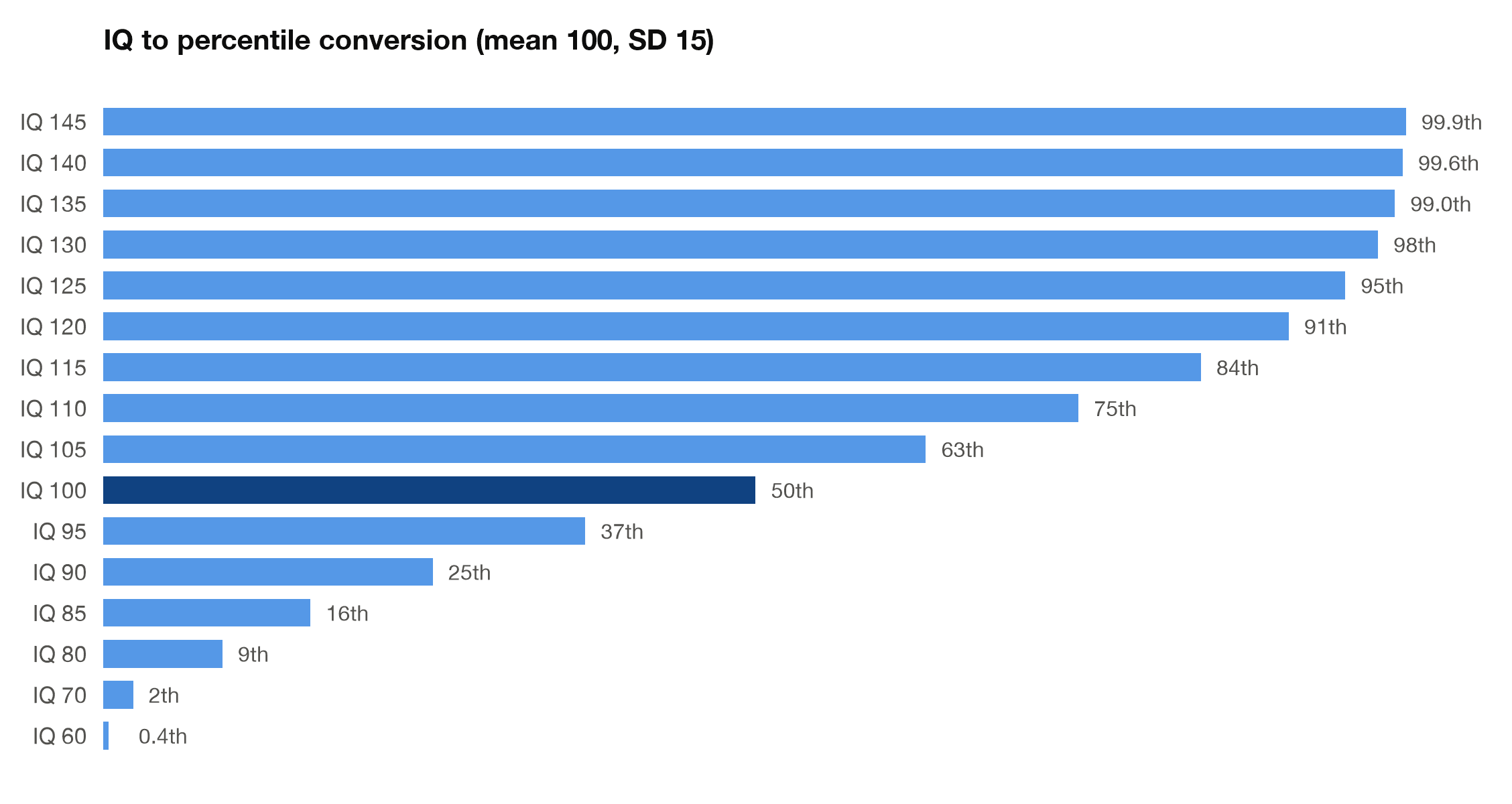
Modern tests report "deviation IQs": the Wechsler Full Scale IQ and its index scores, for instance, each have a population mean of 100 and a standard deviation of 15. That standardization is what makes a universal conversion table possible. The figures below are computed with the standard normal distribution function (the method is mathematically identical to scipy.stats.norm.cdf), using mean 100 and SD 15. Each percentile is the share of people scoring below that IQ.
• IQ 85: 15.9th percentile
• IQ 90: 25.3th percentile
• IQ 100: 50th percentile, 1 in 2 score at or above
• IQ 110: 74.7th percentile, about 1 in 4 at or above
• IQ 115: 84.1st percentile, about 1 in 6
• IQ 120: 90.9th percentile, about 1 in 11
• IQ 125: 95.2nd percentile, about 1 in 21
• IQ 130: 97.7th percentile, about 1 in 44
• IQ 135: 99.0th percentile, about 1 in 102
• IQ 140: 99.6th percentile, about 1 in 261
• IQ 145: 99.87th percentile, about 1 in 741
• IQ 150: 99.957th percentile, about 1 in 2,331
• IQ 160: 99.997th percentile, about 1 in 31,574
The reverse lookups are just as useful: the 90th percentile corresponds to an IQ of 119.2, the 95th to 124.7, the 98th to 130.8, the 99th to 134.9, and the 99.9th to 146.4. One caveat applies to the extremes. The normal curve is an excellent approximation through most of the range, but real norm samples are finite, so published tables extrapolate at the far tails, and scores above about 160 cannot be normed meaningfully.
The rarity math: from percentile to "1 in N"
Converting a percentile to a rarity is one division: if your percentile leaves p percent of people at or above your score, the score occurs in about 1 person in 100/p. The interesting behavior is in the tail. Near the middle of the distribution, 5 IQ points move you modestly: from 100 to 105 changes the rarity from 1 in 2 to about 1 in 3. High in the tail, the same 5 points are dramatic: 130 to 135 moves you from 1 in 44 to 1 in 102, and 145 to 150 from 1 in 741 to 1 in 2,331. Small score differences translate into large rarity differences precisely where the curve is thinnest, which is one reason single points should never be over-read there. For what one of those individual scores means in depth, see what an IQ of 130 means.
Percentile landmarks that matter in real life
Percentiles anchor decisions at both ends of the scale. At the low end, the clinical definition of intellectual disability is built around an IQ score below about 70, two standard deviations below the population mean of 100, roughly the 2nd percentile. At the high end, the same two-standard-deviation logic runs in reverse: American Mensa accepts scores at or above the 98th percentile, and gifted rules such as Ohio's statute identify "superior cognitive ability" from a score two standard deviations above the mean, minus the "standard error of measurement" (the expected wobble in an obtained score). The symmetry is the point: the same bell curve that defines eligibility for support services at one tail defines gifted and high-IQ-society eligibility at the other. The distribution behind all of this is covered in the IQ bell curve explained.
Percentiles vs labels: the words change, the math does not
Score labels have never been stable. Terman's 1916 table attached words like "superior intelligence" to ratio-IQ bands, and its author conceded that "the boundary lines between such groups are absolutely arbitrary, a matter of definition only." A century later the words still differ from publisher to publisher, which is why experts convened a consensus conference at the 2018 meeting of the American Academy of Clinical Neuropsychology: no universally accepted system exists for assigning qualitative descriptors to score ranges. Percentiles solve the problem the labels cannot. A 97.7th percentile means exactly the same thing on every properly normed test, in every decade, whatever adjective sits next to it.
Reading your own percentile correctly
• A percentile is a rank, never a percent correct: An IQ of 100 means you outscored about half of the norming population. It says nothing about how many items you answered correctly.
• Your percentile is a range: Every obtained score carries measurement error, so one sitting yields a percentile range rather than a point. A reported IQ of 120 with a typical confidence interval spans roughly the 84th to the 95th percentile. Good reports show the interval, as our guide to IQ confidence intervals explains.
• Norm quality decides whether the number means anything: A percentile describes standing relative to the test's norming population. Unnormed online quizzes have no defined reference population, so their percentiles do not correspond to the table on this page.
Frequently asked questions
What percentile is an IQ of 120?
An IQ of 120 is the 90.9th percentile, meaning about 91% of people score below it and roughly 1 in 11 score at or above it (computed from the normal distribution with mean 100 and SD 15).
What IQ is the 99th percentile?
IQ 134.9, so in practice a score of 135. About 1 person in 100 scores at that level or higher on a test normed with mean 100 and SD 15.
Is an IQ percentile the same as a test percentage score?
No. A percentile is the percent of the norming population scoring below you, never the percent of questions answered correctly. An IQ of 100 means you outscored about 50% of people, regardless of how many items you got right.
Why do psychologists prefer percentiles over labels like "superior"?
Because labels were never standardized: different tests and eras attached different words to the same score, which prompted a 2020 neuropsychology consensus statement on uniform labels. A percentile is exact and means the same thing on every properly normed test.
How accurate is a percentile from one test session?
Every obtained score carries measurement error, so your true standing is a range. A reported IQ of 120 with a typical confidence interval spans roughly the 84th to 95th percentile, which is why good reports show intervals rather than bare points.
Do online quiz percentiles mean anything?
Only if the test was normed on a representative sample. Percentiles from unnormed quizzes have no defined reference population, so the numbers do not correspond to the table on this page.
The takeaway
A percentile is the cleanest sentence an IQ score can utter: it tells you exactly where a result stands among the people the test was normed on, with no century-old adjectives attached. The math only works when the norms are real. The Reasoning and Intelligence Online Test from RIOT IQ is normed to the modern mean-100, SD-15 scale and reports scores with confidence intervals; you can take the free RIOT IQ test and find your own percentile on the table above.
References
1. Wechsler, D. (1944). The measurement of adult intelligence (3rd ed.). Williams & Wilkins. archive.org
2. Terman, L. M. (1916). The measurement of intelligence. Houghton Mifflin. archive.org
3. Guilmette, T. J., et al. (2020). American Academy of Clinical Neuropsychology consensus conference statement on uniform labeling of performance test scores. The Clinical Neuropsychologist, 34(3), 437-453. pubmed.ncbi.nlm.nih.gov
4. National Academies of Sciences, Engineering, and Medicine. (2015). Clinical characteristics of intellectual disabilities. In Mental disorders and disabilities among low-income children. National Academies Press. ncbi.nlm.nih.gov
5. American Mensa. (n.d.). Qualifying test scores.us.mensa.org
6. Ohio Revised Code § 3324.03. Identification of gifted students.codes.ohio.gov
7. Zhang, Y., et al. (2025). Cognitive impairments and neurofunctional alterations in children with electrical status epilepticus during sleep.pmc.ncbi.nlm.nih.gov
Take our professional IQ test
Want to know your IQ? Try the first ever professional online IQ test.