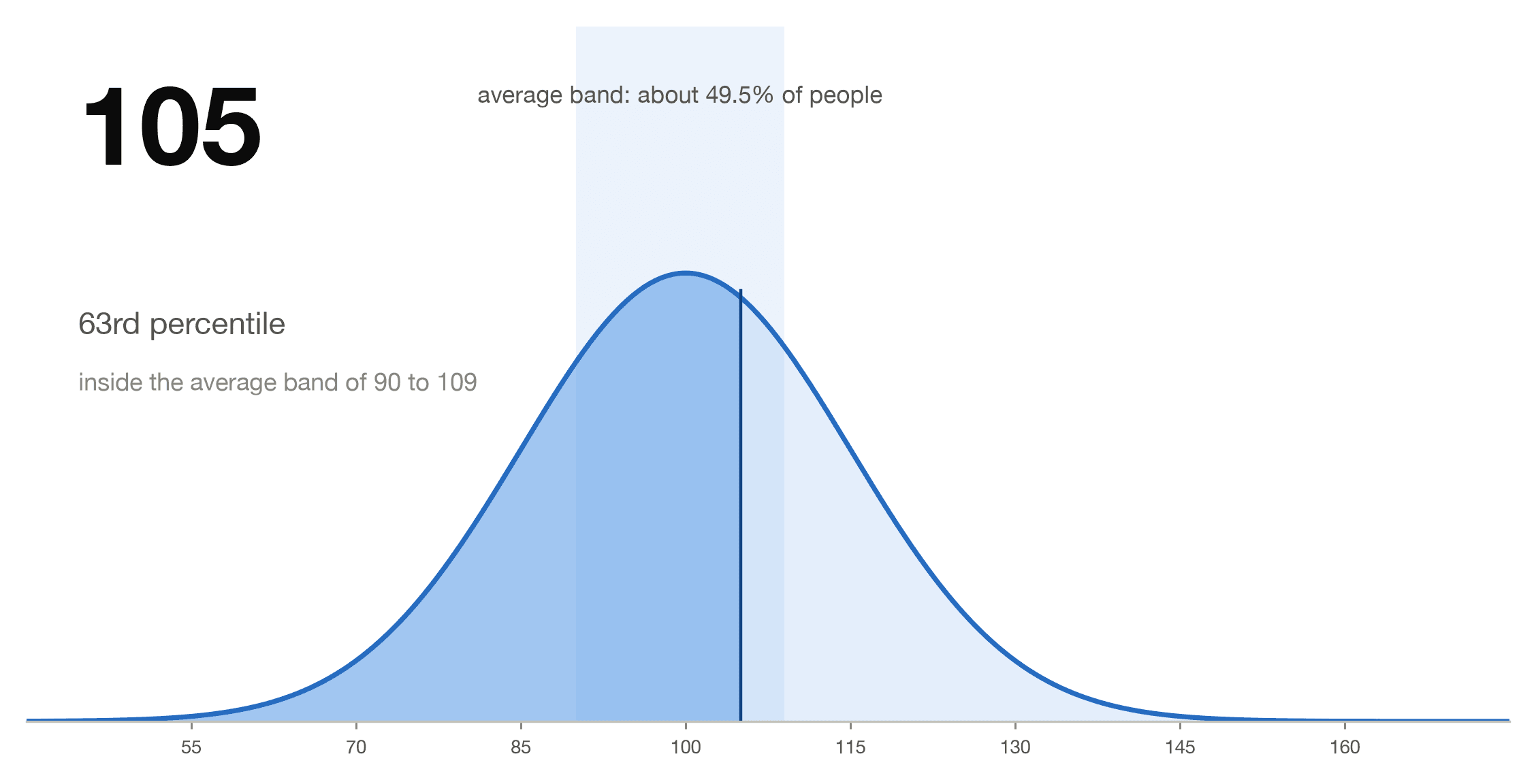
An IQ of 105 lands at the 63rd percentile, inside the average band of 90 to 109. See what an IQ of 105 means and why it sits within testing noise of 100.
Dr. Russell T. WarneChief Scientist
Share
An IQ of 105 is one-third of a "standard deviation" (a measure of how spread out scores are) above the average of 100, which places it at about the 63rd percentile. It sits squarely inside the average band of 90 to 109, the band that holds roughly half of everyone, more than every other band combined. Just as important: on many tests a measured 105 is statistically indistinguishable from a measured 100, because the 5 points between them fit inside the measurement error of even the best instruments. This article explains the math, what "average" actually means, and why small gaps near the middle of the scale should be read lightly.
Where 105 sits on the IQ scale
Modern tests report "deviation scores": the factor indices and the Full Scale IQ are standardized to a population mean of 100 and a standard deviation of 15, which is what makes percentile conversion possible. A 105 is 5 points, one-third of a standard deviation, above the center, and on the standard normal model it lands at the 63.1st percentile. About 37% of people, roughly 1 in 2.7, score 105 or higher, and about 63% score at or below it. A 105 outscored more people than it trailed, though only modestly. How every score maps to a percentile is covered in our guide to IQ percentiles.
What "average" actually means
On Wechsler-style scales the average band runs from 90 to 109. Computed on the standard model, that band contains about 49.5% of the population, which is more than all other bands combined. This was true by design from the start: Wechsler's 1944 classification table assigned his "Average" band exactly 50.00 percent of the population by construction. The average band is the crowded middle of the curve, and a 105 sits comfortably inside it.
The adjective attached to a band is the least stable part of a score report. The American Academy of Clinical Neuropsychology convened its consensus conference on uniform labels precisely because no universally accepted system existed for assigning qualitative descriptors to score ranges. The stable way to read a 105 is the percentile, and the percentile says: above the midpoint, inside the band where most people are. "Average" is a description of the population, never a consolation label.
Why 105 and 100 are effectively the same score
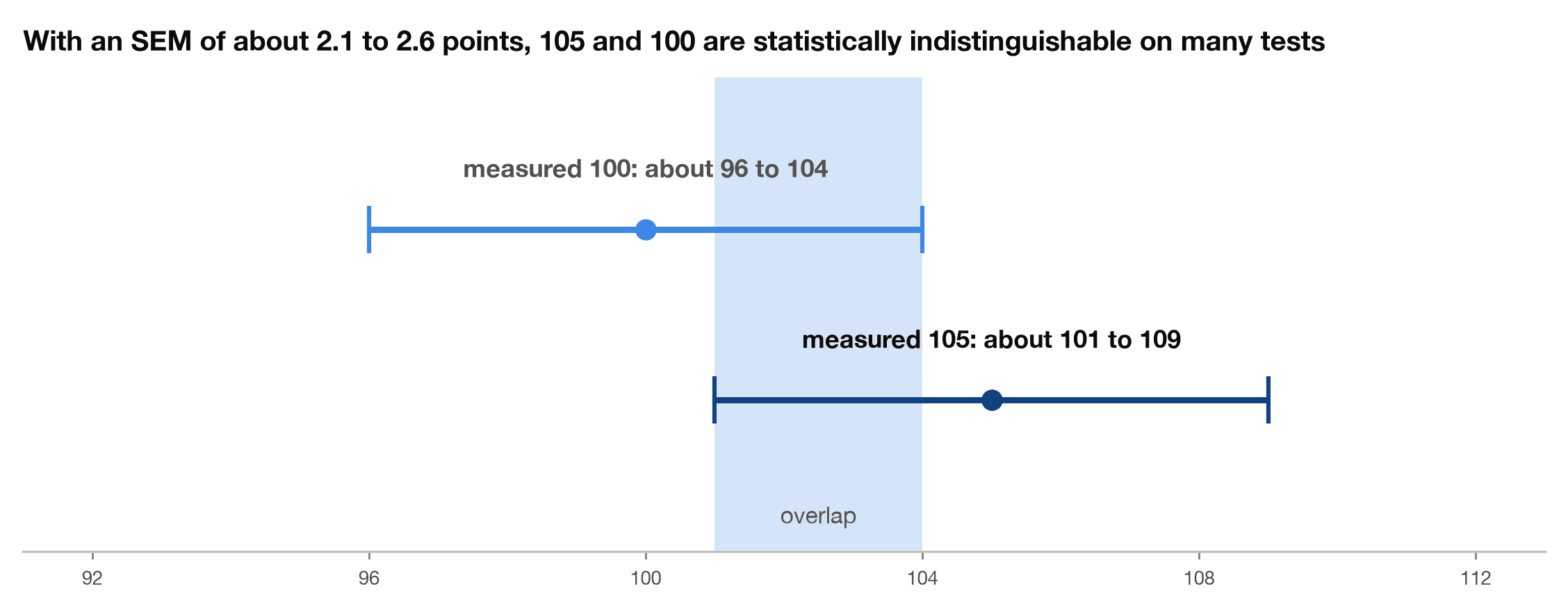
The flagship adult test's Full Scale IQ reliability runs .97 to .98, which converts to a "standard error of measurement" (the typical gap between an obtained score and a person's long-run average) of about 2.1 to 2.6 points. A 95% confidence interval around a measured 105 therefore spans roughly 100 to 110, and the interval around a measured 100, roughly 96 to 104, overlaps it. The same person could plausibly score 100 one day and 105 another with no change in ability at all.
There is a further caveat that cuts the same way. The reviewer of the flagship test's manual notes that internal-consistency-based error estimates should be considered best-case figures, so real-world retest noise is, if anything, larger. A retest of a 105 could land on either side of 100 without meaning anything.
Why small differences look big in the middle of the curve
Percentiles move fastest where the curve is densest, and the curve is densest near the mean. Moving from 100 to 105 crosses about 13 percentile ranks, from the 50th to the 63rd, while moving from 130 to 135 crosses only about 1.3, from the 97.7th to the 99.0th. Around the middle of the scale, tiny score differences leapfrog huge numbers of people. That is a reason to under-read the gap rather than over-read it: the 13 ranks separating 105 from 100 are bought with 5 points that measurement error cannot even guarantee are real. The next landmarks up the scale have their own pages on an IQ of 110 and an IQ of 115.
What a 105 means for school and work
Employment-testing data put the score in ordinary, encouraging company. Gottfredson's analysis of Wonderlic applicant data reports median applicant scores around IQ 100 for cashier, meter reader, and teller, with professional fields such as accountant and teacher around IQ 112. A 105 is at or above the median applicant for a broad set of jobs and within reach of the applicant pools for most others; no mainstream path is closed at 105. Within the average band, differences in conscientiousness, interests, and opportunity dominate individual outcomes far more than a few IQ points do.
The bottom line
An IQ of 105 is average in the literal, statistical sense: it sits in the band where most people are, slightly above the exact center, and within testing noise of 100. The honest reading of any single score is a range around the number, and a well-normed test states that range instead of hiding it. The Reasoning and Intelligence Online Test from RIOT IQ reports a modern deviation score with its measurement error stated; you can take the free IQ test and see where you stand on the same scale described here.
Frequently asked questions
Is an IQ of 105 good?
It is a solidly average score, slightly above the exact center of the scale. A 105 sits at about the 63rd percentile, higher than roughly 6 in 10 people, and inside the average band of 90 to 109 where about half the population scores.
What percentile is an IQ of 105?
About the 63rd percentile on the standard scale (mean 100, SD 15). Roughly 37% of people, about 1 in 2.7, score 105 or higher.
Is 105 IQ better than 100?
On paper it is 13 percentile ranks higher, but the difference is within measurement error. The best tests have a standard error of about 2 to 3 points, so a measured 105 and a measured 100 have overlapping confidence intervals and can come from the same person on different days.
Is an IQ of 105 enough for college?
People throughout the average band complete degrees. A 105 is at or above the median applicant for a broad range of jobs, and at this level study habits, interest, and persistence are the deciding factors far more than further IQ points.
Is 105 an average IQ?
Yes. Test classifications place 90 to 109 in the average band, and that band contains about 49.5% of the population, more than all other bands combined. A 105 is average in the literal, statistical sense: it is where most people are.
Could my real IQ be higher than 105?
Possibly. With a standard error of about 2 to 3 points, a measured 105 reflects a true score somewhere around 100 to 110, which spans the upper half of the average band and touches the high average threshold at 110. Only a reliable, well-normed test can narrow the range.
References
1. Karande, S., Sawant, S., Kulkarni, M., Kanchan, S., & Sholapurwala, R. (2005). Comparison of cognition abilities between groups of children with specific learning disability having average, bright normal and superior nonverbal intelligence. Indian Journal of Medical Sciences, 59(3), 95-103. pubmed.ncbi.nlm.nih.gov
2. Canivez, G. L. (2010). Review of the Wechsler Adult Intelligence Scale-Fourth Edition. In The eighteenth mental measurements yearbook. Buros Institute. ux1.eiu.edu
3. Wechsler, D. (1944). The measurement of adult intelligence (3rd ed.). Williams & Wilkins. archive.org
4. Guilmette, T. J., Sweet, J. J., Hebben, N., et al. (2020). American Academy of Clinical Neuropsychology consensus conference statement on uniform labeling of performance test scores. The Clinical Neuropsychologist, 34(3), 437-453. pubmed.ncbi.nlm.nih.gov
5. Gottfredson, L. S. (1997). Why g matters: The complexity of everyday life. Intelligence, 24(1), 79-132. udel.edu
6. Zhang, Y., et al. (2025). Cognitive impairments and neurofunctional alterations in children with electrical status epilepticus during sleep: Insights from WISC-IV and resting-state fMRI.pmc.ncbi.nlm.nih.gov