A 165 IQ would be about 1 in 136,000, above the 160 ceiling of major IQ tests. What an IQ of 165 means, how rare it is, and why few tests can measure it.
Dr. Russell T. WarneChief Scientist
Share
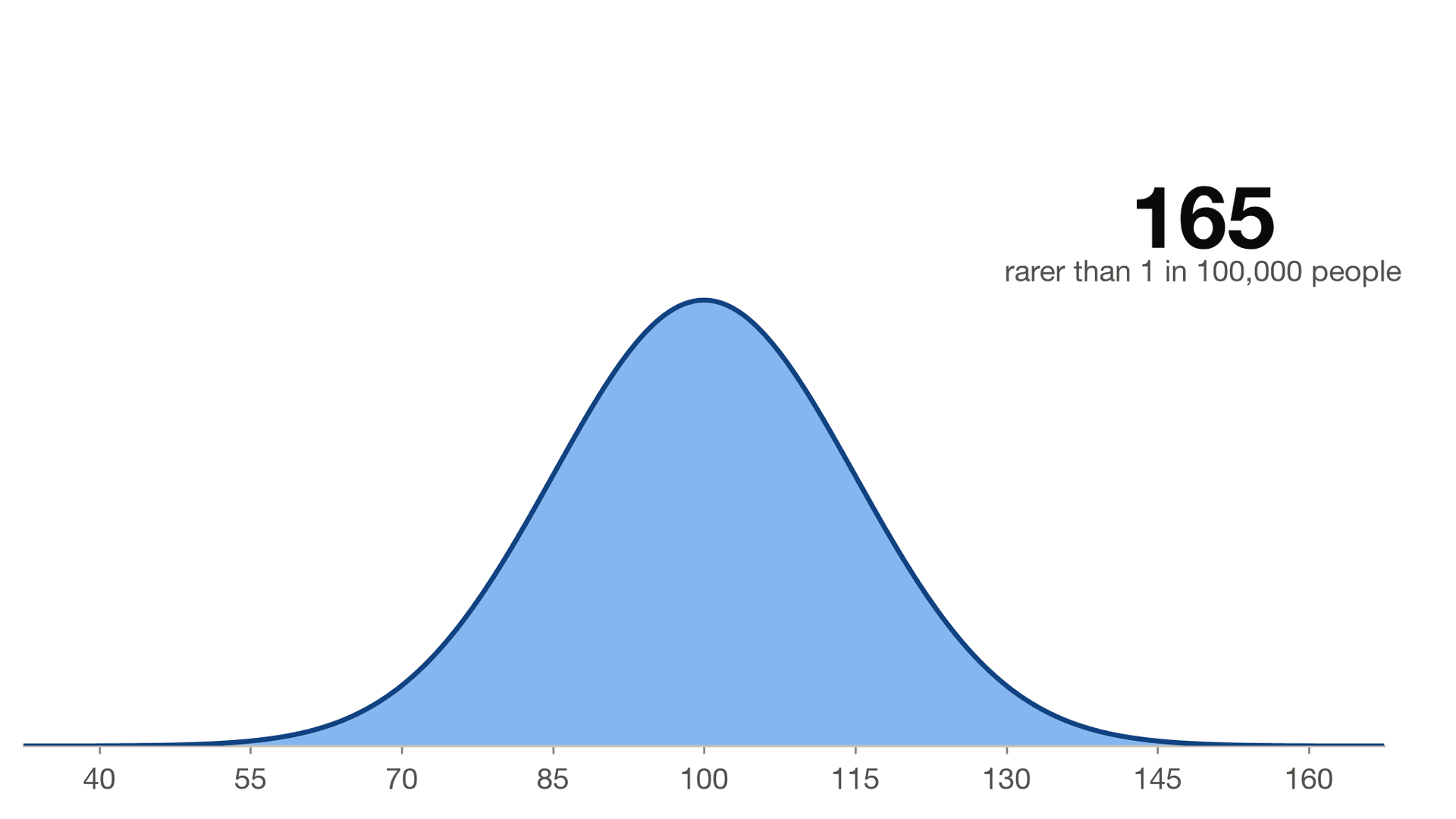
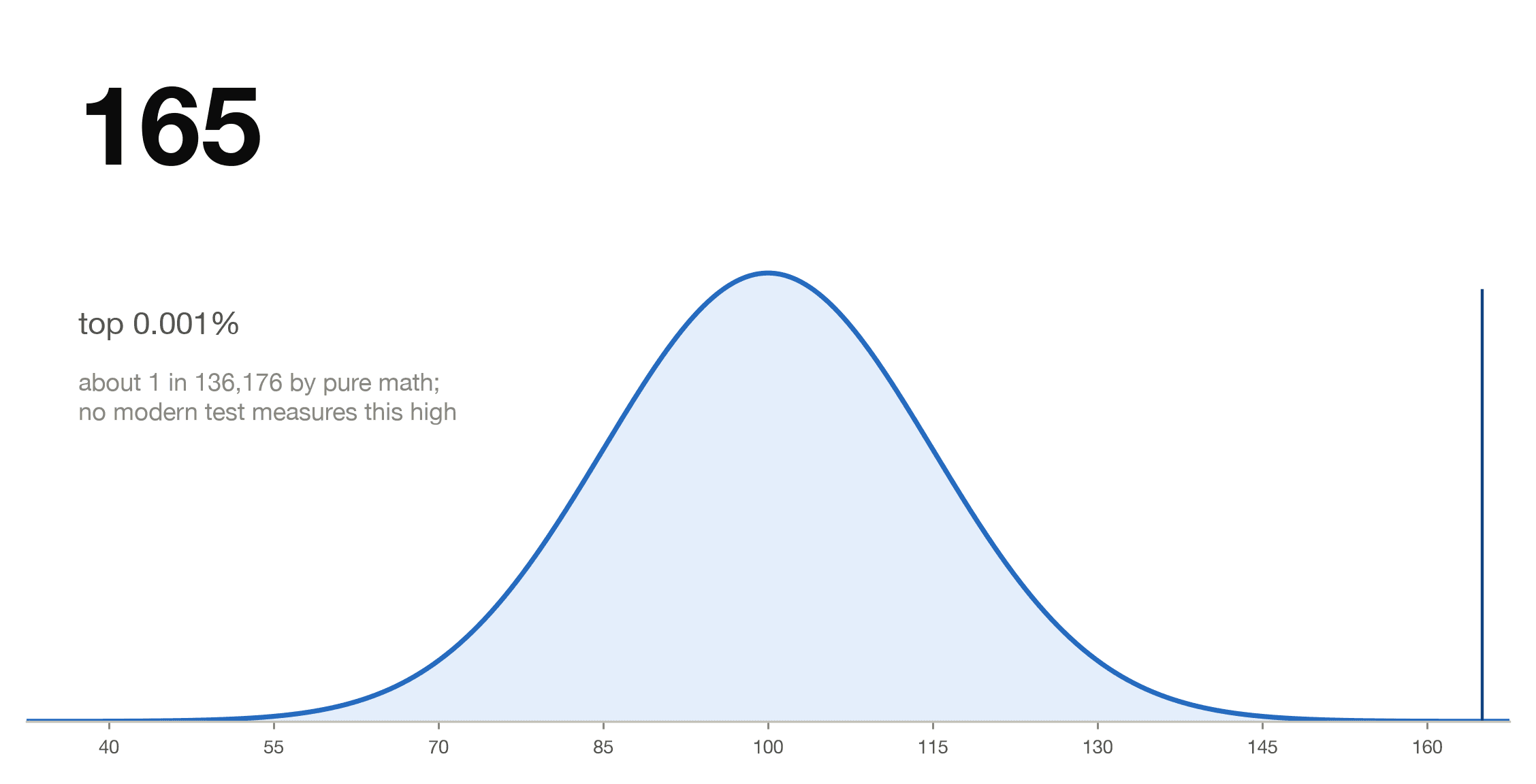
An IQ of 165 would sit 4.33 standard deviations above the mean of 100 on the standard SD-15 scale. Computed from the normal curve, about 1 person in 136,000 would score that high, which is the 99.999th percentile. There is a catch, though: 165 sits above the ceiling of every major clinical IQ test. The WAIS-5 Full Scale IQ tops out at 160, and the Stanford-Binet 5's standard scale also runs to 160, so no standard score report can even display a 165. A real-world 165 almost always comes from special extended norms, an older scale, or a test with no valid norms at all. This article covers the math, the ceilings, and what a 165 would actually mean.
The math: how rare is a 165 IQ?
IQ scores follow a bell curve with a mean of 100 and a "standard deviation," a measure of how spread out scores are, of 15 points. A 165 is therefore 65 points, or 4.33 standard deviations, above average. The normal curve puts the tail probability at about 1 in 136,000 (the precise computed value is 1 in 136,176). That figure is a theoretical extrapolation of the curve, calculated rather than observed, because real norming samples contain almost nobody that far out. For context, about 1 in 8,000 people reach an IQ of 155, while an IQ of 180 works out to roughly 1 in 20 million and lives entirely in folklore territory. A 165 sits in the gap between them.
Why no major test can print a 165
Pearson's technical documentation for the WAIS-5, the current Wechsler adult scale, gives the Full Scale IQ range as 40 to 160; the published sample score reports show every composite axis stopping at 160. The Stanford-Binet 5's standard score scale likewise runs to 160, with a special Extended IQ available beyond it. The reason is norming, the process of anchoring scores to a large reference sample. Among the 2,200 children in the WISC-V normative sample, only 16 obtained any composite score of 150 or higher. Past about 150 to 160 the data simply run out, and a responsible test stops reporting where its evidence stops. Our guide to the highest possible IQ explains the ceiling problem in detail.
Extended norms: the exception that proves the rule
Scores like 165 do get reported in one legitimate context. Pearson published "extended norms" for the WISC-V, developed at the request of the National Association for Gifted Children to distinguish among highly gifted children, raising the composite maximum to 210. The Stanford-Binet 5 offers an Extended IQ that reaches 225. Both are supplemental scoring systems built for a narrow clinical purpose, and both extrapolate far beyond the real reference cases in their samples. Pearson's own report is direct about the limits: "the extended norms are not useful for most children." An extended-norms 165 is a defensible clinical statement about a child's distance from the norm, with much wider uncertainty than an ordinary score.
Why a reported 165 is statistically shaky
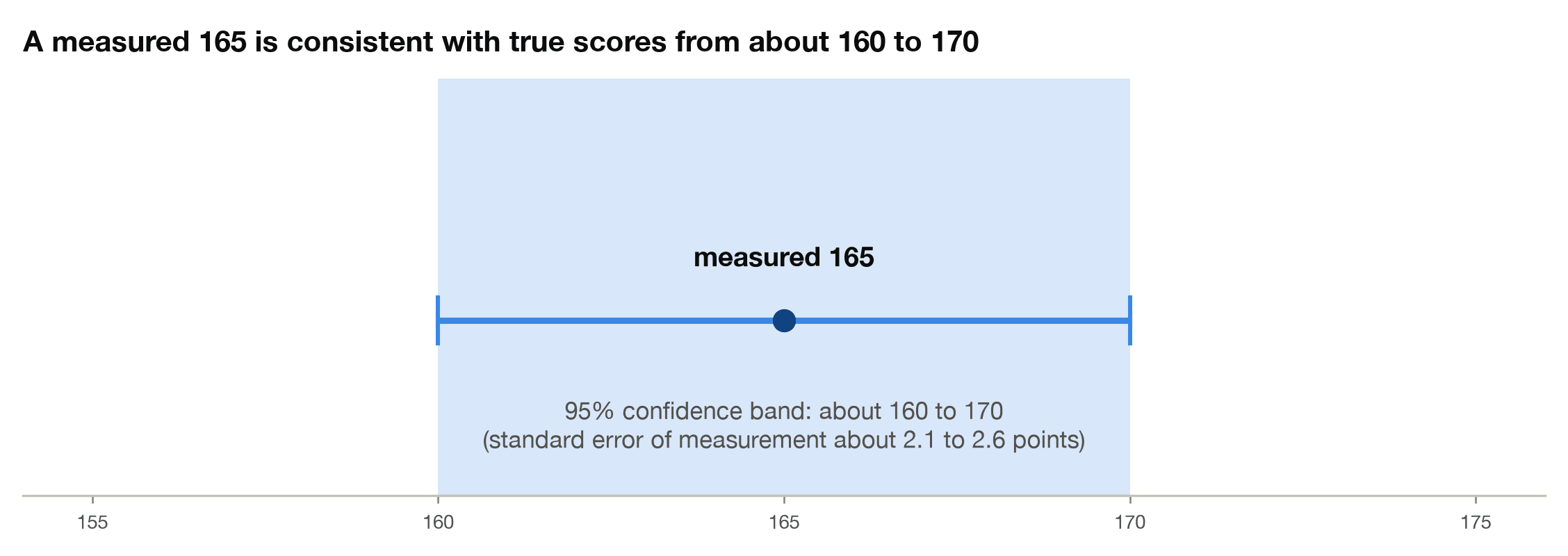
Every IQ score carries "measurement error," the variation you would see if the same person tested on different days. The Supreme Court's Hall v. Florida opinion summarized the professional consensus: an individual score is best understood as a range, roughly five points on either side of the recorded number. At ordinary score levels that band is well estimated. Above the norming range, reliability data barely exist, so the band around a putative 165 is wider and less trustworthy. The Warne-aligned reading of any tested 165 is "far above the measurable range," not "exactly 4.33 standard deviations above the mean."
Where 165+ claims come from
Most circulating 165 figures trace to sources that do not use the modern scale. Early Stanford-Binet scores were "ratio IQs," mental age divided by chronological age, a different quantity under which childhood scores in the 160s and 180s were far more attainable; Leta Hollingworth reported finding twelve children above 180 on that metric after winnowing thousands. Terman's 1916 chart labeled everything above 140 "'near' genius or genius," a classification modern tests dropped entirely. Scale confusion adds more: on an SD-16 scale a 165 converts to roughly 161 modern points (about 1 in 41,000, computed), and on the Cattell SD-24 scale a "165" is only about 141 on the modern metric, roughly 1 in 300. Celebrity attributions are the least reliable of all: no verifiable 165 attribution to any named living person exists, and unsourced numbers of that kind are folklore. A "165 IQ" claim is uninterpretable until you know the test and the scale behind it.
What a 165 would and would not mean
• It would clear every society's bar: American Mensa admits at the 98th percentile and the Triple Nine Society at the 99.9th. A genuine 165 sails past both, though qualifying scores must come from accepted tests whose ceilings sit below 165 anyway.
• It would not carry a genius certificate: There is no scientific definition of "genius," and no modern test uses the label. The word describes extraordinary achievement, which no score guarantees.
• It would not dictate a life: Scores at any level are one input among many. Education, effort, opportunity, and personality decide what ability becomes.
Frequently asked questions
How rare is a 165 IQ?
Computed from the normal curve with mean 100 and SD 15, about 1 person in 136,000 would score at or above 165. The figure is theoretical: norming samples contain almost no one at that level, so the tail is an extrapolation rather than an observed count.
Is a 165 IQ genius level?
There is no official genius score. Terman's 1916 chart labeled everything above 140 "near genius or genius," but modern tests dropped genius labels entirely. A genuine 165 would be exceptional by any standard; the label is historical, not scientific.
Can any IQ test actually measure 165?
Not on the standard norms of the major tests. The WAIS-5 Full Scale IQ tops out at 160, and the Stanford-Binet 5's standard scale also runs to 160. A 165 can only appear through special extended norms, older ratio-scored tests, or unvalidated high-range and online tests.
Can an online IQ test tell me I have a 165 IQ?
An online quiz can print the number, but it cannot support it. Backing a score of 165 would require norm data from hundreds of thousands of people, which no online quiz has. Professionally developed tests cap their reported scores well below that level for exactly this reason.
Does a 165 IQ qualify for Mensa?
On paper it would clear every society's cutoff: Mensa admits at the 98th percentile and the Triple Nine Society at the 99.9th. In practice, qualifying scores must come from accepted tests, and those tests cap below 165.
What does 165 mean on older IQ scales?
On an SD-16 scale like the old Stanford-Binet metric, 165 is about 161 on the modern SD-15 scale, roughly 1 in 41,000 by computation. On the Cattell SD-24 scale, a "165" is only about 141 SD-15, roughly 1 in 300. The number means nothing without the scale.
How to get a number you can actually trust
Within the range where norms are dense, modern IQ testing is precise and highly informative, and that range covers every practical question a score can answer. The Reasoning and Intelligence Online Test caps its reported scores near 145 by design, because a responsible instrument does not print numbers its norms cannot back. If you want a rigorous, properly normed measurement rather than an impressive printout, you can take the RIOT IQ test here.
References
1. Raiford, S. E., et al. (2024). Equivalence of Q-interactive and paper administration of cognitive tasks: WAIS-5 (Q-interactive Technical Report 16). NCS Pearson. pearsonassessments.com