An IQ of 140 is the 99.6th percentile, about 1 in 261 people. Learn why an IQ of 140 was once labeled genius and why psychologists dropped that label.
Dr. Russell T. WarneChief Scientist
Share
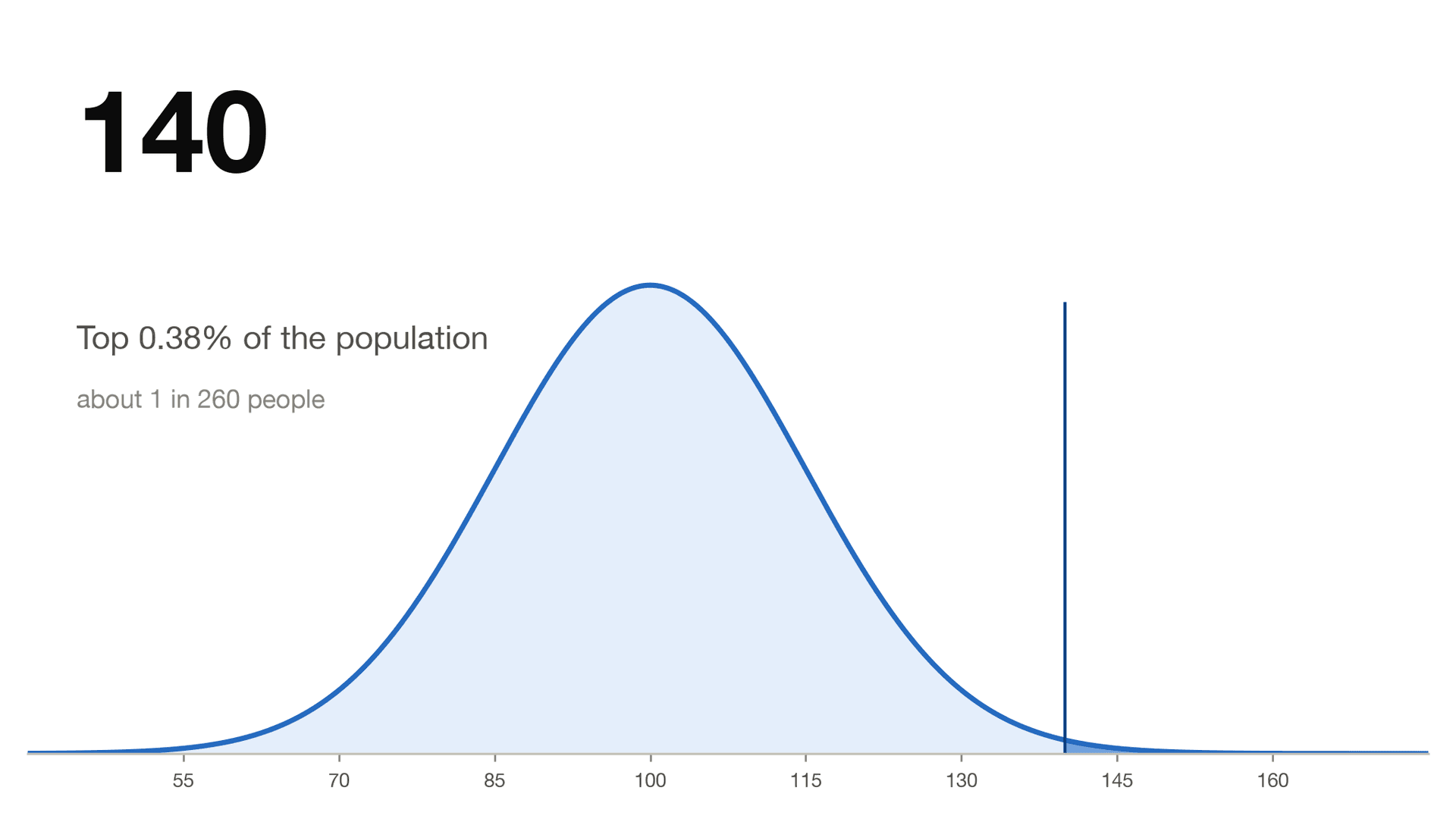
An IQ of 140 sits at the 99.6th percentile of a modern IQ scale: computed from the normal distribution with a mean of 100 and a "standard deviation" (a measure of score spread) of 15, about 0.38% of people score 140 or higher, roughly 1 person in 261. The score's popular reputation comes from history: Lewis Terman's 1916 classification labeled scores above 140 "'near' genius or genius," and the phrase stuck. No modern IQ test uses a genius label. This article covers the rarity math, where the genius association came from, and why psychologists abandoned it.
How rare is a 140 IQ?
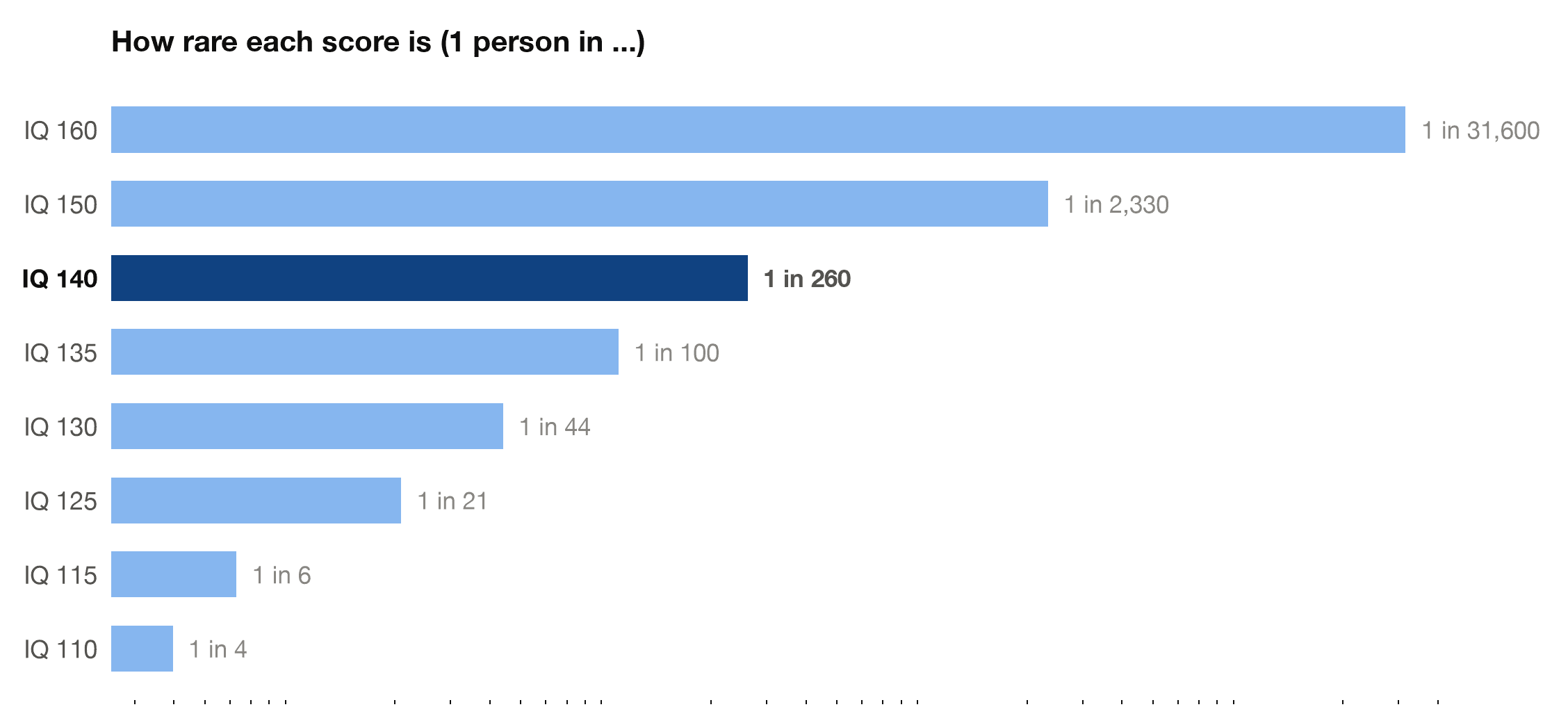
On the mean-100, SD-15 scale, a 140 is a "z score" of +2.67, which corresponds to the 99.62nd percentile (the figures here are computed with the standard normal distribution). That leaves the top 0.38%, or about 1 in 261 people. In a typical 1,000-student high school, only 3 or 4 students would be expected to score at this level. For how these conversions work across the whole scale, see our guide to IQ percentiles.
Where the "genius = 140" idea came from
The association has a precise source. In his 1916 book The Measurement of Intelligence, Terman published a classification table for the Stanford-Binet whose top row read: "Above 140 .... 'Near' genius or genius." Newspapers and popular books repeated the row for decades, and 140 became shorthand for genius in the public imagination. Terman himself was more careful than his readers: in the same book he wrote that "the boundary lines between such groups are absolutely arbitrary, a matter of definition only."
There is also a unit problem. Terman's 1916 scores were "ratio IQs": mental age divided by chronological age, times 100. Modern tests use "deviation IQs," which rank you against your own age group on the bell curve. The two scales stretch differently at the high end, so a 1916 "140" is not the same quantity as a modern 140. Quoting old genius thresholds against today's scores mixes currencies.
Why psychologists dropped the genius label
David Wechsler, whose tests became the clinical standard, reprinted Terman's table in 1944 and criticized it directly, observing that "we are furnished no rationale for the choice of the indicated class intervals." His own classification topped out at "Very Superior," defined as IQ 128 and over and comprising 2.2% of people, with the bands derived from the area under the normal curve. The genius row simply disappeared, and no major modern test has revived it. Current instruments use descriptors like "Very Superior" or "Extremely High," as we explain in our article on what a genius IQ score would be.
The most famous attempt to attach IQs to acknowledged geniuses ran the logic in reverse. Catharine Cox's 1926 study estimated childhood IQs for 301 eminent historical figures, from Leibniz to Lincoln, by reading biographical records of their early achievements. Those numbers are retrospective estimates made centuries after the fact, never test scores, and they are the source of most "IQ of a famous genius" figures still circulating today.
Does a 140 IQ predict genius-level achievement?
The best evidence comes from Terman's own long-term project, the Terman Life Cycle Study, which began in 1921-1922 and followed 1,528 California children who had scored 135 or higher on the early Stanford-Binet. Within this high-scoring group, later-life outcomes varied widely, and the variation tracked qualities beyond the test. Analyses of the cohort found that "conscientiousness" (a trait of persistence and dependability) and career success each predicted lower mortality risk, and a classic 1993 analysis reported that conscientiousness in childhood was clearly related to survival into old age.
In other words, a score in the 140s bought entry to a capable group, and what happened next depended heavily on character and circumstance. Modern scholarship on Terman, including a 2019 evaluation by Dr. Russell T. Warne, counts an overemphasis on IQ among the mixed parts of his legacy. A 140 is a strong signal of reasoning ability at the 99.6th percentile. Genius, in the accomplishment sense, is a label earned by work, and scores slightly higher still, such as a 145 IQ, carry the same caveat.
Frequently asked questions
Is an IQ of 140 a genius IQ?
No test today labels any score genius. The idea comes from Terman's 1916 classification, which called scores above 140 near genius or genius, but Wechsler dropped the label in his classifications and modern tests top out at descriptors like Very Superior or Extremely High. A 140 is better described as the 99.6th percentile.
How rare is an IQ of 140?
About 1 person in 261 scores 140 or higher, computed from the normal distribution with mean 100 and SD 15 (the top 0.38%). In a typical 1,000-person high school, that is only 3 or 4 students.
What jobs do people with an IQ of 140 have?
There is no job list attached to a score. High measured ability predicts success in cognitively demanding fields on average, but Terman's study of more than 1,500 children with IQs of 135 and up found that outcomes within the group depended heavily on traits like conscientiousness and on opportunity.
Is 140 IQ higher than gifted?
Yes. The common gifted threshold is 130 (top 2.3%), while 140 is the top 0.4%. Some programs for exceptionally gifted students use higher bars still, such as 145, three standard deviations above the mean.
Did Einstein have an IQ of 140 or more?
Nobody knows; Einstein never took a modern IQ test. Published numbers for historical figures are retrospective estimates in the style of Cox's 1926 study, which inferred childhood IQs of 301 eminent people from biographies. Such estimates are educated guesses rather than measurements.
The takeaway
An IQ of 140 places you around the 99.6th percentile, rarer than 1 in 250, and carries a genius label only in century-old tables that psychology has long since retired. If you want a rigorous estimate of your own standing on the scale tests actually use, the Reasoning and Intelligence Online Test from RIOT IQ reports modern deviation scores with stated precision; you can take the free RIOT IQ test and see where you fall without the folklore.
References
1. Terman, L. M. (1916). The measurement of intelligence. Houghton Mifflin. archive.org
2. Wechsler, D. (1944). The measurement of adult intelligence (3rd ed.). Williams & Wilkins. archive.org
3. Cox, C. M. (1926). Genetic studies of genius: Vol. II. The early mental traits of three hundred geniuses. Stanford University Press. archive.org
4. Kern, M. L., Friedman, H. S., Martin, L. R., Reynolds, C. A., & Luong, G. (2009). Conscientiousness, career success, and longevity: A lifespan analysis. Annals of Behavioral Medicine, 37(2), 154-163. pmc.ncbi.nlm.nih.gov
5. Friedman, H. S., Tucker, J. S., Tomlinson-Keasey, C., Schwartz, J. E., Wingard, D. L., & Criqui, M. H. (1993). Does childhood personality predict longevity? Journal of Personality and Social Psychology, 65(1), 176-185. pubmed.ncbi.nlm.nih.gov
6. Warne, R. T. (2019). An evaluation (and vindication?) of Lewis Terman: What the father of gifted education can teach the 21st century. Gifted Child Quarterly, 63(1), 3-21. eric.ed.gov
Take our professional IQ test
Want to know your IQ? Try the first ever professional online IQ test.