An IQ of 90 is inside the average range that covers about half the population. What an IQ of 90 means, its percentile, and how to interpret the score.
Dr. Russell T. WarneChief Scientist
Share
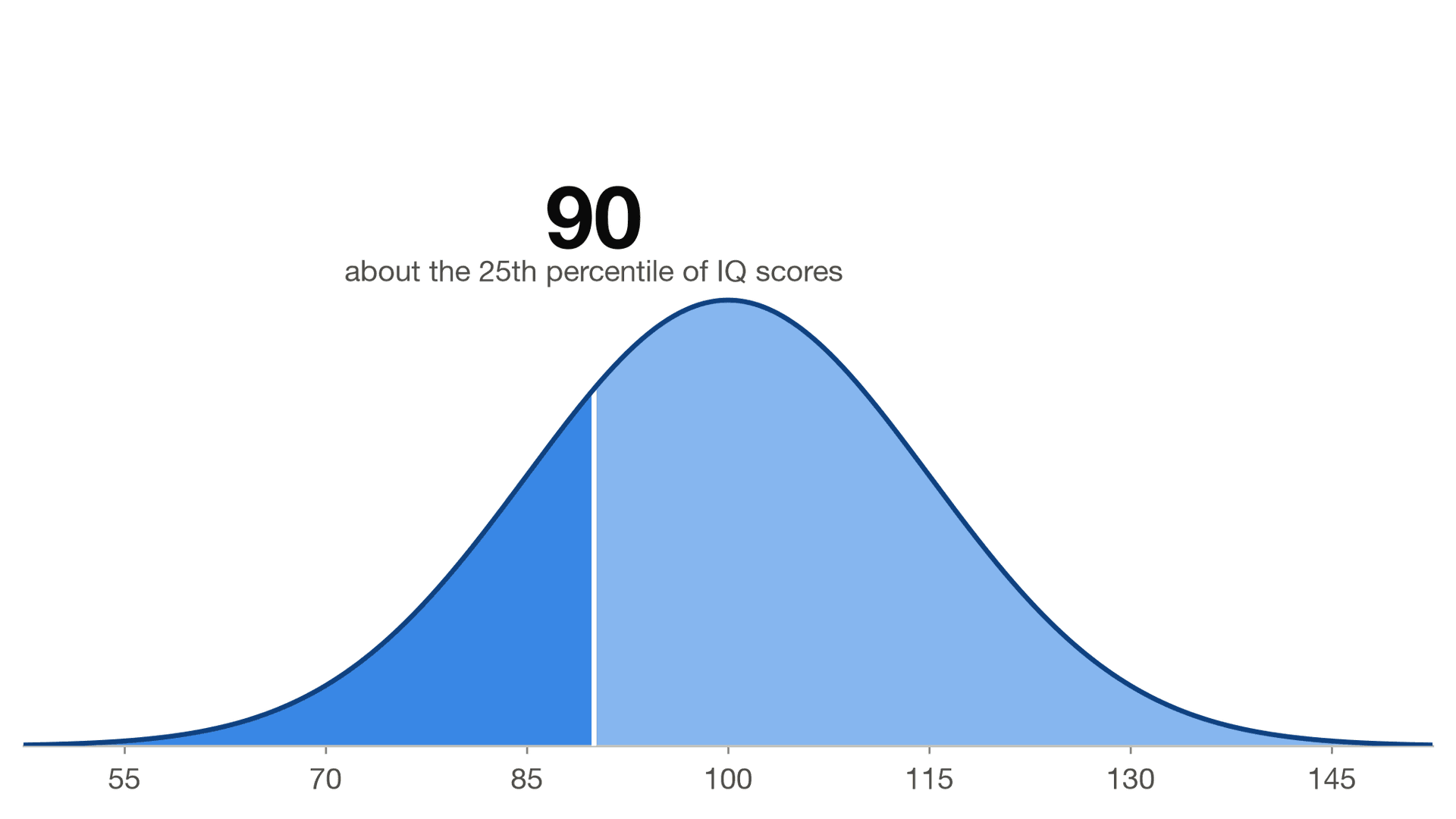
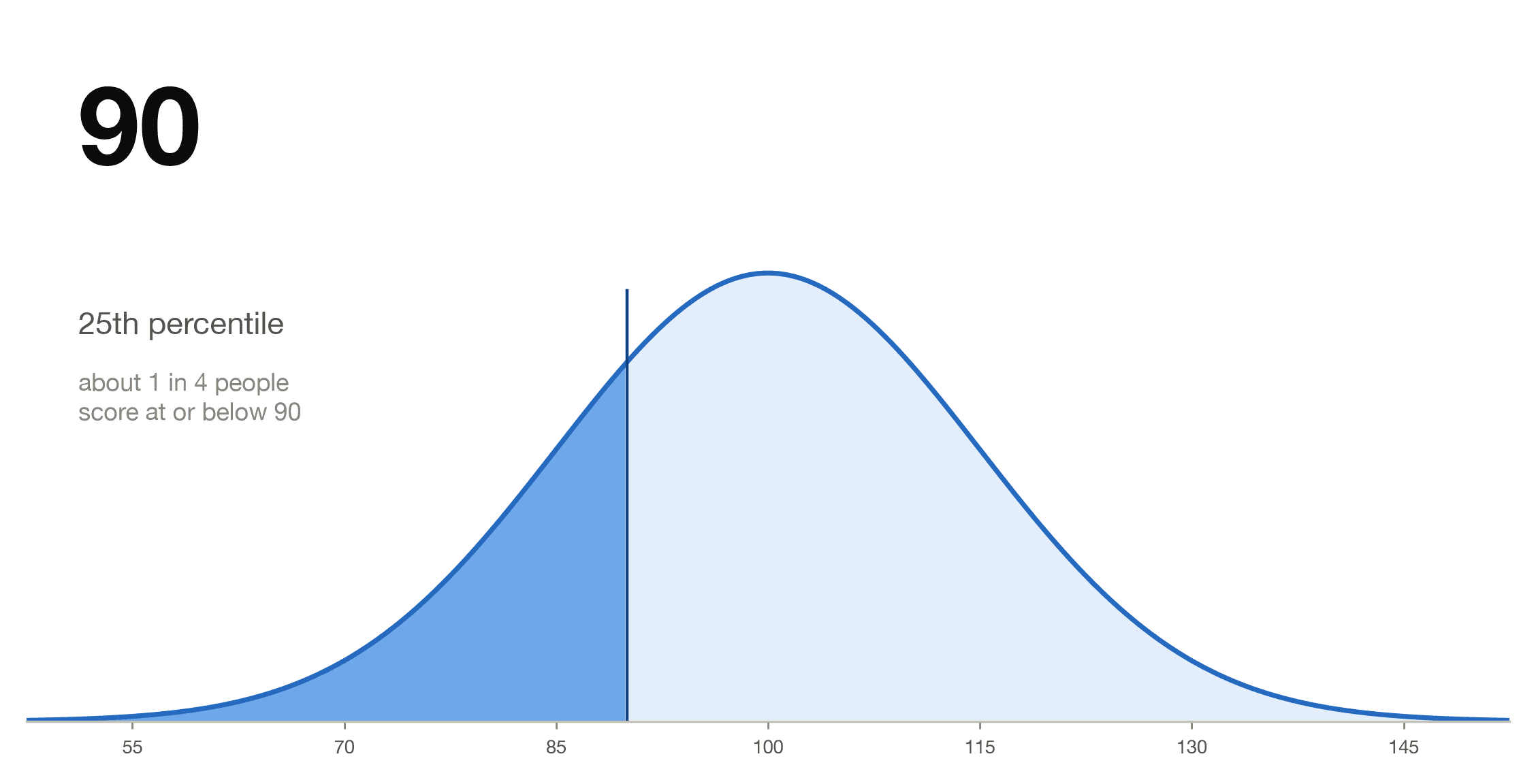
An IQ of 90 is an average score. Wechsler-style tests label the whole span from 90 to 109 "Average," so a 90 sits at the lower edge of the same band that contains roughly half the population. Computed from the normal curve with a mean of 100 and a "standard deviation" (the statistic that describes how spread out scores are) of 15, a 90 lands at about the 25th percentile: roughly 1 person in 4 scores at or below it, and about 75% score higher. Normal measurement error means a tested 90 is best read as roughly 85 to 95. This article covers the percentile math, why the boundary at 90 means less than it looks, and what the score implies for school and work.
Where 90 Falls on the Bell Curve
Percentile and rarity
A 90 corresponds to a z-score of -0.67, which the normal curve places at about the 25th percentile. Integrating the same curve across the Average band shows that roughly half of all people score in the 90-109 range a 90 belongs to. Both figures are calculated from the normal curve with a mean of 100 and a standard deviation of 15 rather than taken from any publisher's tables; empirical norm tables differ trivially.
A century inside the average band
The WAIS-IV descriptive system labels 90-109 "Average," with "Low Average" (80-89) below it and "High Average" (110-119) above. The average band has been drawn around this region for over a century: Terman classified 90-110 as "normal, or average, intelligence" in 1916. For what typical adult scores look like in practice, see our article on the normal IQ score for adults.
Why the Boundary at 90 Means Less Than It Looks
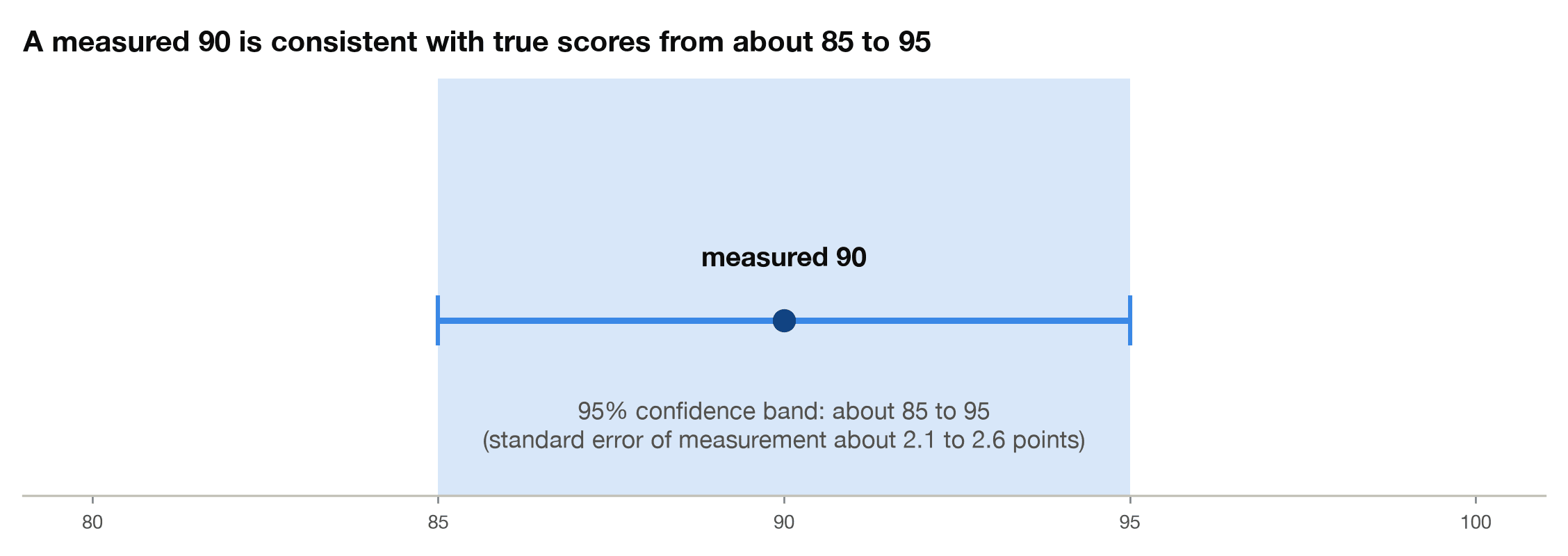
Band labels are conveniences laid over a continuous scale; nothing changes in a person between an 89 and a 91. Measurement adds its own blur: the U.S. Supreme Court in Hall v. Florida (2014) described an IQ score as "best understood as a range, e.g., five points on either side of the recorded score," so a tested 90 is consistent with true scores from about 85 to 95, a span that straddles the Low Average and Average labels. The honest summary of a 90 is "average, toward the lower part of the average range," with the emphasis on average. For the band just below, see our article on what an IQ of 85 means.
Everyday Life With a Score of 90
A 90 is compatible with a very wide range of ordinary school and work outcomes. Plenty of people around this score complete college degrees, though highly abstract programs demand more from them, and study skills, persistence, and program choice make a large practical difference. In the workplace, Gottfredson's (1997) review places scores near 90 inside the applicant pools of many ordinary occupations, from skilled trades to clerical, sales, service, and protective-services work, with hands-on training and experience counting heavily. One historical footnote from the same paper: 1990s military entry floors mapped to roughly IQ 85 to 91 across the services by her arithmetic, though the AFQT the services actually use is an aptitude composite rather than an IQ test, and those figures are 1997-era.
Can the Number Move?
Retest scores wobble by around five points either way from measurement error alone, and better conditions (sleep, motivation, testing in your strongest language) can recover points that a bad day took away. Lasting change in underlying general ability is a different matter: no training program has been shown to produce large, durable gains, so treat products promising to raise your IQ with skepticism. The useful question is whether your tested score reflects your true level, which good testing answers. Where a 90 sits relative to "good" scores is covered in our article on what counts as a good IQ score.
How to Get a Reliable Reading
Unnormed online quizzes are entertainment; a meaningful score comes from a test with real norms taken under good conditions. The Reasoning and Intelligence Online Test from RIOT IQ is a professionally developed, normed assessment, and the free IQ test is the quickest way to see where you stand on the actual scale. If your result surprises you in either direction, a retest under better conditions is more informative than a shrug.
Frequently asked questions
Is an IQ of 90 average?
Yes. Wechsler-style tests label 90-109 as the Average band, and Terman drew the "normal or average" range at 90-110 as far back as 1916. A 90 is at the lower edge of average, about the 25th percentile computed from the bell curve.
What percentile is an IQ of 90?
Computed from the normal curve with mean 100 and standard deviation 15, a 90 is at about the 25th percentile. Roughly a quarter of people score at or below 90, and about three quarters score higher.
Is an IQ of 90 good enough for college?
Plenty of people around this score complete degrees, though highly abstract programs demand more of them. Study skills, persistence, program choice, and support make a large practical difference, and an IQ score is a probability statement rather than a gate.
Can an IQ of 90 increase?
Retest scores wobble by around five points either way from measurement error alone, and better testing conditions can help. No training program has been shown to produce large, lasting gains in underlying general ability, so treat any product promising to raise your IQ with skepticism.
What jobs can someone with an IQ of 90 do?
A very wide range. Employment research places scores near 90 within the applicant pools of many ordinary occupations, from skilled trades to service, clerical, sales, and protective-services work, with hands-on training and experience counting heavily.
References
1. Gottfredson, L. S. (1997). Why g matters: The complexity of everyday life. Intelligence, 24(1), 79-132. udel.edu
2. Grieve, R. (2020). WAIS interpretation [Course document reproducing WAIS-IV Table 6.3 descriptive categories]. Western Kentucky University. people.wku.edu
3. Hall v. Florida, 572 U.S. 701 (2014). Legal Information Institute, Cornell Law School. law.cornell.edu
4. Terman, L. M. (1916). The measurement of intelligence. Houghton Mifflin. archive.org
5. Warne, R. T. (2020). In the know: Debunking 35 myths about human intelligence. Cambridge University Press. doi.org/10.1017/9781108593298
Take our professional IQ test
Want to know your IQ? Try the first ever professional online IQ test.