Mar 13, 2026·IQ Scores & Interpretation
Is a 120 IQ Considered Gifted?
An IQ of 120 places you in the top 10% of the population. Discover if a 120 IQ is considered gifted, what it means for your career, and how to test your true cognitive ability.
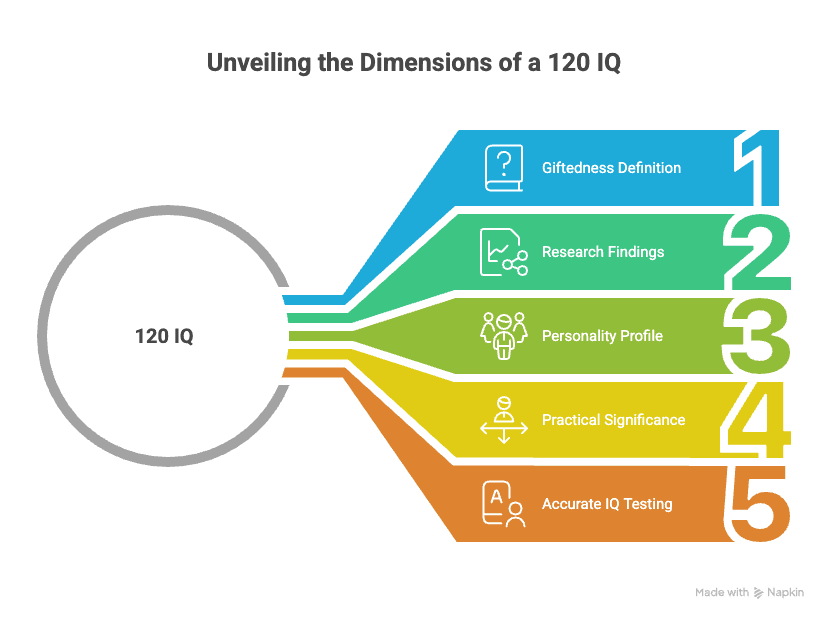
An IQ of 120 is an undeniably strong score, placing a person in approximately the top ten percent of the population. While it is meaningfully above average, whether it officially qualifies as "gifted" depends entirely on how that term is defined within a specific context. On standard clinical tests where the average is 100 and the standard deviation is 15 points, a score of 120 falls into the "High Average" or "Superior" range. To put this into perspective, in a room of one hundred randomly selected adults, only about ten would score at or above this level. However, it is not exceptionally rare in the way that extreme upper-end scores are; a 130 IQ represents about one in fifty people, while a 145 is seen in roughly one in a thousand.
What IQ score actually qualifies as gifted?
Because "gifted" is a fluid educational and social category rather than a fixed psychometric term, there is no universally agreed-upon threshold. In the early days of intelligence testing, the boundary was strict. Lewis Terman, the Stanford psychologist who pioneered longitudinal studies of high-ability individuals, used a cutoff of 135. Historically, most gifted education programs followed suit, requiring scores in the 130 to 135 range, which corresponds to the ninety-eighth or ninety-ninth percentile.
Today, the criteria vary drastically by location and institution. Some school districts utilize multiple pathways to identify giftedness, incorporating academic achievement or creative portfolios alongside cognitive testing. Consequently, a 120 IQ might easily qualify for a program that uses a broader 115-point cutoff, but it would fall short in a district maintaining the traditional 130-point baseline.
What does the research on high IQ actually show?
Definitions aside, intelligence research reveals consistent patterns regarding individuals who score in the 120 range. Higher cognitive ability correlates with more favorable life outcomes, including stronger academic performance, advanced educational attainment, higher income, and even better physical health and longevity. These are statistical probabilities rather than individual guarantees, and the benefits of a higher IQ accumulate gradually across the entire distribution curve.
There is no sudden, magical cognitive leap that occurs the moment someone crosses a specific gifted threshold. A person at 120 possesses a meaningful advantage over someone at 100, just as a person at 130 holds an advantage over someone at 120. This measurable, empirical reality is why researchers advocate for keeping IQ at the center of giftedness discussions, rather than relying solely on subjective measures like leadership or creativity, which can make the concept difficult to study coherently.
Does a high IQ come with a distinctive personality profile?
A persistent cultural stereotype suggests that highly intelligent individuals are inherently eccentric, emotionally intense, or socially isolated. Decades of research thoroughly debunk this "troubled genius" myth. Studies demonstrate that people with higher IQ scores are generally better adjusted, reporting better mental health, more stable relationships, and lower rates of criminality than the general public. While there are modest correlations between high IQ and traits like openness to experience or slightly lower neuroticism, these links are too weak to form a definitive psychological profile. Ultimately, a score of 120 signifies strong reasoning and problem-solving capabilities, but it dictates very little about a person's character, temperament, or emotional life.
What is the practical significance of a 120 IQ?
In practical terms, an IQ of 120 provides the cognitive capacity necessary to tackle academically and professionally demanding work. Careers in medicine, law, engineering, and scientific research draw heavily from the upper ranges of the intelligence distribution, and a score of 120 places an individual comfortably within the threshold where success in these rigorous fields is highly feasible. However, cognitive ability is only one piece of the puzzle. Conscientiousness, motivation, specific domain knowledge, and a genuine fit for the work are equally critical. A high IQ readily opens professional doors, but it requires drive and effort to actually walk through them.
How can you accurately find out your IQ score?
Relying on informal estimates based on career success or academic grades is never a reliable substitute for formal testing. To know your IQ with confidence, you must take a professionally developed assessment. While individually administered clinical exams like the Wechsler Adult Intelligence Scale remain the gold standard, modern digital options now offer clinical-grade accuracy without the prohibitive cost and scheduling hurdles.
The Reasoning and Intelligence Online Test (RIOT) is the first digital assessment developed to meet the rigorous joint standards of the American Educational Research Association, the American Psychological Association, and the National Council on Measurement in Education. Created by Dr. Russell Warne and normed on a representative United States sample, the RIOT provides a comprehensive cognitive profile—including a Full Scale IQ and six specific index scores—offering the deep, scientifically validated insights that a single estimated number can never provide.
Watch “Are IQ Tests Accurate?” with Dr. Russell T. Warne on the Riot IQ YouTube channel to see how psychologists interpret scores like 120 and what they actually represent.
Take our professional IQ test
Want to know your IQ? Try the first ever professional online IQ test.
Article Categories
All ArticlesUnderstanding IQ ScoresTaking an IQ TestRIOT-Specific InformationGeneral IQ & IntelligenceAdvanced Topics & ResearchIQ Scores & InterpretationMensa & High-IQ SocietiesOnline IQ Tests IQ Test Basics & FundamentalsAverage IQ & DemographicsFamous People & IQHistory & Origins Of IQ TestingAccuracy, Reliability & CriticismSpecial Population & Related ConditionsImproving IQ / PreparationSpecific IQ Tests & FormatsIQ Testing for HR & RecruitmentSkills Assessment
Related Articles
What IQ Do Gifted People Have?What Does IQ Predict?What Is the Difference Between IQ and Emotional Intelligence?IQ vs. EQ: Which One Matters More for Career Success?What Is a Ceiling Effect on an IQ Test?What Is a Norm Group in IQ Testing?What Is Full Scale IQ? How to Read the Overall ScoreIs 145 a High IQ Score?What Is a 'Good' IQ Score?Understanding IQ Score Scales: A Complete GuideIs a 120 IQ Considered Gifted?What Is the Dumbest IQ Score?Is an IQ of 170 considered a genius?Is My IQ Score Good?What is a Good IQ Score?What is Considered a High IQ?Understanding Your Free IQ Test Results in 2026Why is 100 the Average IQ?Does IQ Change With Age?What Does an IQ of X Mean?Does IQ Matter?What is the IQ Scale/Range?What is the Highest Possible IQ?What is a Genius IQ Score?Is a 97 IQ considered dumb?
Take our IQ testsCompare all tests
Basic IQ Test
5 subtests + 5 cognitive abilities
Features
- ~13 Minutes
- IQ score
- Cognitive abilities breakdown
- ±5.6 IQ margin of error
5/15 Subtests
Learn moreVocabulary
Matrix Reasoning
SToVeS
Visual Reversal
Symbol Search
Full IQ Test
15 subtests + all cognitive abilities
Features
- ~52 Minutes
- IQ score
- Cognitive abilities breakdown
- ±3.7 IQ margin of error
15/15 Subtests
Learn moreVocabulary, Information, Analogies
Matrix Reasoning, Visual Puzzles, Figure Weights
Object Rotation, SToVeS, Spatial Orientation
Computation Span, Exposure Memory, Visual Reversal
Symbol Search, Abstract Matching
Simple Reaction Time, Choice Reaction Time

Community
Intelligence Journals & Organizations
Our Articles