A 170 IQ score is exceptionally rare, placing you in the 99.9th percentile. Discover if a 170 IQ is considered a genius, and the truth behind the troubled genius myth.
Dr. Russell T. WarneChief Scientist
Share
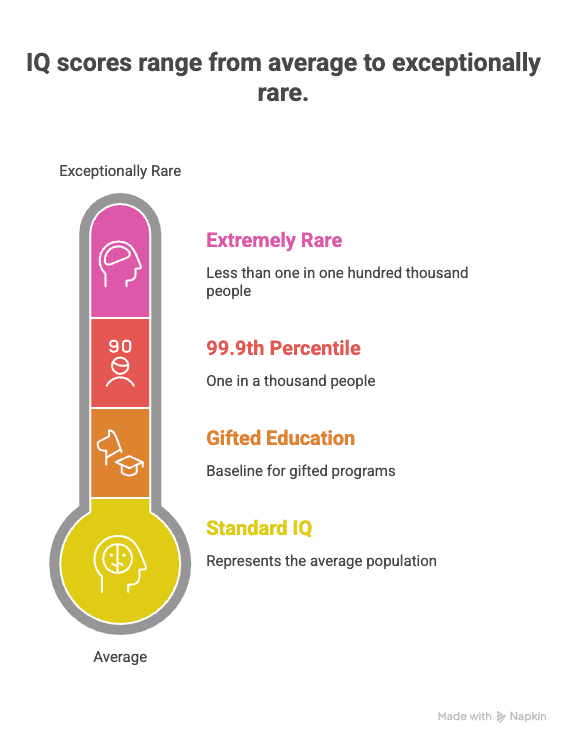
An IQ of 170 is extraordinarily rare. On the standard scale used by most professional intelligence tests—where the average is 100 and the standard deviation is 15 points—a score of 170 sits more than four and a half standard deviations above the mean. Statistically, fewer than one in one hundred thousand people score at this level. Whether that qualifies someone as a "genius," however, depends entirely on how you define the word, which is a much more complicated question than it first appears.
What does a score of 170 represent statistically?
To place a score of 170 in context, you have to look at how human intelligence is distributed. Roughly sixty-eight percent of the population scores between 85 and 115, and ninety-five percent fall between 70 and 130. By the time you reach an IQ of 145, you are already looking at the 99.9th percentile, or about one in a thousand people.
A score of 170 extends so far beyond that threshold that it enters a statistical territory most IQ tests simply are not built to measure with precision. Professional assessments are calibrated to accurately gauge where the vast majority of the population falls. At the extreme upper tail of the curve, the reference group used for comparison grows incredibly thin. Therefore, any score reported as a 170 on a professionally developed test should be understood as a rough estimate with meaningful uncertainty, rather than an exact measurement.
Is "genius" actually a scientific term?
The short answer is no. "Genius" does not have a formal, universally accepted definition in modern psychology or intelligence research. It is a cultural and historical concept rather than a psychometric one.
In popular conversation, the label is usually applied to individuals who have produced world-altering creative or intellectual work, such as groundbreaking scientists or legendary composers. That definition is based entirely on real-world achievement and output, not a number on a test. In fact, many of history's most celebrated intellects never took an IQ assessment. While some early twentieth-century psychologists, like Lewis Terman, used "genius" to categorize specific high-IQ brackets, modern researchers actively avoid the term. They prefer precise language about specific score ranges and their empirical outcomes over culturally loaded labels.
At what IQ level does research typically identify exceptional ability?
When studying high cognitive ability, researchers generally focus on the threshold around an IQ of 130, which corresponds to the 98th percentile. This is the baseline most gifted education programs use and where the bulk of academic literature on high-ability populations draws its samples.
Studies following mathematically precocious youth have shown that within this top percentile, finer score distinctions do still matter. Individuals at the absolute peak of the distribution are statistically more likely to earn doctorates, secure patents, and achieve high-level recognition in their fields. However, the data does not suggest that hitting a discrete threshold—whether 160, 170, or beyond—suddenly unlocks a qualitatively different category of human being. The relationship between cognitive ability and life outcomes is a continuous slope, not a sudden staircase.
What are the actual life outcomes associated with a very high IQ?
The research on high intelligence and life trajectories is remarkably consistent. Individuals with higher scores generally experience better educational attainment, higher incomes, improved physical health, and longer lifespans.
Crucially, the data heavily contradicts the popular cultural trope of the tormented, socially dysfunctional "mad genius." Longitudinal studies that tracked high-IQ children well into their senior years found that they grew up to be well-adjusted adults. They exhibited lower rates of mental illness, higher rates of stable relationships, and greater professional success than the general public. There is simply no empirical evidence that scoring a 170 produces a uniquely intense inner experience, a distinctive psychological profile, or a specific set of eccentric personality traits.
How reliable are scores at this extreme range?
The reliability of extreme scores deserves far more scrutiny than it usually gets. Because professionally developed tests are normed on samples of a few thousand people, the number of individuals who naturally score at or above 170 within that reference group is vanishingly small. When a test is calibrated using such sparse data at the upper limits, the resulting scores carry a substantial margin of error.
Intelligence scores at any level reflect a range of plausible performance rather than a fixed point, but at the extreme high end, that standard error of measurement expands significantly. Consequently, any score reported above 145 or 150 should be interpreted with extreme caution. Claims of individuals possessing an IQ of 170, 180, or higher—especially when derived from brief internet quizzes—are almost certainly massive overestimates. Most free online tests lack the calibration to produce accurate results at any level, let alone at the furthest edges of human capability.
How can you obtain a legitimate IQ score?
The only proven way to determine your true cognitive baseline is through a properly developed, scientifically validated intelligence test. Individually administered clinical exams, such as the Wechsler Adult Intelligence Scale, remain the traditional gold standard.
For those seeking clinical-grade accuracy without the logistical hurdles of in-person testing, the Reasoning and Intelligence Online Test (RIOT) provides a modern alternative. As the first online IQ test built to meet the uncompromising joint standards of the American Educational Research Association, the American Psychological Association, and the National Council on Measurement in Education, the RIOT was developed by Dr. Russell Warne and normed on a highly representative United States sample. It provides a Full Scale IQ alongside detailed index scores measuring Verbal Reasoning, Fluid Reasoning, Spatial Ability, Working Memory, Processing Speed, and Reaction Time. Deliberately designed with a score range of 75 to 145, the RIOT prioritizes strict interpretive integrity over flattering users with extreme, scientifically unmeasurable numbers.
Watch “How Intelligence and IQ Work in the Brain” with Dr. Richard Haier on the Riot IQ YouTube channel to explore what extremely high IQ scores may indicate about cognitive ability.
Take our professional IQ test
Want to know your IQ? Try the first ever professional online IQ test.