An IQ of 145 places you in the top 0.1% of the population. We explain why this score is considered extremely high and why only 1 in 750 people achieve it.
Dr. Russell T. WarneChief Scientist
Share
An IQ of 145 is exceptionally high. On most standardized intelligence tests, this score places an individual in approximately the top 0.135% of the population, meaning only about 1 in 665 people would score at this level or higher. To understand what this means, it helps to know how IQ scores are distributed and interpreted.
IQ scores follow a normal distribution (often called a "bell curve"), where the average is set at 100, and the standard deviation (a measure of how spread out scores are) is 15 points. About 68% of the population scores between 85 and 115, and approximately 95% scores between 70 and 130. Scores become increasingly rare as they move further from the average in either direction.
What Do Different IQ Ranges Mean?
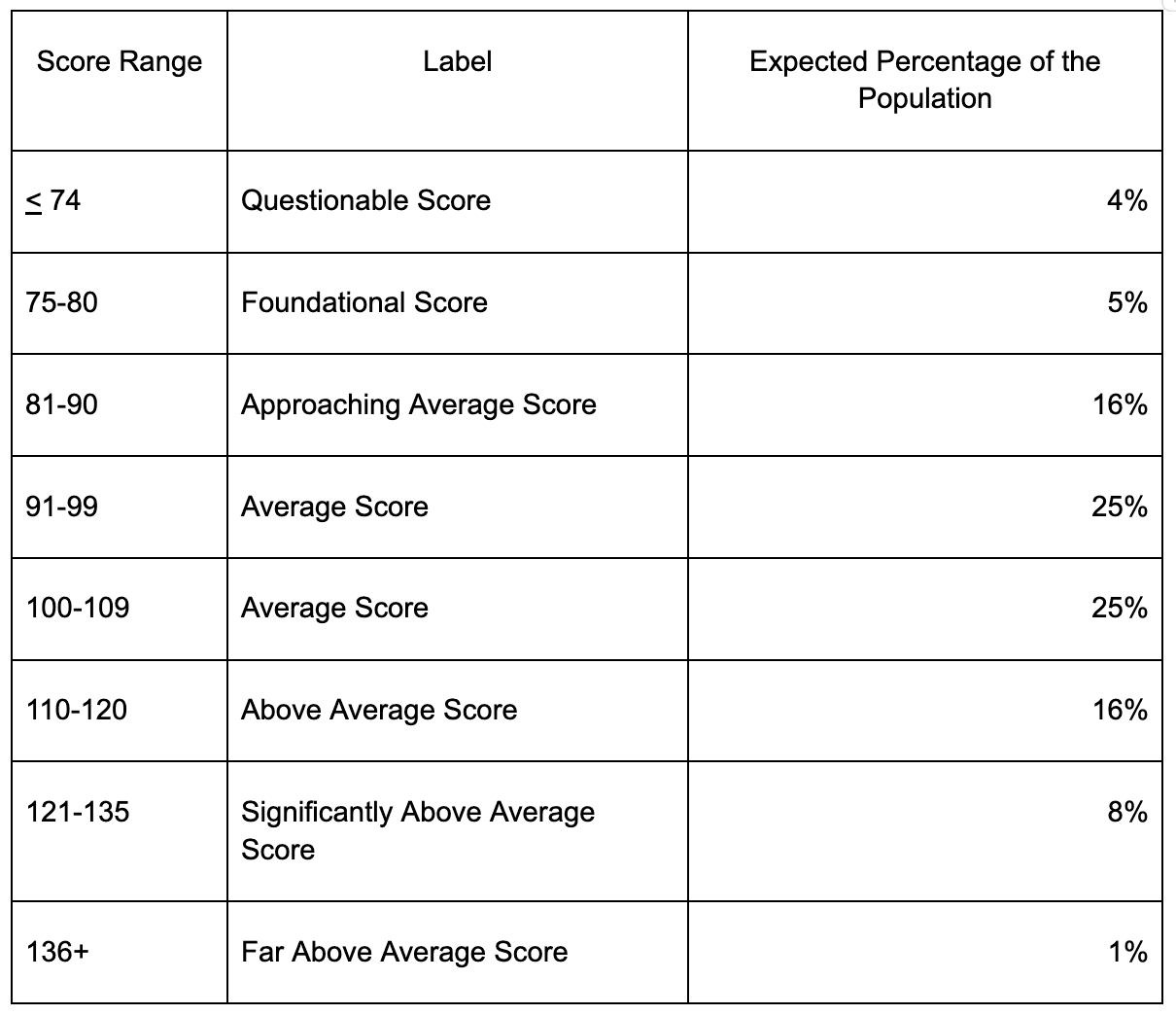
IQ test publishers use labels to describe different score ranges, though terminology has evolved over time. The table below shows how the Reasoning and Intelligence Online Test (RIOT) labels different scores: A score of 145 is well within the "Far Above Average Score" category. Some classification systems add further distinctions above 130, using terms like "gifted" or "highly gifted," but regardless of the specific label, 145 represents cognitive ability that is genuinely rare.
It is important to understand that these labels describe the score, not the person. An IQ score reflects how well someone performed on a test compared to others in their age group, which is a relative measure rather than some fixed quantity of intelligence.
Does a High IQ Predict Life Success?
Research consistently shows that higher IQ scores correlate with favorable outcomes across many domains. People with high IQ tend to performbetter academically, attain more prestigious occupations, earn higher incomes, and enjoy better physical and mental health on average. They also tend to have lower rates of divorce, criminal behavior, and premature death.
These associations are probabilistic rather than deterministic. A high IQ opens doors and makes certain achievements more attainable, but it does not guarantee success. Hard work, personality traits, opportunity, and circumstances all play significant roles. Someone with an IQ of 145 has substantial cognitive advantages, but translating those advantages into accomplishments still requires effort and favorable conditions.
Is an IQ of 145 Considered Gifted?
Historically, psychologists equated giftedness with high IQ. Lewis Terman's famous longitudinal study of gifted children, which began in the 1920s and continued for over 70 years, used an IQ cutoff of approximately 140. By that standard, 145 qualifies as gifted.
Modern definitions of giftedness vary considerably. Legal definitions in educational contextsdiffer by state and locality, creating inconsistency in who qualifies for gifted services. Some emphasize IQ exclusively, while others incorporate creativity or domain-specific talents. Despite this definitional complexity, most people with an IQ of 145 would meet virtually the definition of “gifted” in most locations.
Contrary to popular stereotypes of the troubled genius, research indicates that people with high IQ scores are generally well-adjusted. Terman's subjects grew up to have lower rates of mental illness, divorce, and criminality than the general population, along with higher rates of professional and personal success. Later research has replicated these findings. The idea that exceptional intelligence comes with inherent psychological costs is largely unsupported by evidence.
Can All IQ Tests Accurately Measure a Score of 145?
Obtaining an accurate IQ score at this level requires a well-constructed test with appropriate measurement range. Not all tests can reliably distinguish among individuals at the high end of the distribution. Tests designed for the general population may have "ceiling effects" that prevent them from accurately measuring very high ability.
Professionally developed IQ tests address this by including items difficult enough to differentiate among high-scoring examinees. The quality of the norm sample also matters—comparing performance to a representative sample of the intended population is essential for accurate interpretation. Tests with self-selected or non-representative norm samples can produce distorted results, particularly at the extremes.
Test-retest reliability is another consideration. While IQ is generally stable across the lifespan, individual scores can fluctuate somewhat between testing sessions due to factors like fatigue, anxiety, or measurement error. A score of 145 on one occasion might be 140 or 150 on another. This normal variation does not change the fundamental interpretation: all of these scores indicate exceptionally high cognitive ability.
What Are the Upper Limits of IQ Measurement?
Most professionally developed IQ tests have an effective measurement ceiling somewhere between 145 and 160. Beyond this range, there simply are not enough people in norm samples to establish reliable score distinctions. Claims of IQ scores substantially above 160 should be viewed skeptically, as they typically come from tests without adequate psychometric properties at those levels or from outdated ratio IQ calculations.
TheReasoning and Intelligence Online Test (RIOT) reports IQ scores ranging from 75 to 145, covering the vast majority of the population while maintaining measurement precision. Developed by Dr. Russell T. Warne, who has over 15 years of experience in intelligence research, the RIOT meets professional standards for psychological assessment established by the American Educational Research Association, American Psychological Association, and the National Council on Measurement in Education, making it the first online IQ test to do so. For individuals who score at the ceiling of a professionally developed test like the RIOT, the most accurate interpretation is that cognitive ability is at least at that level, which is certainly exceptional by any reasonable standard.
The Bottom Line
An IQ of 145 is definitely high. It is a score achieved by fewer than 1 in 700 people. It indicates exceptional reasoning ability and correlates with favorable outcomes across education, career, health, and other life domains. While IQ is not destiny, a score at this level represents a genuine cognitive advantage that, when combined with effort and opportunity, can facilitate remarkable achievements.
Watch “Human Intelligence vs. AI: What Really Defines ‘Smart’?” with Gilles Gignac on the Riot IQ YouTube channel to see how very high IQ scores fit into broader definitions of intelligence.
Take our professional IQ test
Want to know your IQ? Try the first ever professional online IQ test.