Does your IQ change with age? Your IQ score stays mostly stable for life because it always compares you to people your own age. Fluid skills peak in your 20s and slowly decline, but crystallized knowledge often grows—keeping your IQ steady.
Dr. Russell T. WarneChief Scientist
Share
One of the most common questions people have about intelligence is whether IQ changes as we get older. The answer is more nuanced than a simple yes or no. Understanding how IQ relates to age requires distinguishing between two different concepts: relative intelligence (how you compare to others your age) and absolute cognitive ability (your actual mental capacity).
IQ Scores Are Designed to Stay Stable
Modern IQ tests use what's called a "deviation IQ," which compares an examinee’s performance to other people in their age group. When a person takes an IQ test, their score reflects how well they performed compared to the average person your age, not compared to people of all ages. A 10-year-old with an IQ of 120 and a 40-year-old with an IQ of 120 have both performed better than about 90% of people their own age.
Research confirms this stability. Studies show that IQ scores arequite consistent across the lifespan, especially from adolescence onward. The correlation between IQ scores taken years apart is typically around .70 to .85, which is quite high for psychological measures. Significant changes are uncommon for most people.
Taking An IQ Test During Childhood & Adulthood
Young children's brains are still developing, and their cognitive abilities can change more dramatically than those of adults. A child who scores average at age 5 might score above average by age 10, or vice versa. This is why psychologists are cautious about making long-term predictions based on IQ tests given to very young children.
Alfred Binet, who created the first successful intelligence test in 1905, recognized that children's minds develop as they age. His insight was that smarter children would perform cognitively like older children, while less intelligent children would perform more like younger children. This observation led to the concept of "mental age." (Read more about the History of IQ tests here.) Today's tests no longer use mental age for scoring, but Binet's fundamental insight remains true: cognitive development happens rapidly and somewhat unpredictably during childhood.
In adulthood, different mental abilities follow different trajectories. Research on cognitive aging shows that "crystallized intelligence," accumulated knowledge, and verbal abilities remain stable or even increase slightly through middle age and don't decline until very late in life (typically the mid-to-late 80s). This is why older adults often excel at vocabulary tests and tasks that draw on learned information gained through experience.
"Fluid intelligence", the ability to solve novel problems and reason abstractly, peaks in early adulthood and declines gradually thereafter. Processing speed and working memory also show noticeable declines with age, even when dementia is not present. Older adults may take longer to solve problems or need more time to learn new information.
Because IQ tests compare examinees to others in their age group, these age-related changes are built into the scoring system. A 70-year-old is compared to other 70-year-olds who are experiencing similar cognitive changes. This is why a healthy older adult can maintain a stable IQ score despite some cognitive slowing.
What Causes IQ Scores to Change?
Several factors can cause genuine changes in IQ scores:
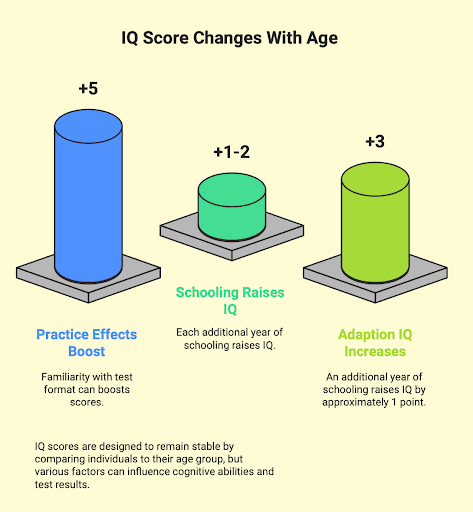
Practice effects occur when people retake the same test or a similar test. Familiarity with the test format can boost scores by about 5 points on a second test and about 3 points on a third test. This reflects test-taking savvy rather than a real increase in intelligence.
Educational experiences can raise IQ. Research suggests that an additional year of schooling raises IQ by about 1-2 points. This seems to be one of the most reliable ways to see genuine increases in cognitive ability.
Brain injury, illness, or exposure to toxins can lower IQ. Head trauma, lead poisoning, and prenatal exposure to drugs or alcohol can all decrease cognitive functioning. Avoiding these harmful exposures can prevent such declines.
Environmental enrichment can produce modest gains. Adoption studies in wealthy countries show that children adopted into more enriching environments experience IQ increases of about 3 points compared to expectations if they had remained with their birth families. However, researchers don't know exactly which specific factors drive this increase.
What This Means for You
The stability of IQ across adulthood means your cognitive abilities are a relatively enduring part of who you are. However, this does not mean your potential is fixed. While your standing compared to peers tends to remain consistent, you can still learn new skills, acquire knowledge, and become more effective at problem-solving in your specific domains of work or interest.
If you're curious about how your cognitive abilities compare to others your age, taking a professionally developed IQ test can provide valuable insights. Tests likethe Reasoning and Intelligence Online Test (RIOT) are specifically designed with age-appropriate norms, ensuring accurate comparison to your peer group. To learn more on why do people use IQ tests, watch this video:
Take our professional IQ test
Want to know your IQ? Try the first ever professional online IQ test.