Is your IQ score good? It depends on the context. We explain why there is no sharp cutoff for intelligence and how different jobs require different scores.
Dr. Russell T. WarneChief Scientist
Share
IQ scores are important for understanding a person’s intelligence, but they can be difficult to interpret. Physical measurements like height and weight are easy to understand. But when someone gets an IQ score, it can be hard to know whether it’s a good score or not.
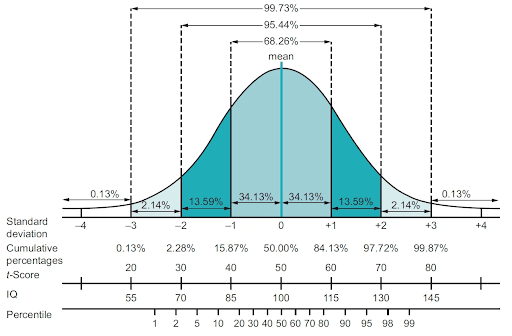
The average IQ score is 100, and when graphed, the scores form a bell-shaped curve called a “normal distribution,” which is pictured below. The standard deviation (a measure of how spread out scores are) of IQ scores is 15. Based on that information and what we see in the graph, we can conclude:
• The further from the average of 100 a score is, the fewer people who obtain that score. In other words, there are a lot of people whose IQs are near the average, but a lot fewer obtain IQs that are much higher or much lower than average.
• Over two-thirds (68.26%) have an IQ within 15 points (i.e., 1 standard deviation) of the average. These are people that most psychologists would consider in the “normal range” of intelligence.
• Half of people have a score above average (that is, 100 or higher)
When you look at the graph, you should notice how there is a smooth transition from average IQ to the extremely high or extremely low scores. There is no sharp division between “good” and “not good” IQs, or between “low,” “average,” or “high” IQ scores. This means that there is no inherent cutoff where the “good” IQ scores begin.
Whether an IQ score is “good” or not depends on the context and use of the score. If an employer is using an IQ test to identify applicants for a job, then 85 is a good score if the worker is monitoring machinery in a factory, but 85 is not a good score when selecting a physician. This makes interpretation harder than if there were firm cutoff rules. But it also makes any interpretations more adaptive to the context of the examinee and the test.
Watch “How Much Can Embryo Selection Increase IQ?” with Dr. Jonathan Anomaly on the Riot IQ YouTube channel to see how researchers think about IQ levels and what they actually mean.
Take our professional IQ test
Want to know your IQ? Try the first ever professional online IQ test.