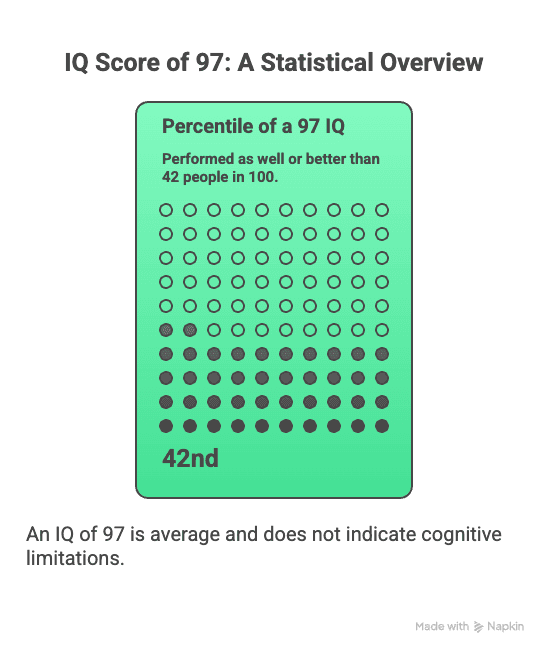
An IQ of 97 is not dumb—it is almost exactly average. Discover what a 97 IQ score actually means, where it falls in percentiles, and how it impacts your career.
Dr. Russell T. WarneChief Scientist
Share
No. An IQ of 97 is not dumb by any meaningful definition. It is, by design, almost exactly average. Sitting just three points shy of the population mean of 100 on the standard scale used by professional intelligence tests, a score at this level places a person squarely within the cognitive baseline of the vast majority of the population. It carries absolutely none of the cognitive limitations that the word "dumb" implies.
What does a score of 97 actually mean in practice?
IQ scores are relative measures, not absolute tallies of brainpower. Most professional tests use a scale where the average is 100 and the standard deviation is 15 points. This means that roughly two-thirds of the human population naturally scores somewhere between 85 and 115. A score of 97 falls just below the exact midpoint of that central band. Given the natural margin of measurement error inherent in any psychological test, the difference between a 97 and a 100 is statistically trivial.
If you look at it on a percentile basis, a score of 97 places a person at approximately the 42nd percentile. In a room of one hundred people, they performed as well as or better than forty-two of them. This is a completely ordinary, expected result—which is a statement of statistical fact, not a criticism.
Where did the idea that an average IQ is inadequate come from?
The cultural association between average intelligence and inadequacy is a societal misunderstanding rather than a scientific reality. IQ was never designed to divide people into "smart" and "dumb" categories. When Alfred Binet and Theodore Simon developed the first intelligence tests in 1905, their goal was simply to identify children who needed additional educational support, not to rank or stigmatize the general public.
The modern conflation of average performance with deficiency reflects an unrealistic cultural expectation that everyone should have intelligence in extreme abundance. By statistical definition, half of the population will always score below 100. That is not a societal problem that needs to be solved; it is simply how a normally distributed human trait works.
What cognitive abilities does this score reflect?
A person scoring a 97 demonstrates the reasoning, problem-solving, and learning capacities typical of the general public. They are fully capable of acquiring new skills, understanding moderately complex information, completing higher education, and succeeding in a wide range of occupational and social environments.
Research consistently shows that the lower boundary for stable, independent functioning—such as holding steady employment, managing personal finances, and navigating social institutions—is considerably below the average marker. A score of 97 presents no meaningful cognitive barrier to success in the vast majority of everyday contexts.
Does a 97 IQ limit your educational or professional prospects?
Success depends on a myriad of factors far beyond raw intelligence, including motivation, conscientiousness, domain-specific knowledge, and access to opportunity. IQ is a broad predictor of outcomes at the population level, not a deterministic ceiling for any individual person.
However, research is clear that cognitive demands do vary across different fields. Roles requiring rapid acquisition of highly complex technical knowledge or sustained abstract reasoning in novel domains tend to draw from the higher ranges of the IQ distribution. While a 97 will certainly not hold you back in most professional careers, it might present a steeper learning curve in highly rigorous, abstract fields. This is not a judgment on a person's worth, but rather a reflection of how cognitive ability aligns with specific task demands.
How stable and reliable is an IQ score of 97?
Intelligence scores remain relatively stable throughout adulthood, though they are not perfectly rigid. Factors like fatigue, testing conditions, practice effects, and natural measurement error can cause slight fluctuations across different testing days. Because of this, any reported score should be understood as a highly accurate estimate rather than an immutable brand.
A score of 97 obtained on a scientifically validated, professionally normed test is a reliable indicator of average cognitive performance. However, securing that same number from a free internet quiz means very little. Most casual online assessments lack the reliability data, representative norm samples, and professional development standards required to produce trustworthy results.
What is the right way to interpret your cognitive profile?
IQ measures a specific and highly important dimension of human ability: your general reasoning capacity and how quickly you learn. It does not measure your character, your creativity, or your drive. A score of 97 captures one meaningful piece of information about how your brain works, but it does not summarize who you are as a person.
The most useful way to view your score is to analyze how your specific mental strengths align with the demands of your academic or professional environments. For those who want to move beyond informal estimates and discover their true cognitive baseline, the Reasoning and Intelligence Online Test (RIOT) offers a clinical-grade solution. Created by Dr. Russell Warne and normed on a representative United States sample, it is the first digital assessment to meet the strict standards of the American Educational Research Association, the American Psychological Association, and the National Council on Measurement in Education. The RIOT delivers a deeply accurate, professionally grounded measurement you can actually trust to guide your life choices.
Watch “Are IQ Tests Accurate?” with Dr. Russell T. Warne on the Riot IQ YouTube channel to understand how scores like 97 are interpreted within the normal IQ range.
Take our professional IQ test
Want to know your IQ? Try the first ever professional online IQ test.