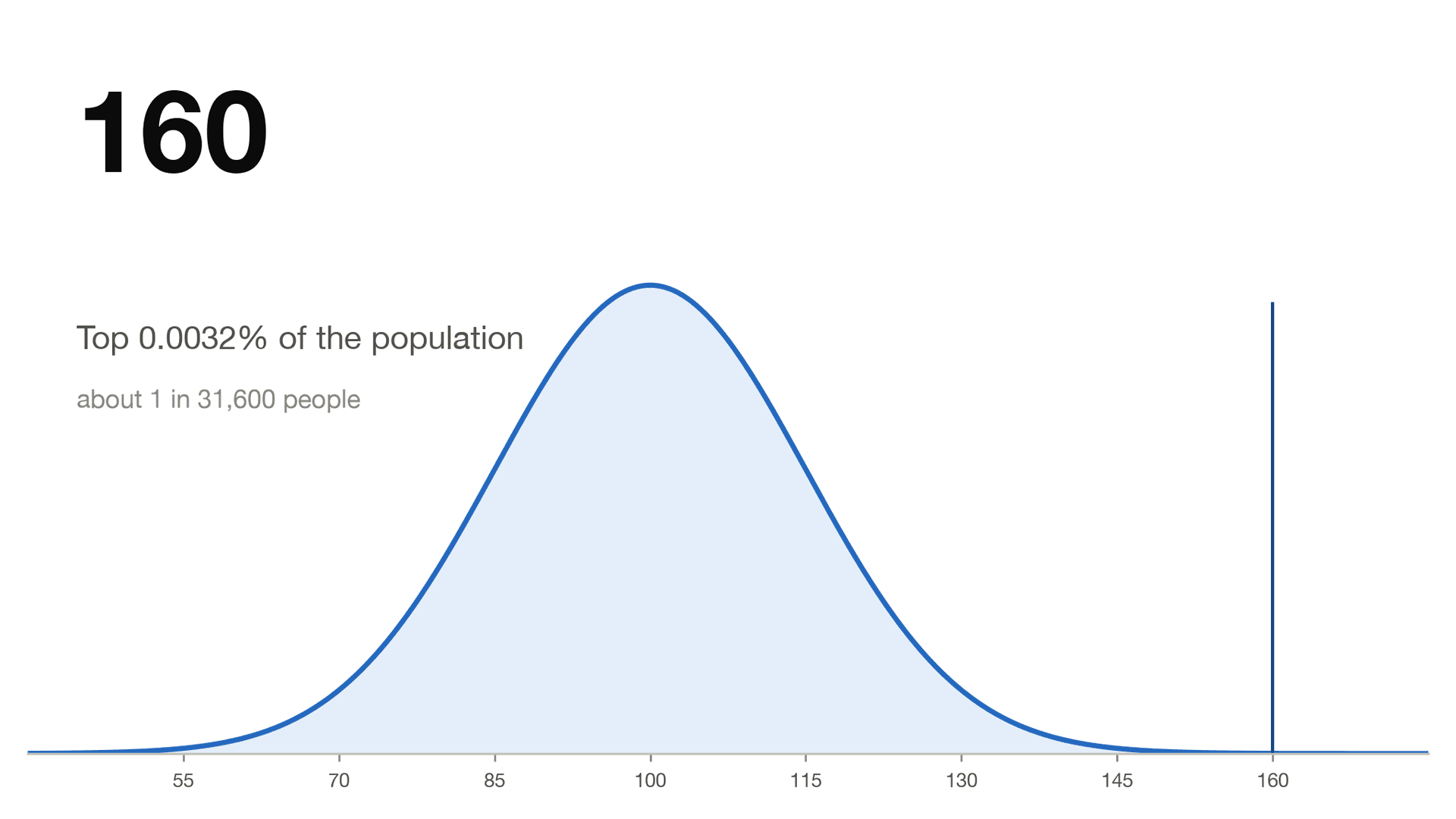
A 160 IQ is 4 standard deviations above average, about 1 in 31,574 people. See what a 160 IQ really means and why scores this high are so hard to measure.
Dr. Russell T. WarneChief Scientist
Share
An IQ of 160 is four "standard deviations" above the mean of 100, which places it at the 99.997th percentile. On a perfectly normal bell curve, about 1 in 31,574 people would score at or above this level. A 160 also sits at the exact ceiling of the most widely used adult IQ test, so it marks the point where measurement itself starts to run out. This article covers the rarity math, why scores near 160 are the least precise numbers on the whole scale, and what long-term research shows about people who reach this level.
How rare is an IQ of 160?
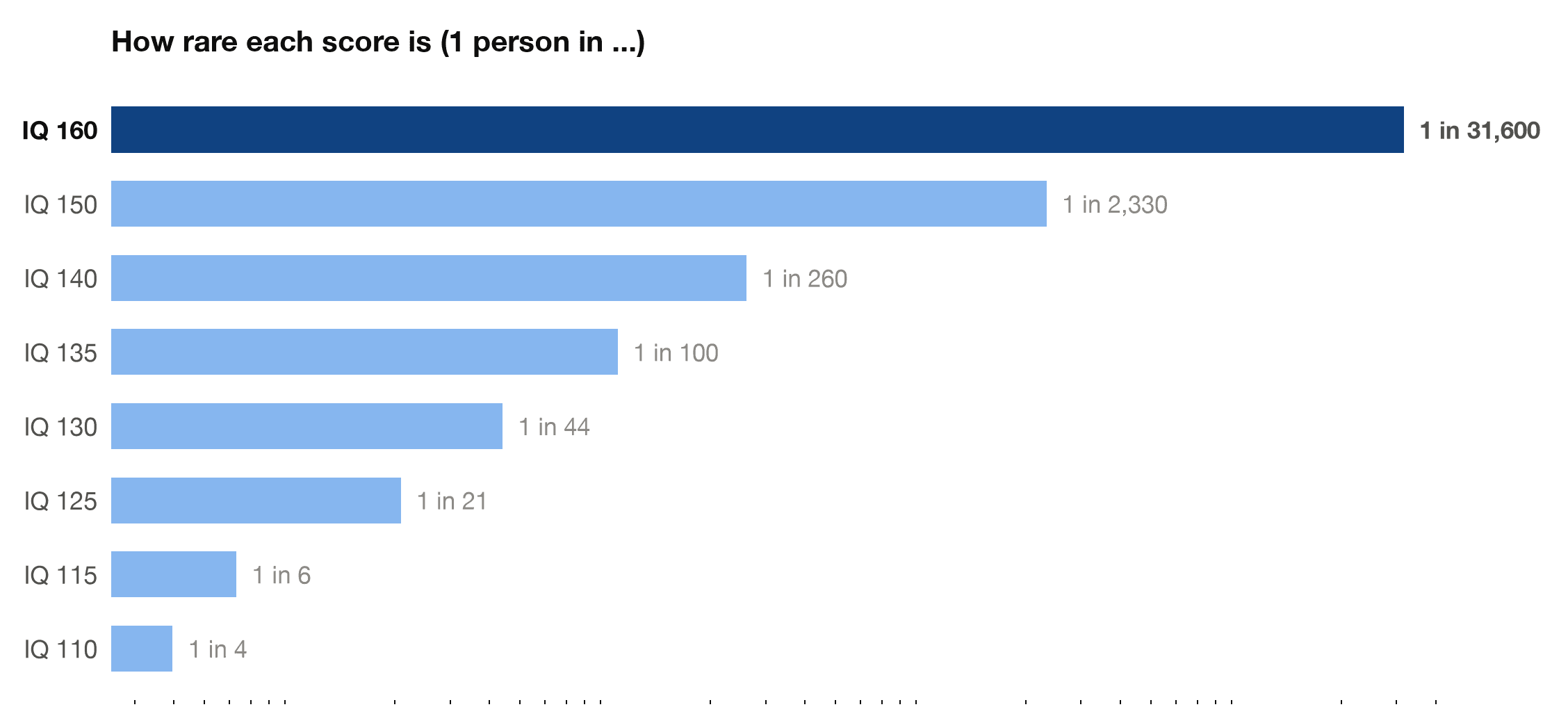
The arithmetic is straightforward. Modern tests report "deviation IQs," scores placed on a bell curve with a mean of 100 and a standard deviation of 15. A 160 is (160 minus 100) divided by 15, exactly 4.0 standard deviations above average. The proportion of a normal distribution beyond that point is about 0.003 percent, which works out to roughly 1 person in 31,574. Our guide to the IQ bell curve walks through the distribution mechanics in detail.
It helps to state the model assumption out loud. If IQ were perfectly normally distributed, a country the size of the United States, about 342 million people, would hold roughly 10,800 people at 160 or above, and the world about 260,000. Real score distributions have slightly heavier tails than the pure normal curve, so observed counts run somewhat higher. Treat these figures as illustrations of the model, and not as census results.
The heavier tails explain why two different rarity figures circulate for the same score. Talent-search researchers often describe this level as roughly the top 1 in 10,000, while the strict normal-curve value is 1 in about 31,574. The gap comes from how such people are found, typically through "out-of-level" testing such as taking the SAT at age 12, and from the fact that empirical distributions hold more extreme scorers than the idealized curve predicts. Both numbers are honest answers to slightly different questions.
Why scores near 160 are the least precise on the scale
The Wechsler Adult Intelligence Scale, Fourth Edition (WAIS-IV), is the most widely used adult IQ test, and its Full Scale IQ ranges from 40 to 160, or plus and minus four standard deviations. A 160 is literally the highest number the test can print. The instrument cannot distinguish a person who scored 160 from anyone more capable; everyone at or above the ceiling receives the same number.
The "norm sample" problem runs deeper. The WAIS-IV was standardized on 2,200 people. Multiply 2,200 by a rarity of 1 in 31,574 and the expected number of true 160-level scorers in the entire standardization sample is about 0.07 people. In practical terms, nobody at that level was in the room when the test was normed, so scores near the ceiling are statistical extrapolations rather than direct comparisons with peers.
Ordinary measurement error adds its own blur. WAIS-IV Full Scale reliability is excellent, between .97 and .98 across age groups, yet even that translates to a "standard error of measurement" of about 2.1 to 2.6 points, and a 95 percent confidence interval of roughly plus or minus 4 to 5 points in the middle of the scale. The test review reporting those figures calls them best-case estimates, and precision degrades further at the extremes, where items run out and norm cases thin. A reported 160 versus a reported 155 is not a defensible distinction.
What life looks like at this level
The best modern evidence comes from Makel, Kell, Lubinski, Putallaz, and Benbow (2016), who followed profoundly gifted young people identified at the 160-plus level through the Study of Mathematically Precocious Youth and the Duke Talent Identification Program. By age 40, 37 percent had earned doctorates, 7.5 percent held academic tenure (4.3 percent at research-intensive universities), and 9 percent held patents. As a group, they did extraordinarily well.
Those are group outcomes, though, and the variation within the group was wide. A score this high is a strong statistical advantage. It is not a guarantee of eminence, and it sets no particular life course for any individual.
"Exceptionally gifted" is a label; "genius" is not
Gifted-education taxonomies do have a name for this range. The Davidson Institute's guide places 130 to 144 as gifted, 145 to 159 as highly gifted, 160 to 174 as exceptionally gifted, and 175 and above as profoundly gifted, while cautioning that these ranges "are not universally agreed upon." No modern standardized test uses a genius classification at any score; we cover why in our article on whether an IQ of 170 is considered genius.
Celebrity numbers deserve extra suspicion here. The claim that Einstein or Hawking "had an IQ of 160" appears in no documented test record; neither is known to have taken a modern IQ test, and Hawking deflected the question when asked. Any specific number attached to them is a retrospective guess.
Old scores above 160 are a different currency
Historical accounts of children with IQs of 180 or higher come from early twentieth-century "ratio IQ" scoring, which divided mental age by chronological age. Those numbers are not comparable to modern deviation scores. Even Lewis Terman, who built the field's most famous high-IQ study, could not screen cleanly at extreme cutoffs: his selection process famously passed over two future Nobel laureates in physics. Warne, Larsen, and Clark (2020) showed the misses were statistically expected, concluding that although the accomplishments of the 1,528 Genetic Studies of Genius subjects are impressive, "they do not represent the pinnacle of human achievement." One-shot childhood testing at extreme thresholds misclassifies people in both directions. For the record-claims side of this topic, see the highest IQ ever recorded.
The bottom line
A 160 on a legitimate, properly normed test is evidence of ability at the outer edge of what psychometrics can measure. Read it as "at or above the instrument's ceiling" rather than as a precise rank. If you want to know where you stand on the scale where tests are actually precise, the Reasoning and Intelligence Online Test from RIOT IQ reports modern deviation scores with stated measurement error, which is what a trustworthy IQ number looks like.
Frequently asked questions
How rare is an IQ of 160?
On the standard bell curve (mean 100, SD 15), 160 is four standard deviations above average, about 1 in 31,574 people, or the 99.997th percentile. Real-world counts run somewhat higher because actual score distributions have slightly fatter tails than the perfect normal curve.
Is an IQ of 160 genius level?
"Genius" is not a scientific category on any modern IQ test. Gifted-education taxonomies typically call 160 to 174 "exceptionally gifted." Researchers avoid the word genius because it implies achievement, which an IQ score alone cannot guarantee.
Can an IQ test actually measure 160?
Barely. The WAIS-IV Full Scale IQ stops at exactly 160, and its 2,200-person norm sample would be expected to contain essentially zero people at that level, so scores up there are extrapolations with wide error bands. Treat 160 as at or above the test's ceiling rather than a precise point.
Did Einstein have an IQ of 160?
There is no record that Einstein ever took an IQ test; the 160 figure is a retrospective guess repeated online. Any specific number attached to Einstein or Hawking is unverified.
What jobs can someone with a 160 IQ do?
Anything; a score sets no occupational limit in either direction. In the Makel et al. (2016) study of people identified at this level in adolescence, 37 percent earned doctorates and many became professors, executives, and patent holders, but outcomes still varied widely within the group.
References
1. Canivez, G. L. (2010). Review of the Wechsler Adult Intelligence Scale-Fourth Edition. In R. A. Spies, J. F. Carlson, & K. F. Geisinger (Eds.), The eighteenth mental measurements yearbook (pp. 684-688). Buros Institute. ux1.eiu.edu
2. Makel, M. C., Kell, H. J., Lubinski, D., Putallaz, M., & Benbow, C. P. (2016). When lightning strikes twice: Profoundly gifted, profoundly accomplished. Psychological Science, 27(7), 1004-1018. pubmed.ncbi.nlm.nih.gov
3. Warne, R. T., Larsen, R. A. A., & Clark, J. (2020). Low base rates and a high IQ selection threshold prevented Terman from identifying future Nobelists. Intelligence, 82, 101488. doi.org
4. Davidson Institute. (2021). Guide to understanding giftedness.davidsongifted.org
Take our professional IQ test
Want to know your IQ? Try the first ever professional online IQ test.