Aug 3, 2026·IQ Scores & InterpretationACT to IQ Conversion Chart Explained
From ACT 36 to ACT 13: view the complete conversion chart and discover why admissions tests are imperfect IQ proxies. Measure your profile with RIOT!
Dr. Russell T. WarneChief Scientist

Every year, millions of American students receive an ACT score and immediately wonder what it says about their intelligence. Taking an IQ test would answer that question directly — but most students have never taken a proper cognitive battery, and their ACT score is the closest proxy they have. The question of how to convert ACT scores to IQ equivalents is legitimate, the correlation between them is real and well-documented, and the methodology for producing conversion estimates is transparent. So is the list of reasons those conversions should be treated as rough approximations rather than precise measurements. This article walks through all of it: the research basis for the correlation, the conversion methodology, a usable reference chart, and the specific caveats that matter for interpreting any converted figure.
The Empirical Basis: How Strongly Are ACT and IQ Correlated?
The correlation between ACT scores and general cognitive ability is not an assumption — it is a documented research finding with a specific source. Koenig, Frey, and Detterman's landmark 2008 study in the journal Intelligence, using a sample of participants with both ACT and ASVAB scores, found a correlation of r = .77 between ACT composite scores and the Armed Services Vocational Aptitude Battery — a well-validated measure of general cognitive ability that strongly correlates with IQ. A separate analysis within the same study, using Raven's Advanced Progressive Matrices as the IQ measure with a sample of 149 participants, found a correlation of r = .61 between ACT composite scores and Raven's-derived IQ scores. The authors concluded that ACT scores can be used to accurately predict IQ in the general population and that use of a composite ACT score as a rough estimate of IQ can prove useful when other testing methods are unavailable or impractical — including as a clinically useful estimate of premorbid intelligence in individuals with ACT scores on file. That is a meaningful endorsement from peer-reviewed research — not a claim that ACT and IQ are interchangeable, but a specific acknowledgment that the correlation is strong enough for the ACT to serve as a useful proxy.
For comparison, the ACT also correlates at r = .87 with the SAT — meaning the two college admissions tests are more similar to each other than either is to a pure IQ measure. Both primarily measure academic achievement alongside reasoning ability, which is why their IQ correlations are strong but not perfect.
Why the Conversion Is an Approximation — Not an Equivalence
Before presenting the conversion chart, I want to be precise about its limitations — because understanding what the conversion can and can't tell you is as important as knowing the numbers themselves.
The ACT measures academic skills and knowledge specific to high school education — grammar and rhetoric, algebra and trigonometry, reading comprehension, and scientific data interpretation. IQ tests measure broader cognitive abilities — fluid reasoning, working memory, processing speed, verbal intelligence — with less sensitivity to what has been specifically taught. This distinction is not a minor technical point. A student who has received excellent instruction in trigonometry, practiced ACT math formats extensively, and has strong test-taking strategies can score significantly higher on the ACT than their general cognitive ability would predict. The reverse is also true: a student from an underserved school who has had limited exposure to ACT content may score lower than their genuine reasoning ability warrants.
Several external factors influence ACT performance that don't reflect IQ: test-taking strategies and format familiarity, the quality of high school instruction received, study habits and preparation time, socioeconomic factors affecting access to preparation resources, and test anxiety on the day. None of these factors affect IQ scores in the same way, which is why the correlation is .61–.77 rather than 1.0.
The conversion methodology is also imperfect in a second specific way: ACT test-takers are a post-secondary population of college-bound high school students, not a general population sample. This means ACT score distributions are not calibrated against the full population IQ distribution — they are calibrated against a cognitively selected subset of it. The correction for this is to adjust IQ estimates upward from what a raw percentile mapping would suggest, because the ACT testing population sits above the general population average. The IQ estimates are adjusted to a mean of approximately 105 for ACT test-takers based on WAIS-IV normative data stratified by education level — reflecting the fact that college-bound students represent a cognitively above-average sample of the age cohort. With those caveats named, here is the reference chart.
ACT to IQ Conversion Chart
The estimates below are derived from percentile-based mapping between ACT composite scores and the IQ scale, adjusted for the college-bound population distribution. They represent approximate IQ equivalents, not exact measurements.
ACT Score | Percentile (Approx.) | Estimated IQ Equivalent |
36 | 99+ | 141–145 |
35 | 99 | 137–140 |
34 | 99 | 133–136 |
33 | 98 | 130–132 |
32 | 97 | 127–129 |
31 | 96 | 124–126 |
30 | 94 | 121–123 |
29 | 92 | 118–120 |
28 | 89 | 115–117 |
27 | 86 | 113–115 |
26 | 82 | 111–112 |
25 | 78 | 109–110 |
24 | 74 | 107–108 |
23 | 68 | 105–106 |
22 | 62 | 103–104 |
21 | 55 | 101–102 |
20 | 48 | 99–100 |
19 | 42 | 97–98 |
18 | 36 | 95–96 |
17 | 29 | 92–94 |
16 | 22 | 89–91 |
15 | 15 | 86–88 |
14 | 10 | 82–85 |
13 | 6 | 78–81 |
How to Read the Chart
A few specific guidance points for interpreting these figures correctly.
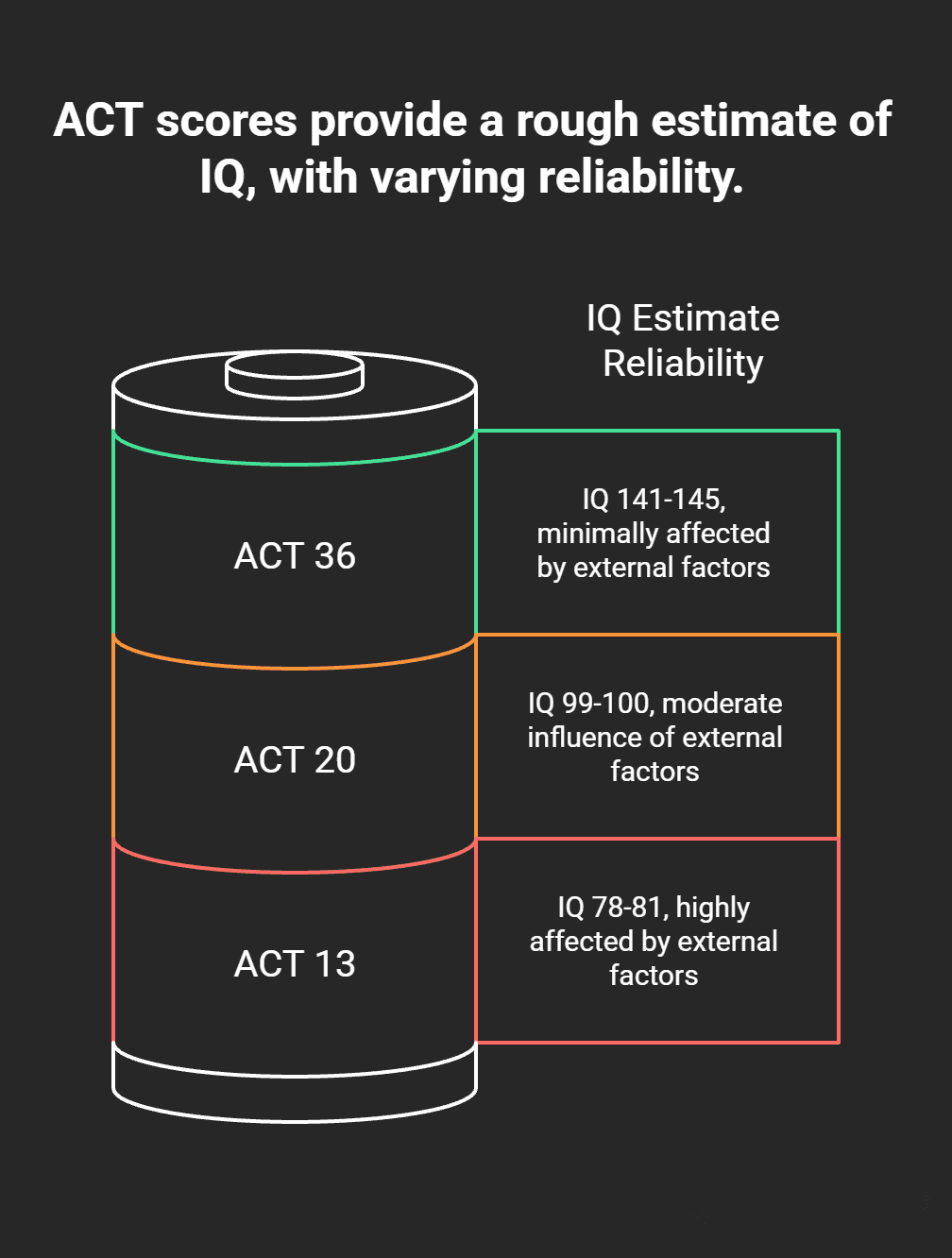
The estimates carry a margin of error of approximately ±8–12 IQ points. The correlation of .61–.77 between ACT and IQ means that a given ACT score corresponds to a range of likely IQ values, not a single point. An ACT of 30, for example, is most likely to correspond to an IQ in the 121–123 range — but the actual IQ of a student scoring 30 might reasonably be anywhere from 110 to 135. A converted score should never be treated as equivalent to an actual score on the target test. Higher ACT scores produce more reliable IQ estimates. The correlation between ACT and IQ is stronger at the extremes of the distribution. A student scoring 34 or 35 is almost certainly at the 99th percentile on a genuine IQ test as well. A student scoring 22 or 23 may have an IQ anywhere across a wider range, because the middle of the ACT distribution is more affected by the non-cognitive factors — preparation, instruction quality, test familiarity — that add noise to the conversion.
The conversion works better for the ACT composite than for individual sections. The composite score averages across English, Math, Reading, and Science, which reduces the impact of any one domain's specific knowledge demands and makes the composite a better proxy for general cognitive ability. Math ACT scores correlated with IQ at r = .56 — lower than the composite's .77 — confirming that domain-specific section scores are noisier proxies for general intelligence than the full composite.
Where the ACT Performs Particularly Well as a Proxy
The Koenig et al. study specifically noted a clinically useful application: clinicians will find ACT scores a reliable estimate of premorbid intelligence in individuals with ACT scores on file. Premorbid intelligence estimation — determining what a patient's cognitive ability was before a neurological event — is an active clinical challenge, and the ACT offers a useful data point when other premorbid markers (education level, occupation) are insufficient to narrow the estimate. This application is one of the most practically grounded justifications for the conversion — not for casual curiosity, but for genuine clinical situations where a standardized cognitive test was not administered before the event of interest, and the best available proxy is whatever academic records exist. In that context, a high school ACT score on file provides meaningful signal about premorbid cognitive level.
What a Converted Score Can and Cannot Tell You
A converted ACT-to-IQ estimate can give you a reasonable directional sense of where your general cognitive ability likely sits — particularly if your ACT score is at the upper or lower extremes of the distribution, where the conversion is most reliable. It can tell you whether you're likely in the average, above-average, or high-ability range on a genuine cognitive battery.
What it cannot tell you is your specific performance on the domains that IQ tests actually measure — fluid reasoning, working memory, processing speed, and visual-spatial ability. ACT and IQ share the general intelligence variance that underlies both, but the specific subtest profiles are different. A student with strong verbal reasoning and weaker processing speed, for example, might have an IQ that's unevenly distributed across indices in a way that a single ACT composite number cannot reflect.
It also cannot tell you anything about how study habits, test preparation, or curriculum quality affected your ACT relative to your underlying ability. Factors such as socioeconomic status and test anxiety can influence both ACT and IQ scores, highlighting the limitations of using ACT as a sole indicator of intelligence — but they influence ACT scores considerably more than they influence well-designed IQ batteries.
The Takeaway
The ACT correlates meaningfully with IQ — at r = .61 to .77 depending on the IQ measure used — which is strong enough to support useful rough estimates but not strong enough to make conversions precise. The chart above represents the best available proxy mapping, adjusted for the college-bound population and grounded in peer-reviewed research. Every figure in it carries a margin of error of roughly ±8–12 IQ points and should be read as a range rather than a point estimate.
If you want an actual cognitive profile — one that reports your fluid reasoning, verbal comprehension, working memory, and processing speed as separate domain scores rather than collapsing everything into a single composite — a properly constructed IQ assessment does something that an ACT conversion can only approximate. The RIOT gives you exactly that: a domain-level cognitive profile built on the same psychometric framework as clinical batteries, with a known margin of error and percentile comparisons against a representative adult sample.
References
Koenig, K. A., Frey, M. C., & Detterman, D. K. (2008). ACT and general cognitive ability. Intelligence, 36(2), 153–160. http://www.iapsych.com/iqmr/koening2008.pdf Cogn-IQ.org. (2026). ACT to IQ Score Conversion Table & Calculator — percentile mapping, population adjustment methodology. https://www.cogn-iq.org/convert/act-to-iq/ Check-IQ.org. (2025). ACT to IQ Conversion — average ACT scores 2024-2025, section averages, and IQ estimates. https://check-iq.org/conversion/act-to-iq-calculator Legacy Online School. (2026). ACT to IQ Conversion: Estimate and Convert IQ from ACT Score — ACT 36 ≈ IQ 145, ACT 30 ≈ IQ 130. https://legacyonlineschool.com/blog/act-to-iq-conversion-how-to-estimate-iq-from-act-score.html Turito. (2024). ACT to IQ Converter — ACT to IQ Conversion Formula — NLSY79 r = .77 and Raven's r = .61. https://www.turito.com/blog/general/act-to-iq-converter-act-to-iq-conversion-formula CollegeVine. (2024). How does my ACT score translate to an IQ? — different constructs, no direct equivalence. https://www.collegevine.com/faq/70446/how-does-my-act-score-translate-to-an-iq Calculator Academy. (2025). ACT to IQ Calculator — composite score conversion formula. https://calculator.academy/act-to-iq-calculator/ Healthcare 360 Magazine. (2025). Average IQ for Doctors — 120–130 range for comparative occupational context. https://healthcare360magazine.com/average-iq-for-doctors/
Take our professional IQ test
Want to know your IQ? Try the first ever professional online IQ test.
AuthorDr. Russell T. WarneChief Scientist