Jun 4, 2026·IQ Scores & InterpretationWhat Is a Norm Group in IQ Testing?
What is a norm group in IQ testing? Learn how comparison samples shape score meaning, why age norms matter, and what to ask before trusting a result.
Dr. Russell T. WarneChief Scientist
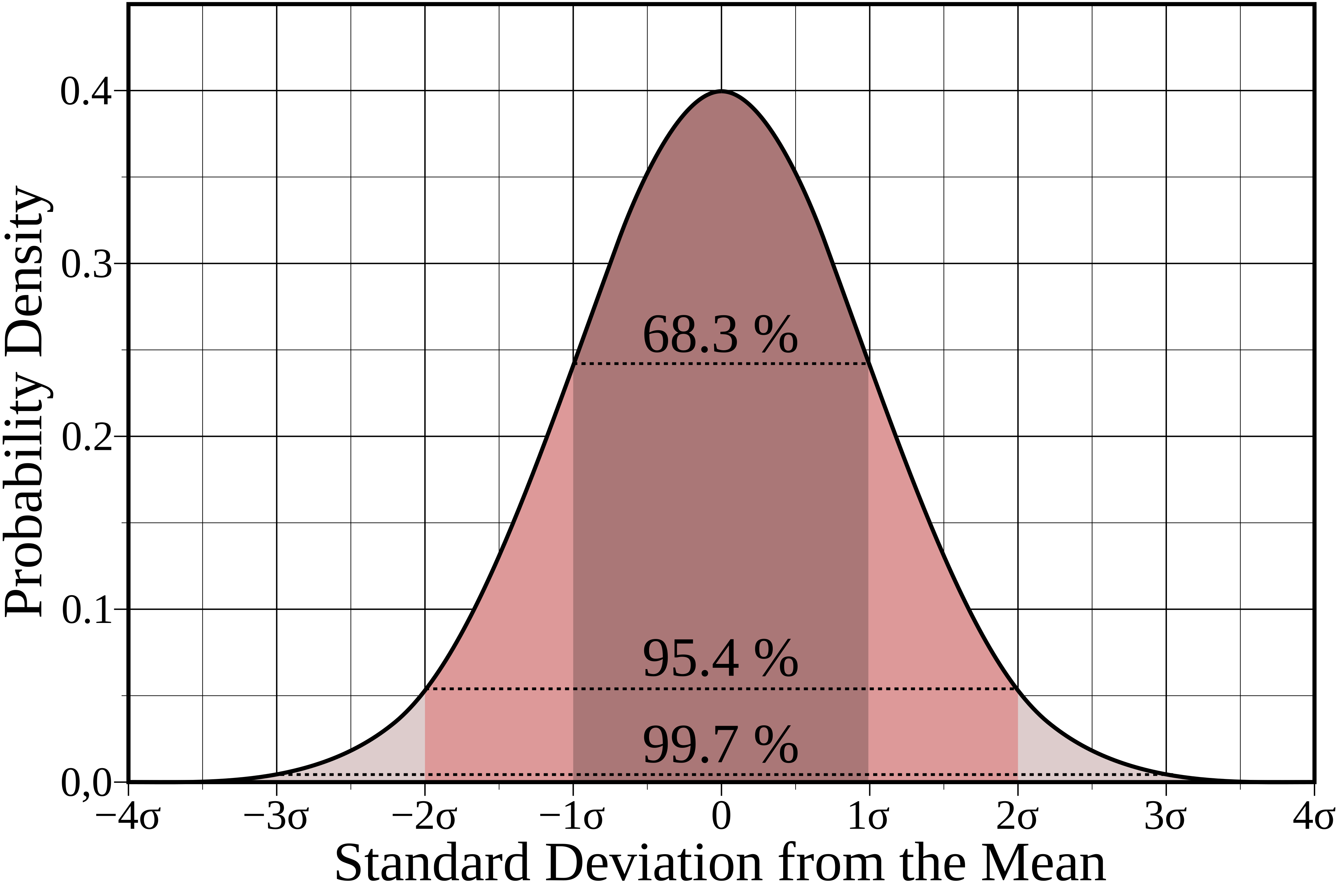
A norm group is the comparison sample behind an
IQ test score. It is the group of people whose results are used to decide what counts as average, above average, or below average on that specific test. Without a norm group, a score has very little meaning. A test can tell you how many items you answered correctly, but it cannot tell you whether that performance is typical unless it has a defensible comparison sample.
Plain Definition
A norm group turns performance into context. It lets a test say, in effect, this result is higher than typical for the comparison group, lower than typical, or close to average. That sounds simple, but it is one of the most important parts of score interpretation. A weak or poorly described norm group can make a precise-looking number much less trustworthy.
Why the Average Is 100
The familiar average IQ of 100 is not magic. It is a scoring convention built around the test's norm sample. Raw performance is converted onto a scale so that the center of the comparison group is usually set near 100. That conversion is why raw item counts are not enough. RIOT's article on
raw score vs. scaled score explains how the number correct becomes a more interpretable score, and the guide to
IQ score scales explains the 100-and-15 framework.
Age Norms vs. Population Norms
Age norms compare people with others in a similar age range. That matters because cognitive performance changes across development and adulthood. A fair score report should not casually compare a child, a young adult, and an older adult as if age made no difference. Population norms try to represent the broader group the test claims to measure. Specialized norms can also be useful in some settings, but the report should say what group was used and why. For a deeper look at age interpretation, RIOT's guide to
average IQ by age explains why age comparisons are easy to misunderstand.
How to Spot a Weak Norm Claim
Be cautious when a test gives a high-confidence-looking IQ score but never explains the comparison sample. The number may look official while the comparison behind it is thin, stale, too small, or mismatched to the test taker. Also be cautious when a test compares everyone with one vague online sample. A convenience sample is not automatically useless, but it needs much more humility than a carefully developed norm sample.
What a Good Report Should Say
A useful report should answer four questions: 1. Who was the score compared with? 2. Does that comparison group match the test taker's age or intended population? 3. Are the norms current enough for the claim being made? 4. How much uncertainty surrounds the score? A good report should pair norm information with reliability and
confidence interval language.
Bottom Line
An IQ score is not just a number. It is a number anchored to a comparison group. If the report does not tell you what group was used, the result is incomplete.
Sources
Take our professional IQ test
Want to know your IQ? Try the first ever professional online IQ test.
AuthorDr. Russell T. WarneChief Scientist
